Does Rain Clean Solar Panels? The Honest Answer
Rain helps but doesn't fully clean solar panels. Here's what rain actually removes, what it leaves behind, and when you still need a professional clean.
Ask any solar installer whether rain cleans solar panels and you’ll get a confident “yes.” Ask a solar performance engineer the same question and you’ll get a much more nuanced answer.
The truth sits somewhere in the middle. Understanding it could save you from skipping a necessary clean for years.
What Rain Actually Does to Solar Panels
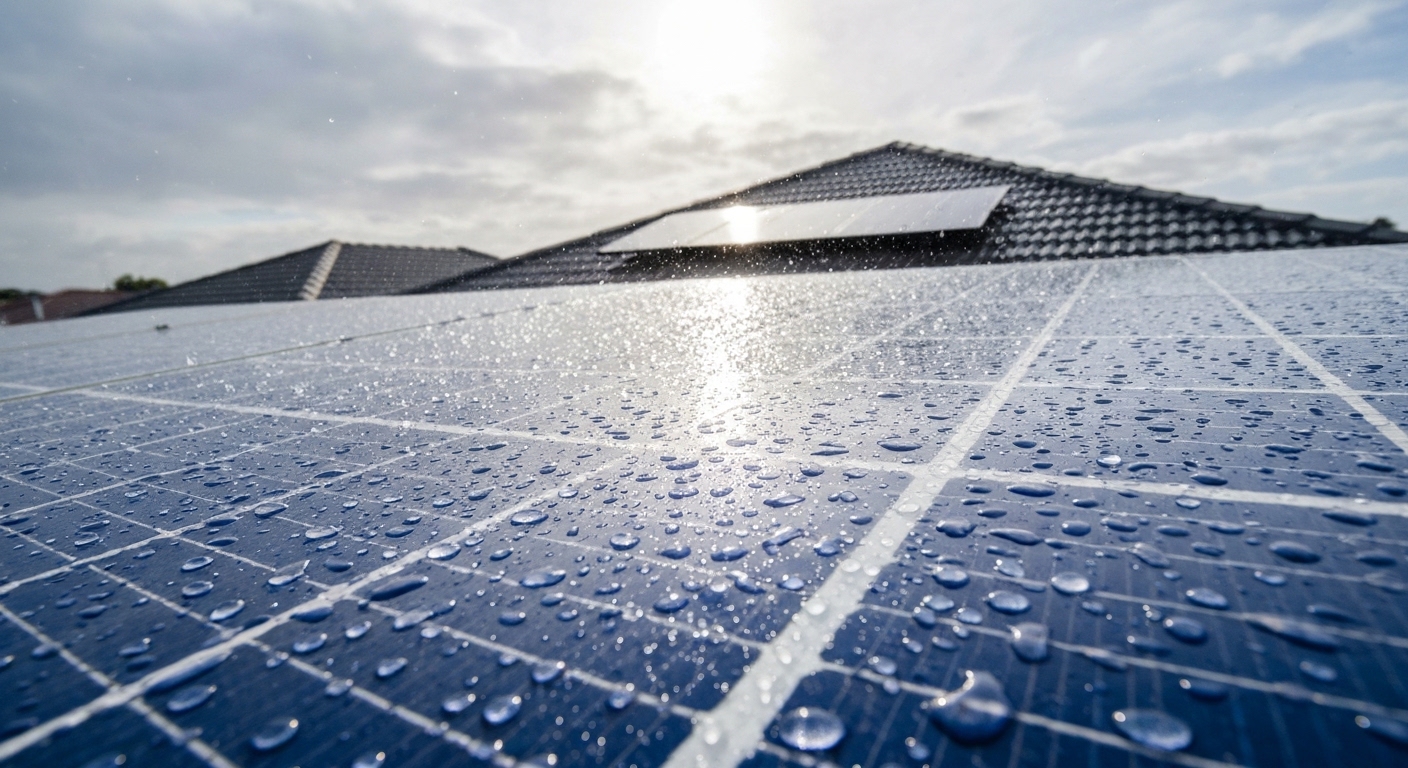
Rain is essentially a free rinse cycle. Light rainfall creates sheeting action across panel glass. It carries some loose dust, light pollen, and surface dirt into the gutter. After a heavy downpour, panels often look noticeably cleaner from the ground.
But “looking cleaner” is not the same as “performing at maximum output.”
What does rain clean on solar panels effectively:
- Loose, uncompacted dust particles
- Light pollen deposited in the last few days
- Fresh bird droppings that haven’t dried or baked onto glass
- Some airborne pollution residue
What rain does NOT remove from solar panels:
- Dried bird droppings — these bake onto the glass in Australian heat and form a bond that water alone can’t break
- Lichen and moss — once established, these are completely rain-resistant
- Pollen films — particularly the oily, sticky pollens from Australian native species (angophoras, eucalypts, callistemons)
- Bushfire smoke residue — creates an oily film that repels water
- Mineral deposits — if your area has hard water or mineral-rich bore water reaching the roof, rain adds to this rather than removing it
- Grime accumulated over many months — compacted dust forms a cement-like layer in Australian climate conditions
The Science: Does Rain Clean Solar Panels Enough to Restore Output?
A 2023 study by UNSW’s School of Photovoltaics and Renewable Energy Engineering monitored 47 rooftop solar systems across greater Sydney over 18 months. The research provides clear data on whether rain cleans solar panels effectively.
Key findings:
- After a heavy rain event (over 25mm) on lightly soiled panels (less than 60 days since last clean): average output recovery of 8–12%
- After light rain (less than 10mm): average output recovery of just 2–4%
- On panels with significant bird dropping accumulation: rain produced negligible improvement in output
- Panels near construction sites or dusty roads: no meaningful improvement from rain alone
The research confirmed that rain is useful as a maintenance tool between professional cleans. But it is not a substitute for them.
Australia’s Climate Makes Rain Less Effective
Several Australian conditions specifically reduce how well rain cleans solar panels:
1. Low pitch angles
Most Australian residential solar installations are on roofs pitched at 15–25°. International research showing effective self-cleaning typically applies to panels pitched at 35° or more. These angles are common in European installations. At lower pitches, water doesn’t sheet cleanly. It pools and dries, leaving mineral deposits.
2. Dry periods between rain
Sydney averages more than 100 dry days in summer. Melbourne has 70 or more. Perth often goes 3–4 months without significant rainfall. During dry periods, soiling accumulates and compacts. When rain finally comes, it’s often not enough to dislodge the hardened layer.
3. Hard water and mineral content
In many parts of regional Australia, bore water and tank overflow reaching the roof deposits calcium and magnesium carbonates on panel glass. Each rainfall can add to this rather than removing it. This slowly builds up a white, hazy film.
4. Bushfire smoke
Smoke from bushfires coats panels with fine carbon particles mixed with organic oils. These are hydrophobic. They actively repel water. Rain will not remove bushfire soiling. Only a proper purified-water clean with gentle agitation will.
The Self-Cleaning Panel Myth
Many modern panels are marketed with “hydrophilic” self-cleaning glass coatings. These coatings cause water to sheet evenly across the glass rather than beading up. In theory, this carries dirt away with it.
In ideal conditions, these coatings work reasonably well. In Australian real-world conditions:
- The coating degrades under UV exposure within 5–10 years
- It doesn’t help with bird droppings or pollen films
- Hard water deposits from rainfall can coat over the hydrophilic layer, reducing its effect
- Low pitch angles negate most of the benefit
Even panels with self-cleaning glass require annual professional cleaning to maintain peak performance and warranty compliance. The Clean Energy Council recommends annual inspections and cleaning for residential solar systems.
When to Stop Relying on Rain to Clean Solar Panels
Stop waiting for rain to clean your panels when you see any of these signs:
- Visible bird droppings from the ground — rain will not remove these
- Output drop of more than 8% compared to same period last year (check your inverter app)
- More than 6 months since last rainfall over 25mm in your area
- Yellow or brown tinge visible across panel surface from ground level
- Post-bushfire — book a clean immediately regardless of rainfall
Does Rain Clean Solar Panels Well Enough to Skip Professional Maintenance?
The practical approach for most Australian homeowners:
- Use rainfall as a supplementary rinse between professional cleans — it does help maintain lightly-soiled panels
- Don’t replace your annual clean with rainfall expectation — even in high-rainfall areas, the types of soiling that reduce output most (bird droppings, pollen, lichen) require mechanical removal
- Monitor your inverter output monthly — this is more reliable than looking at the panels or guessing based on recent rain
According to CSIRO research on solar panel performance, soiling can reduce output by 15–30% in Australian conditions. Rain typically recovers only 5–10% of that loss on moderately soiled panels.
Checking Output After Rain: What to Look For
Your inverter app is the most reliable way to assess whether recent rainfall has actually restored your panels to full output. Here’s how to interpret the data:
Immediate post-rain check: Compare today’s kWh generation with the same date in the previous year. Account for similar weather conditions. If output has jumped 8–15% compared to the week before the rain, the rainfall did meaningful work. If output is unchanged or still well below prior-year figures, soiling that rain couldn’t shift remains on the panels.
Monitoring apps to use: SolarEdge, Enphase Enlighten, Fronius Solar.web, and SolarAnalytics all provide historical generation comparison tools. Most allow you to overlay multiple years to identify trends.
The 10% rule: If your current monthly output is more than 10% below the same month last year, dirty panels are the most likely cause. This applies even if you’ve had recent rainfall. You can’t explain it with unusual weather alone.
Rainwater Quality: An Underappreciated Factor
Not all rain is equal when it comes to solar cleaning. Australian rainfall quality varies significantly:
- Coastal rain: Often slightly acidic and carries sea salt. Can deposit mineral residue rather than removing it.
- Post-dust-storm rain: The first rainfall after a dust event typically makes panels dirtier. The rain bonds dust particles to the glass rather than washing them away.
- High-pollution areas: Rain near industrial zones, highways, or airports carries particulates. These deposit on glass as rain dries.
- Bore water spray: In rural and agricultural areas, irrigation systems that reach rooftops deposit hard minerals. Each rainfall can re-wet these deposits, causing them to spread.
Understanding your local rainfall quality helps you set realistic expectations for what rain will and won’t accomplish between professional cleans.
How to Tell If Rain Has Actually Cleaned Your Panels
After a good rainfall, it’s worth assessing whether it actually helped your panels. Or just wet them. Here’s how to tell:
Check your inverter output the day after rain: Pull up your inverter monitoring app. If output on a sunny day after heavy rain is measurably higher than the previous sunny day before rain, the rain did useful cleaning work. A 5–15% boost on the day after significant rain confirms surface dust removal.
Visual inspection from the ground: If panels are still visibly streaked, have bird dropping shadows, or show a grey-brown haze in afternoon light, rain didn’t clean them. Rain-cleaned panels typically look noticeably brighter in direct sunlight.
TDS test on runoff water: This is advanced but instructive. Catch runoff from a panel in a cup during rain. Test with a TDS meter. High TDS in runoff (above 200 ppm) means the rain is picking up and partially re-depositing dissolved contaminants. Low TDS runoff (below 50 ppm) means the rain is genuinely clean and cleaning the panels effectively.
The Science: Rainfall Angle, Panel Tilt, and Cleaning Effectiveness
Rainfall cleaning effectiveness also depends on your panel installation angle. Panels in Australia are typically tilted 15–35 degrees from horizontal, facing north.
Steeper tilt (30–35°) plus heavy rain equals better self-cleaning. The water flows across the entire panel surface with enough velocity to carry loose particles to the lower edge and off the panel. Horizontal or low-tilt installations (less than 10°) allow water to pool rather than flow. This leaves dissolved mineral deposits behind as water evaporates.
North-facing panels during summer afternoon rain receive very little direct rainwater impact. This is because the rain falls slightly south at a steeper angle. The panel face is largely sheltered. This is why summer rain in Australia is less effective at cleaning north-facing panels than winter rain with its more southerly trajectory.
Practically, this means if your panels are on a flat roof or low-pitch installation, you’ll need to clean more frequently. Rain simply doesn’t clean them as effectively as a standard 22° pitched-roof system in the same suburb.
Conclusion
Does rain clean solar panels? Yes, but only partially and inconsistently. It removes loose dust and fresh surface contamination. A heavy downpour can recover 5–10% output on lightly-soiled panels. But it cannot remove bird droppings, pollen films, lichen, smoke residue, or months of compacted dust.
In Australia’s climate, with long dry periods, low-pitch roofs, and frequent bird activity, annual professional cleaning remains essential. This applies regardless of your rainfall patterns.
Don’t let a bit of rain convince you the panels are clean. Check your output data. It will tell you the truth.
Related: How Often Should You Clean Solar Panels? · Best Time of Day to Clean Solar Panels · Solar Panel Soiling Cost Australia
Frequently Asked Questions
Does rain clean solar panels?
Rain removes loose surface dust but cannot clean stuck-on bird droppings, pollen films, lichen, or oily residue from bushfire smoke. Heavy rain helps more than light drizzle, but it won’t restore panels to peak efficiency.
How much output do panels recover after rain?
Studies show a typical 5–10% recovery in output after a heavy rain event on lightly-soiled panels. Panels with bird droppings or caked grime see minimal improvement from rain alone.
Should I clean panels before or after rain?
After rain is often a better time — the rain softens some soiling and preliminary rinsing reduces the scrubbing effort. However, for heavily soiled panels, book a professional clean regardless of recent rainfall.
How long after rain can I clean solar panels?
Wait until the panels and roof are fully dry — typically 2–4 hours after rain stops. Cleaning wet panels risks spreading dissolved minerals across the glass surface when the water dries, leaving spots.
Sources
-
UNSW School of Photovoltaics and Renewable Energy Engineering (2023). “Soiling and Self-Cleaning Effects on Rooftop Solar Systems in Australian Urban Environments.” Sydney Solar Performance Study.
-
CSIRO Energy (2022). “Solar Panel Performance and Maintenance in Australian Climate Conditions.” Research report on soiling impact and efficiency loss in residential solar installations.
-
Clean Energy Council (2024). “Solar System Maintenance Guidelines for Australian Homeowners.” Best practice recommendations for solar panel cleaning and inspection frequency.
-
Australian Photovoltaic Institute (2023). “National Solar Performance Data: Impact of Environmental Factors on Output.” Annual report on soiling, shading, and weather effects on residential solar generation.
Frequently Asked Questions
Rain removes loose surface dust but cannot clean stuck-on bird droppings, pollen films, lichen, or oily residue from bushfire smoke. Heavy rain helps more than light drizzle, but it won't restore panels to peak efficiency.
Studies show a typical 5–10% recovery in output after a heavy rain event on lightly-soiled panels. Panels with bird droppings or caked grime see minimal improvement from rain alone.
After rain is often a better time — the rain softens some soiling and preliminary rinsing reduces the scrubbing effort. However, for heavily soiled panels, book a professional clean regardless of recent rainfall.
Wait until the panels and roof are fully dry — typically 2–4 hours after rain stops. Cleaning wet panels risks spreading dissolved minerals across the glass surface when the water dries, leaving spots.