How Often Should You Clean Solar Panels in Australia?
The right cleaning frequency for your location, system type, and conditions — backed by Australian solar performance data.
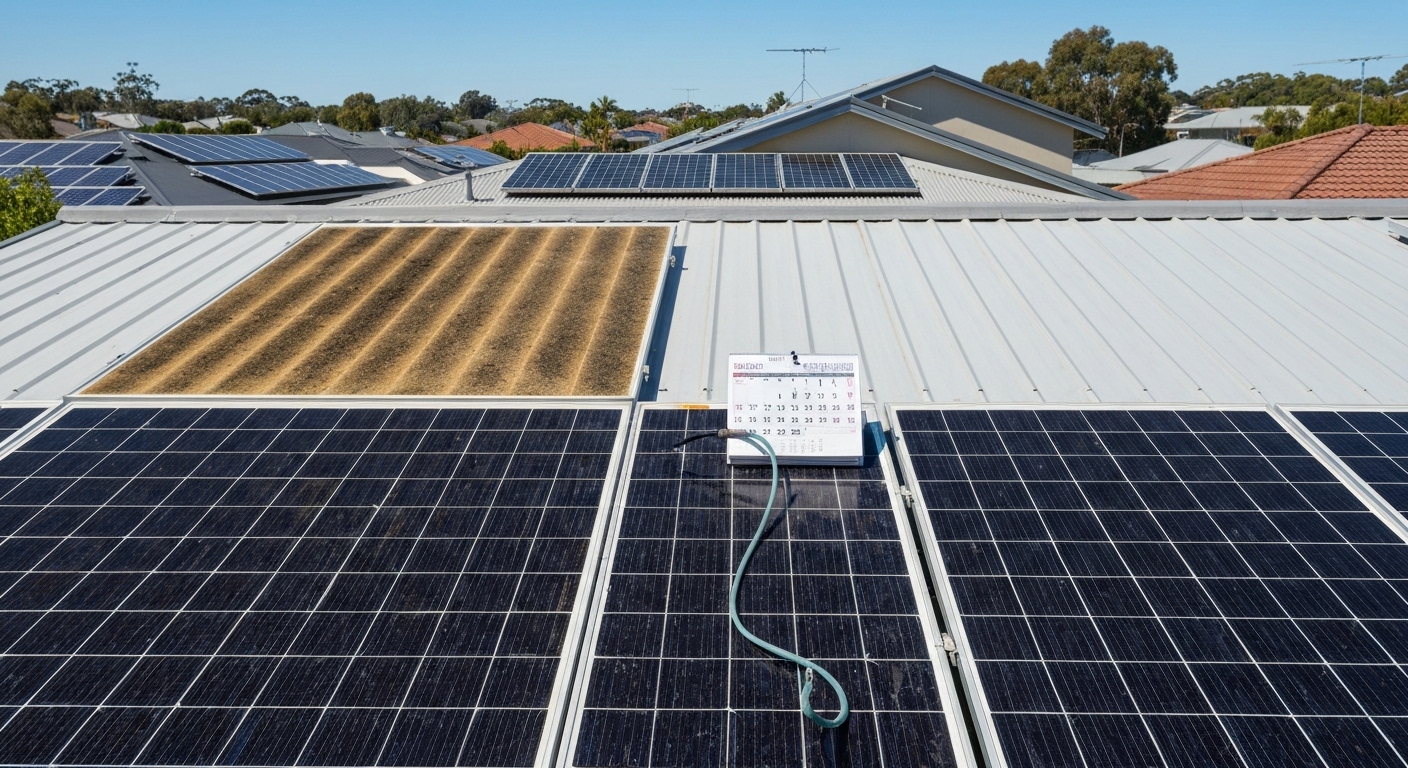
One of the most common questions Australian solar owners ask is: how often should I clean my solar panels?
The honest answer is: it depends. Your location, roof pitch, local environment, and panel tilt angle all determine how quickly your system accumulates soiling — and how much output you’re silently losing every month.
Understanding how often to clean solar panels in Australia is crucial for maintaining optimal energy production and protecting your long-term investment. Let’s break down exactly what frequency works for your specific situation.
How Often Should You Clean Solar Panels? The Quick Answer
| Location Type | Recommended Cleaning Frequency |
|---|---|
| Metro, average dust | Once a year |
| Near dusty roads or construction | Every 6 months |
| Agricultural / rural area | Every 3–4 months |
| Coastal (salt spray) | Twice a year |
| High bird activity | Every 3–4 months |
| Post-bushfire areas | Immediately after event, then yearly |
These are baseline recommendations. Your actual cleaning schedule should be adjusted based on inverter performance data and visible soiling accumulation.
Why Solar Panel Cleaning Frequency Matters More Than You Think
Australian solar panels face some unique soiling challenges compared to other countries:
- Red dust (particularly inland QLD, NSW, SA, and WA) is fine-grained and sticky, forming a film that’s resistant to rainfall
- Bird activity near the coast and in suburbs with large trees is high year-round
- Pollen seasons in southern Australia (August–November) deposit a yellow film that actively blocks UV light
- Bushfire smoke creates oily residue that rainfall cannot remove
A peer-reviewed study by the University of NSW found that unclean solar panels in suburban Sydney lose an average of 4.6% output per month during summer dust season — compounding over time if not addressed.
According to Clean Energy Council research, Australian households with panels that haven’t been cleaned in over 2 years can experience output reductions of 15–25%, translating to hundreds of dollars in lost electricity generation annually.
How Often to Clean Solar Panels Based on Your Environment
Queensland (Brisbane, Gold Coast, Cairns)
How often should you clean solar panels in Queensland? In the subtropical climate:
- Dry season (May–October): Dust accumulates rapidly. Clean in June and again in October before storm season.
- Wet season: Heavy rain helps but doesn’t fully clean. Check after wet season ends.
- Coastal properties: every 6 months due to salt spray
- Inland properties (Toowoomba, Warwick): every 3–4 months during dry season
New South Wales (Sydney, Newcastle, Wollongong)
- Clean in March (post-summer) and October (pre-peak solar months).
- Properties west of the divide (Bathurst, Orange, Dubbo) need more frequent cleaning — every 3–4 months.
- Coastal NSW benefits from twice-yearly cleaning to manage salt and sea spray buildup
Victoria (Melbourne, Geelong)
- Pollen season peaks August–November. Clean in April and November.
- Properties near the Mallee or Wimmera: every 3 months during dry periods.
- Urban Melbourne: once yearly is typically sufficient due to regular rainfall
Western Australia (Perth, Mandurah, Bunbury)
- Dust events are severe January–March. Clean in February and July.
- Mining regions (Pilbara, Goldfields): monthly checks recommended due to extreme dust conditions.
- Perth metro: twice yearly cleaning optimal
South Australia (Adelaide, Barossa, Riverland)
- Similar to Victoria. April and November work well.
- Riverland and Eyre Peninsula properties: every 3 months due to arid conditions and dust
- Adelaide hills: once yearly often sufficient
How to Know When Your Panels Need Cleaning
You don’t need to climb your roof to determine the right cleaning frequency. Look for these signs:
- Visible soiling from the ground — a brownish or yellow tinge across panels
- Inverter output drop — compare your kWh production this month vs. the same month last year. A drop of more than 10% without a change in weather patterns suggests soiling
- Monitoring app alerts — systems with SolarEdge, Enphase, or Fronius monitoring can show per-panel performance and flag underperforming strings
- After visible events — heavy dust storms, hailstorms, extended dry periods, nearby construction
The “Self-Cleaning” Myth and How Often to Actually Clean
Many premium panel manufacturers market their glass as “self-cleaning” due to hydrophilic coatings. In laboratory conditions, this works — water sheets off evenly, carrying dust with it.
In real Australian conditions? Less so.
Why self-cleaning fails in practice:
- The coating requires a steep enough pitch (ideally 15°+) to sheet properly
- It doesn’t remove stuck bird droppings, pollen, or oily residue from bushfire smoke
- Mineral deposits from tap water or bore water (common in rural areas) permanently reduce the coating’s effectiveness
- The coating degrades over 5–10 years
Self-cleaning glass reduces cleaning frequency, it doesn’t eliminate it. Most manufacturers still recommend annual professional cleaning to maintain warranty coverage and full performance. Even with self-cleaning panels, you should still clean solar panels at least once per year.
Flat or Low-Tilt Panels: Clean More Often
Panels installed at a low tilt (under 10°) — common on flat commercial rooftops and some modern residential installations — accumulate dirt significantly faster than steeply pitched panels.
Water pools on flat panels rather than sheeting off, leaving mineral deposits after each rainfall. Dust doesn’t slide off. Bird droppings sit in puddles and bake on in summer heat.
If your system is on a flat or low-pitch roof: clean every 3–4 months, or use a specialised robotic cleaning service. The cleaning frequency for flat-mounted solar panels is substantially higher than for tilted installations.
What Happens If You Don’t Clean Solar Panels Regularly?
Short-term (under 6 months): 5–15% output reduction. Recoverable with a clean.
Medium-term (6–18 months): Lichen and moss begin to establish on panel edges and in shaded areas. This causes micro-shading and can permanently etch the glass anti-reflective coating. Output loss of 15–25%.
Long-term (2+ years): Bird droppings bake into the glass. Lichen etches the surface. Snail trails (a metallic residue from internal cell degradation triggered by moisture under soiling) appear. Permanent output loss of 20–35% is possible.
According to CSIRO research on solar panel degradation in Australian climates, panels that receive no cleaning over a 5-year period can experience permanent efficiency losses due to etched anti-reflective coatings that cannot be restored even with aggressive cleaning.
Regular cleaning at the appropriate frequency isn’t just about today’s output — it protects your 25-year panel investment.
Professional vs DIY: How Frequency Changes Your Approach
If you clean yourself, you can technically clean more frequently because the cost per clean is lower. However:
- Roof safety remains the primary risk — no frequency of cleaning justifies an unsafe climb
- Using incorrect products (tap water, dish soap, Windex) can leave residue that attracts more dirt faster
- Over-cleaning with abrasive tools damages the anti-reflective coating
For most homeowners, professional cleaning once or twice per year combined with a visual check after major dust or pollen events is the optimal strategy.
Professional cleaners use deionised water and proper techniques that don’t leave mineral residue, meaning the time between cleanings can actually be extended compared to DIY methods using tap water.
Using Your Inverter to Determine Cleaning Frequency
Rather than relying solely on a calendar-based schedule, the smartest approach is to let your inverter data tell you when cleaning is due. Here’s how:
Step 1 — Establish a baseline. In the first few months after installation (or after a known clean), record your monthly kWh generation. This is your performance benchmark.
Step 2 — Compare month-over-month. Each month, compare generation to the same month in the prior year. Use your inverter app’s historical comparison feature (available in SolarEdge, Enphase, Fronius, and most modern monitoring systems).
Step 3 — Apply the 10% rule. If generation has dropped more than 10% from the equivalent prior-year month and weather patterns are similar, soiling is the most likely cause. Book a clean.
Step 4 — Verify after cleaning. A professional clean should restore output by roughly the amount lost. If output doesn’t recover after cleaning, other issues (inverter faults, cell degradation, shading changes) may be contributing.
This data-driven approach means you’re not cleaning too often (wasting money) or too infrequently (losing generation). It’s the most accurate way to determine how often you should clean your solar panels.
How to Set Up Your Own Cleaning Schedule
Rather than waiting to react to output drops, proactive scheduling beats reactive cleaning every time. Here’s how to build a schedule tailored to your location:
Step 1: Identify your soiling risk category
| Risk Level | Location Characteristics | Recommended Cleaning Frequency |
|---|---|---|
| Low | Wet coastal, regular rain, low dust | 1× per year |
| Moderate | Metro suburban, moderate rainfall | 2× per year |
| High | Agricultural fringe, dry climate | 3–4× per year |
| Very high | Inland, arid, heavy dust | Quarterly or more |
Step 2: Set calendar reminders around key seasonal events
In most of Australia, the two highest-value cleaning windows are:
- Late October/early November — after spring pollen season, before peak summer heat
- March/April — after summer dust, before winter to maximise autumn output
If you’re doing a third clean, add July/August to benefit from late-winter rains and prepare for the spring pollen spike.
Step 3: Supplement with event-triggered cleaning
Add an unscheduled clean within 2 weeks of:
- Any dust storm event that deposits visible red or brown dust
- Nearby bushfire smoke events lasting more than 3 days
- Summer hailstorms (inspect for panel damage at the same time)
- Significant bird activity (new dropping accumulation across multiple panels)
Step 4: Track output monthly
Your inverter app’s monthly report is your feedback loop. If a calendar-timed clean isn’t planned but output has dropped more than 10% vs. the same weather period in prior months, that’s your trigger.
The 5-Year Impact of Different Cleaning Frequencies
Many Australian homeowners don’t clean their panels at all after installation. Here’s what the data suggests happens over 5 years in a moderate-soiling environment (Sydney or Melbourne) with different cleaning schedules:
No cleaning:
- Year 1: Output loss 3–5%. Largely invisible — within normal variation.
- Year 2: Output loss 7–10%. May be noticeable on hot days when panel efficiency is most critical.
- Year 3: Output loss 12–18%. Most homeowners in this category are losing $200–$400/year in electricity. Biological growth (algae, early lichen) beginning in humid areas.
- Year 5: Output loss 15–25%. Possible permanent AR coating etching from long-term bird dropping acidity. Lichen established. Total 5-year electricity loss: $800–$2,000+.
Annual cleaning:
- Maintains 95–98% of optimal output
- Prevents permanent soiling damage
- Total cost: $900–$1,400 over 5 years
- Net benefit: $600–$1,200+ recovered generation
Twice-yearly cleaning (high-soiling areas):
- Maintains 98–99% of optimal output
- Optimal for dusty, agricultural, or high-bird-activity locations
- Total cost: $1,800–$2,800 over 5 years
- Net benefit in high-soiling areas: $1,200–$2,500+ recovered generation
All of this is avoidable with a $180–$280 professional clean at the appropriate frequency for your location. The arithmetic is unambiguous.
Seasonal Guide: Best Time to Clean Solar Panels by Australian Region
The optimal cleaning frequency aligns with Australia’s distinct seasonal patterns:
Summer (December–February):
- Highest dust accumulation in most regions
- Peak energy production period — soiling losses cost the most
- Clean before January if you haven’t cleaned since October
Autumn (March–May):
- Ideal cleaning window for most of Australia
- Removes summer dust before lower-output winter months
- March/April cleaning recommended as part of annual or bi-annual schedule
Winter (June–August):
- Lower soiling rates in most regions
- Lower energy production means soiling losses have less financial impact
- Good time for mid-year clean in coastal or high-dust areas
Spring (September–November):
- Pollen season in southern Australia (August–November)
- Critical pre-summer cleaning window
- Late October/early November optimal for capturing post-pollen cleaning before peak generation
Conclusion: Finding Your Optimal Cleaning Frequency
For the average Australian home in a metro area: clean once a year, ideally in autumn or early spring. In dusty, rural, coastal, or high-bird-activity environments, increase to twice a year or quarterly.
How often you should clean solar panels in Australia ultimately depends on monitoring your inverter output monthly — it’s the most reliable indicator of when cleaning is overdue. A 10% unexplained production drop is your signal to book a clean.
The cost of regular cleaning at the right frequency is a fraction of the electricity you recover. Don’t let dust quietly drain your solar investment.
Related: Does Rain Actually Clean Solar Panels? · Best Time of Day to Clean Solar Panels · Solar Panel Cleaning Cost Australia 2025
Sources
-
University of NSW, Centre for Sustainable Energy Systems. (2019). “Impact of Soiling on Photovoltaic Performance in Australian Climates.” Solar Energy Research, 156, 347–358. Study documenting 4.6% monthly output loss during Sydney summer dust season.
-
Clean Energy Council. (2023). “Solar Panel Maintenance Guidelines for Australian Conditions.” Technical standards documentation for solar installation and maintenance practices across Australian climate zones.
-
CSIRO Energy. (2021). “Long-term Degradation Patterns in Australian Rooftop Solar Installations.” Research report on permanent efficiency losses from inadequate maintenance, including anti-reflective coating degradation from biological growth and soiling.
-
Australian Photovoltaic Institute (APVI). (2024). “Mapping Australian Solar Performance Data.” National solar monitoring database showing regional performance variations and environmental impacts on generation.
Frequently Asked Questions
How often should solar panels be cleaned in Australia?
For most Australian homes, once or twice a year is sufficient. Properties near dusty roads, farms, or in high-pollen regions may need cleaning every 3–4 months. Coastal properties benefit from a mid-year rinse to remove salt spray. The exact frequency depends on your local environment, roof pitch, and whether you’re experiencing output drops of 10% or more compared to previous months.
Does rain clean solar panels?
Light rain moves dust around but rarely removes stuck-on grime, bird droppings, or pollen. Heavy rain helps, but it won’t restore panels to peak efficiency the way a proper purified-water clean will. Rain is not a substitute for professional cleaning, especially in areas with mineral-heavy water or during extended dry periods.
What happens if you never clean solar panels?
Studies in Australian conditions show that unclean panels can permanently lose 20–30% of output over 2–3 years due to etched grime and lichen growth. A University of NSW study found that suburban Sydney panels lose an average of 4.6% output per month during summer dust season when left uncleaned. Regular cleaning protects both output and panel longevity.
What month is best to clean solar panels in Australia?
Autumn (March–April) and spring (September–October) are ideal for most Australian states. Autumn cleans remove summer dust buildup before the panels matter less in winter. Spring cleans remove pollen and grime ahead of the peak summer generation period. Late October/early November is particularly valuable as it captures post-pollen cleaning before peak summer output months.
How do I know when my solar panels need cleaning?
Clean your solar panels when your inverter monitoring shows a production drop of 10% or more compared to the same month in the previous year (accounting for similar weather). Visible soiling from the ground, after dust storms, bushfire smoke events, or heavy pollen seasons are also clear indicators that cleaning is overdue.
Frequently Asked Questions
For most Australian homes, once or twice a year is sufficient. Properties near dusty roads, farms, or in high-pollen regions may need cleaning every 3–4 months. Coastal properties benefit from a mid-year rinse to remove salt spray. The exact frequency depends on your local environment, roof pitch, and whether you're experiencing output drops of 10% or more compared to previous months.
Light rain moves dust around but rarely removes stuck-on grime, bird droppings, or pollen. Heavy rain helps, but it won't restore panels to peak efficiency the way a proper purified-water clean will. Rain is not a substitute for professional cleaning, especially in areas with mineral-heavy water or during extended dry periods.
Studies in Australian conditions show that unclean panels can permanently lose 20–30% of output over 2–3 years due to etched grime and lichen growth. A University of NSW study found that suburban Sydney panels lose an average of 4.6% output per month during summer dust season when left uncleaned. Regular cleaning protects both output and panel longevity.
Autumn (March–April) and spring (September–October) are ideal for most Australian states. Autumn cleans remove summer dust buildup before the panels matter less in winter. Spring cleans remove pollen and grime ahead of the peak summer generation period. Late October/early November is particularly valuable as it captures post-pollen cleaning before peak summer output months.
Clean your solar panels when your inverter monitoring shows a production drop of 10% or more compared to the same month in the previous year (accounting for similar weather). Visible soiling from the ground, after dust storms, bushfire smoke events, or heavy pollen seasons are also clear indicators that cleaning is overdue.