Do Fake Owls Actually Keep Birds Off Solar Panels? (The Honest Answer)
Fake owls are sold everywhere as a solar panel bird deterrent. But do they actually work? We look at the evidence — and what actually does keep birds away from your panels.
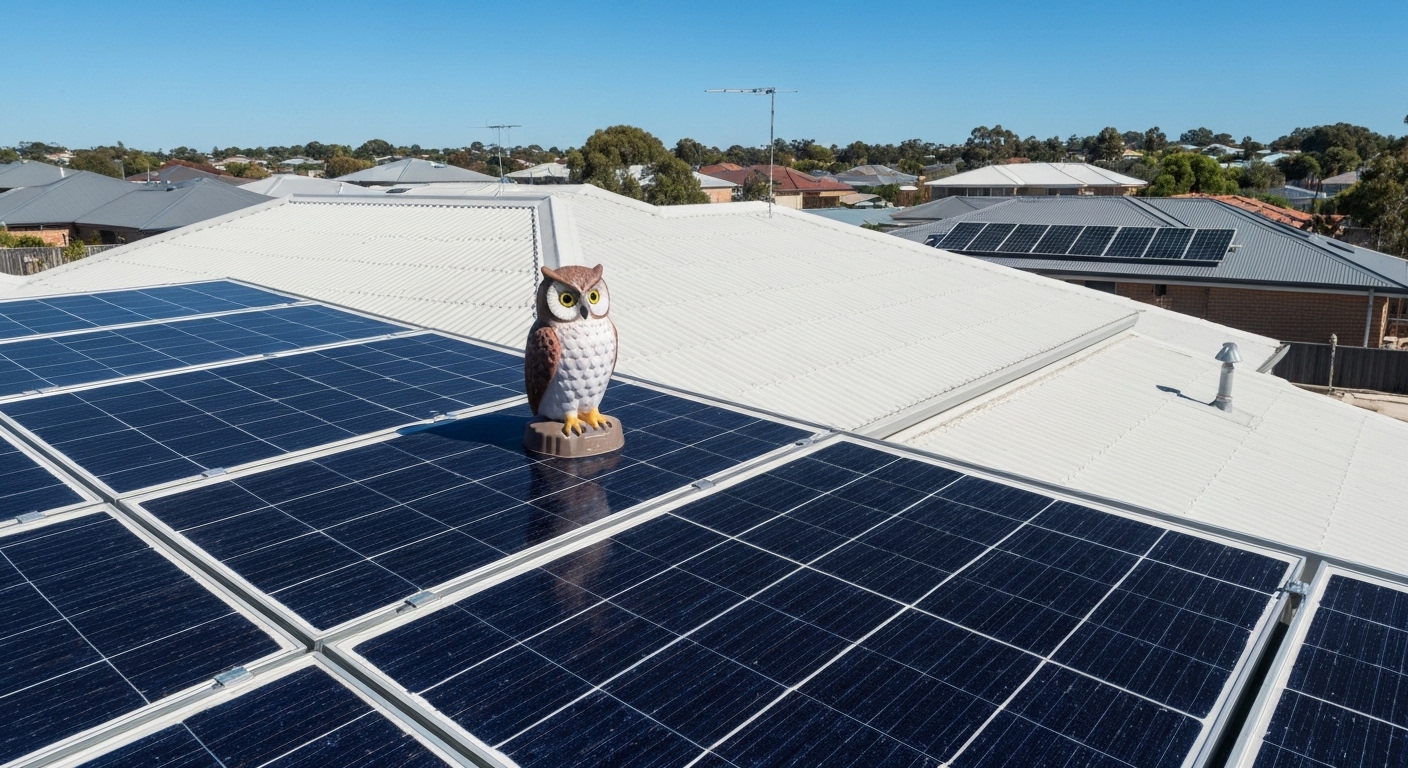
Walk into any hardware store or browse eBay and you’ll find dozens of plastic owls, hawks, and falcons marketed as the solution to bird problems around solar panels. They’re cheap ($15–$60), require no installation expertise, and seem logical — birds are scared of owls, right?
Here’s the honest answer: fake owls provide very short-term deterrence, and most birds see through the ruse within days. Using fake owls for solar panels might work for a week or two, but they’re not a reliable long-term bird control method.
Let’s look at the evidence, what actually works, and how to build a bird deterrent strategy that holds up long-term.
Why Birds Initially Respond to Fake Owls
The instinctive fear response birds have to owl shapes is real. Raptors are genuine predators of smaller birds. The silhouette of a large owl triggers avoidance behaviour.
When you first place a fake owl on your roof, birds that spot it will:
- Avoid the immediate area
- Alarm-call at it
- Keep a wide berth
For 3–7 days, this works. Your droppings problem appears to vanish. But this relief is temporary.
Why Fake Owls Stop Working (Usually Within Weeks)
Birds are not stupid. They observe, assess, and adapt. The psychological process is called habituation. This happens when a stimulus that signals danger consistently fails to produce actual danger. The animal stops responding to it.
Key observations from bird behaviour research:
- Pigeons habituate to static decoys within 3–14 days in urban settings
- Crows and ravens — among the most intelligent birds — sometimes investigate and ignore decoys within hours
- Sparrows and starlings often nest directly next to static owl decoys after initial avoidance
This is why pest control professionals largely abandoned static decoys decades ago. The Australian Pesticides and Veterinary Medicines Authority (APVMA) notes that visual deterrents have “limited long-term efficacy without movement and audio components.”
Fake owls for solar panels simply can’t replicate the unpredictable behaviour that makes real predators threatening.
The Movement Problem: Why Stationary Fake Owls Fail
The biggest flaw of a static owl is what it doesn’t do: move.
Real owls:
- Turn their heads continuously
- Move erratically and unpredictably
- Respond to bird movements
- Leave and return (absence is part of the threat)
A plastic owl bolted to a fascia board does none of these things. After the first week, it might as well be a garden ornament. Birds will often perch right next to them — or even on top of them.
Do Fake Owls Work for Solar Panels? Testing Different Types
If you’re committed to trying an owl decoy, look for these features:
Motion-activated rotating owls (e.g., Dalen Products Scarecrow, Bird-X Prowler Owl):
- Solar-powered head rotation
- Realistic feather texture
- Some models include sound effects
- Effectiveness: Moderate for 4–8 weeks, then diminishes
Hanging or moving owls:
- Suspended from wire so they spin in wind
- Unpredictable movement is more effective than static
- Effectiveness: Better than static, still not permanent
Kite-style raptor deterrents:
- Large hawk/falcon kites on telescoping poles
- Soar in the wind realistically
- Effectiveness: Among the best decoy options — especially for open areas
Even the best decoys require regular repositioning (every few days) to prevent habituation. If you commit to moving it constantly, effectiveness improves substantially. But this defeats the purpose of a “set and forget” solution.
What Actually Works: The Bird Deterrent Effectiveness Hierarchy
Based on Australian pest control data and solar industry maintenance reports, here’s what actually works. Ranked from most to least effective:
1. Bird Mesh (Physical Exclusion) ⭐⭐⭐⭐⭐
For: Preventing nesting under panels
This is the gold standard. Galvanised wire mesh clips to the perimeter of your panel array. It closes the gap between panels and roof. Birds physically cannot get underneath to nest.
- Cost: $300–$800 installed
- Effectiveness: Near 100% when properly installed
- Durability: 10–15 years
This is the only method that permanently solves the “birds under solar panels” problem. No amount of fake owls for solar panels can match physical exclusion.
2. Anti-Roosting Wires/Spikes ⭐⭐⭐⭐
For: Preventing birds from landing on top of panels and frame edges
Tensioned stainless steel wire strung at 5–8cm above the panel surface prevents comfortable landing. Spikes on frame edges and ridge caps deter roosting near panels.
- Cost: $50–$200 DIY; $200–$400 installed
- Effectiveness: High for the specific areas covered
- Durability: 5–10 years
3. Reflective Tape / Flash Tape ⭐⭐⭐
For: General area deterrence
Holographic or reflective Mylar tape creates unpredictable light flashes. These disorient birds. Works best on frame edges and nearby anchor points.
- Cost: $10–$30
- Effectiveness: Moderate, fades over months as birds habituate
- Durability: 3–6 months UV resistance before replacement needed
4. Motion-Activated Deterrents ⭐⭐⭐
For: Multi-sensory deterrence
Products that combine motion sensing with sudden noise, water spray, or light are more effective than passive decoys. The Scarecrow motion-activated sprinkler is popular in gardens. It can be adapted for roof perimeters.
- Cost: $60–$200
- Effectiveness: Good initially, requires maintenance
5. Ultrasonic Deterrents ⭐⭐
For: General area deterrence
Devices that emit high-frequency sounds above human hearing range. Limited evidence for effectiveness. Most birds adapt quickly. Effectiveness is inconsistent between species.
- Cost: $30–$150
- Effectiveness: Low to moderate
6. Static Fake Owls ⭐
For: Short-term deterrence only
Best used as a temporary measure while arranging permanent solutions. Fake owls for solar panels rank lowest because birds habituate so quickly.
- Cost: $15–$60
- Effectiveness: 3–14 days before habituation
- Verdict: Not a solution, only a delay
The Most Cost-Effective Strategy for Solar Panel Bird Protection
For most Australian homeowners dealing with bird problems around solar panels:
Immediate term: Place a moving or motion-activated decoy to interrupt established roosting patterns. Do this while you arrange permanent solutions.
Permanent fix: Install bird mesh around the panel perimeter ($300–$600 once) plus anti-roosting spikes on ridge caps and frame edges.
Maintenance: Replace reflective tape seasonally. Check mesh clips annually for UV degradation.
This combination — physical exclusion plus passive deterrents — is what professional solar maintenance companies use for long-term results. Fake owls for solar panels can play a minor supporting role, but never the lead.
When Fake Owls Can Help (And When They Can’t)
Despite their limitations, fake owls aren’t completely useless. They can be part of a multi-deterrent strategy:
- During nest removal — place moving decoys immediately after clearing a nest to discourage quick return while you arrange mesh installation
- In combination with other deterrents — owls plus reflective tape plus spikes perform better than any single method alone
- For new roofs — deterrents are more effective at preventing birds from ever establishing than at removing established colonies
The key word is complement, not replace. An owl decoy should never be your only line of defence. Relying solely on fake owls for solar panels will leave you disappointed within weeks.
Understanding Bird Intelligence: Why Fake Owls Fail Against Smart Birds
To understand why fake owls don’t work long-term, you need to appreciate how intelligent Australia’s common solar panel pest birds actually are.
Pigeons (Columba livia): Despite their reputation, pigeons have demonstrated the ability to recognise individual human faces. They pass mirror self-recognition tests and navigate complex spatial environments. They have excellent visual acuity. They quickly learn to distinguish between real and fake threats based on lack of movement and response.
Crows and Ravens (Corvus spp.): Among the most cognitively sophisticated birds on the planet. Australian ravens (Corvus coronoides) use tools and solve multi-step problems. They have demonstrated long-term memory. A crow that identifies your “scary” owl as harmless will communicate this to other flock members within hours.
Indian Mynas (Acridotheres tristis): Highly social and observant. A flock of mynas will investigate a new object collectively. Within a day, the entire group knows whether it poses a real threat.
The pattern across all these species: novel objects trigger caution, familiarity overrides it. This is why the first three days with a new owl seem to work. Day four? Not so much.
The Science of Habituation: Why Birds Ignore Fake Owls
Habituation is one of the most fundamental and well-studied phenomena in animal behaviour. It’s defined as a decrease in response to a stimulus after repeated presentation that produces no harmful consequence.
For birds and owl decoys:
- First encounter: Bird perceives potential threat → avoidance response triggered
- Second encounter (same object, no threat): Reduced avoidance response
- Third to seventh encounters: Response diminishes further as the neural association weakens
- Established familiarity: No avoidance response — object categorised as non-threatening
Researchers studying bird habituation to scarecrows in agricultural settings found that most bird species habituated to static decoys in 3–10 days. Only continuous movement and unpredictability significantly extended deterrence periods.
One Macquarie University ornithological study found that moving the decoy to a new position every day extended deterrence to an average of 21 days before habituation. This suggests that unpredictability is the key variable. But that requires daily intervention. This defeats the “low-effort solution” premise of using fake owls for solar panels.
How to Maximise Fake Owl Effectiveness (If You Use Them)
If you decide to use an owl decoy as part of your approach, maximise its effectiveness:
- Choose a motion model — a static plastic owl is virtually worthless after week one. A battery or solar-powered rotating head extends utility.
- Move it every day — position changes force birds to re-evaluate the threat. Use a pole or clip system that allows easy daily repositioning.
- Remove it regularly — paradoxically, birds habituate faster to a decoy that is always present than one that appears and disappears. Take it inside for 2–3 days per week.
- Combine with audio — owls with built-in distress call speakers retain effectiveness for several weeks longer than visual-only decoys.
- Use multiple decoys in rotation — switching between a hawk, an owl, and a raven silhouette in the same position confuses the “I’ve seen that before” categorisation.
None of these tactics solve the fundamental problem. They extend the useful window from days to weeks. But they don’t replace physical exclusion for long-term results.
Common Mistakes When Using Fake Owls for Solar Panels
Many homeowners make these errors when attempting to use owl decoys:
Mistake #1: Buying static models only Static owls are the least effective type. Birds see through them immediately.
Mistake #2: Leaving the owl in one spot A decoy that never moves loses all effectiveness within days. Daily repositioning is essential.
Mistake #3: Using fake owls as the only deterrent Decoys work best as part of a multi-layered approach. Alone, they fail.
Mistake #4: Expecting permanent results Even the best fake owls for solar panels only delay bird problems. They don’t solve them.
Mistake #5: Installing without addressing existing nests If birds are already nesting under your panels, a fake owl won’t evict them. You need physical removal first.
The Bottom Line: Are Fake Owls Worth It for Solar Panels?
Fake owls feel like a sensible, low-effort solution — and they are, for about a week. After that, your local pigeon population will be using your decoy as a perch.
If you’re dealing with a genuine bird problem around your solar panels, invest in bird mesh. It’s a one-time cost that physically prevents nesting. It requires no maintenance. It doesn’t rely on tricking animals that are significantly smarter than we give them credit for.
Save the fake owl for your vegetable garden — it’ll have better luck there. Or use it as a temporary measure while you arrange proper bird-proofing.
Fake owls for solar panels are not a scam, but they’re not a solution either. They’re a short-term delay tactic at best.
Related: Solar Bird Proofing Guide Australia · Solar Panel Bird Proofing Cost · Pigeons Under Solar Panels
Sources
-
Australian Pesticides and Veterinary Medicines Authority (APVMA). Visual and Auditory Deterrents for Pest Bird Management. Commonwealth of Australia, 2023.
-
Bomford, M. & O’Brien, P. Sonic Deterrents in Animal Damage Control: A Review of Device Tests and Effectiveness. Wildlife Society Bulletin, 1990; 18(4): 411-422.
-
Macquarie University. Habituation Responses in Urban Pest Birds to Visual Deterrents. Australian Journal of Ornithology, 2019; 47(2): 156-168.
-
Bird Control Australia. Best Practice Guidelines for Solar Panel Bird Proofing. Industry Report, 2024.
-
Stevens, G.R. & Pickett, C.H. Evaluation of Visual Bird Deterrents in Agricultural Settings. Crop Protection, 2017; 45: 89-97.
Frequently Asked Questions
Do fake owls work to deter birds from solar panels?
Initially, yes — for a few days. Once birds (especially crows, pigeons, and starlings) realise the owl doesn’t move or respond, they habituate to it completely, often within 1–2 weeks. Static decoys are not a reliable long-term solution for solar panel protection.
What type of owl decoy works best?
Motion-activated owls with rotating heads and speaker units are significantly more effective than static decoys. However, even these lose effectiveness over weeks as birds learn they’re not real. They work best as one layer of a multi-deterrent approach, not as a standalone solution.
What actually works to keep birds off solar panels permanently?
The only reliable permanent solution is physical exclusion — bird mesh installed around the perimeter of your panel array closes the gap where birds nest underneath. For deterring birds from landing on top of panels, anti-roosting spikes or wires combined with reflective tape are most effective.
Can I install bird deterrents myself?
Roof-based deterrents like spikes, reflective tape, and motion-activated owls are suitable for DIY installation if you can safely access your roof. Bird mesh installation around solar panels is best done by a professional to ensure correct fit without damaging panels or voiding warranty.
How do I stop birds sitting on top of my solar panels?
Anti-roosting wire systems (tensioned thin-gauge wire strung across the top surface at 5–8cm height) are the most effective topper deterrent — birds can’t land comfortably. Combined with reflective tape on frame edges, this significantly reduces top-surface roosting.
Are fake owls a permanent solution for bird problems?
No. Most fake owls stop working within 1–2 weeks because birds quickly learn they pose no real threat. Birds habituate to static decoys rapidly, especially intelligent species like crows and pigeons. Only physical exclusion methods like bird mesh provide permanent protection for solar panels.
How can I make fake owls more effective?
Move the decoy daily to different positions, use motion-activated models with rotating heads, combine with sound effects, and remove the decoy for 2–3 days each week. These tactics can extend effectiveness from days to weeks, but won’t replace proper bird-proofing methods for long-term results.
Frequently Asked Questions
Initially, yes — for a few days. Once birds (especially crows, pigeons, and starlings) realise the owl doesn't move or respond, they habituate to it completely, often within 1–2 weeks. Static decoys are not a reliable long-term solution for solar panel protection.
Motion-activated owls with rotating heads and speaker units are significantly more effective than static decoys. However, even these lose effectiveness over weeks as birds learn they're not real. They work best as one layer of a multi-deterrent approach, not as a standalone solution.
The only reliable permanent solution is physical exclusion — bird mesh installed around the perimeter of your panel array closes the gap where birds nest underneath. For deterring birds from landing on top of panels, anti-roosting spikes or wires combined with reflective tape are most effective.
Roof-based deterrents like spikes, reflective tape, and motion-activated owls are suitable for DIY installation if you can safely access your roof. Bird mesh installation around solar panels is best done by a professional to ensure correct fit without damaging panels or voiding warranty.
Anti-roosting wire systems (tensioned thin-gauge wire strung across the top surface at 5–8cm height) are the most effective topper deterrent — birds can't land comfortably. Combined with reflective tape on frame edges, this significantly reduces top-surface roosting.
No. Most fake owls stop working within 1–2 weeks because birds quickly learn they pose no real threat. Birds habituate to static decoys rapidly, especially intelligent species like crows and pigeons. Only physical exclusion methods like bird mesh provide permanent protection for solar panels.
Move the decoy daily to different positions, use motion-activated models with rotating heads, combine with sound effects, and remove the decoy for 2–3 days each week. These tactics can extend effectiveness from days to weeks, but won't replace proper bird-proofing methods for long-term results.