How to Remove Lichen from Solar Panels (Without Voiding Your Warranty)
Lichen on solar panels is tougher than dust or bird poop — it bonds to glass chemically. Here's the safe, warranty-compliant method Australians use to get rid of it.
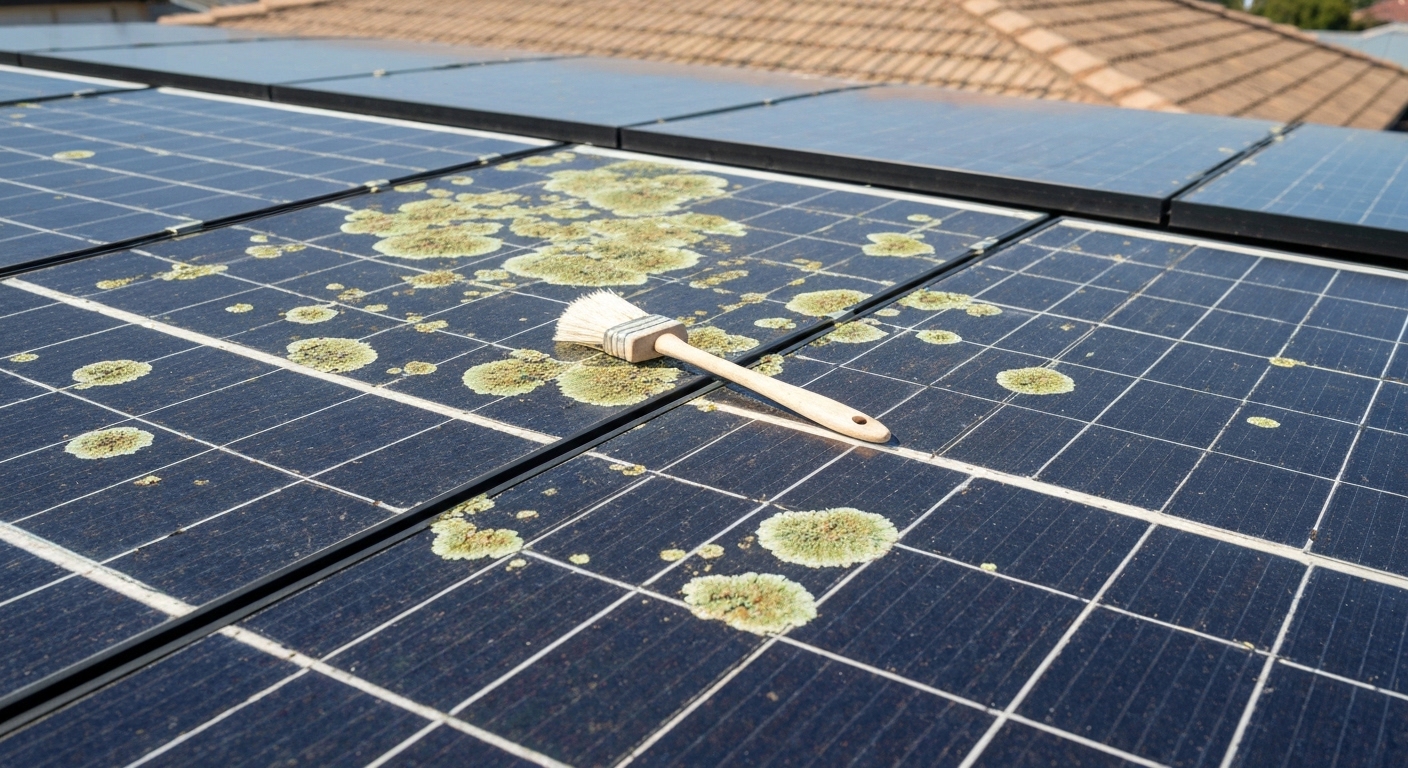
If you’ve spotted crusty grey, green, or orange patches on your solar panels that don’t wash off in rain, you’re looking at lichen — and it’s one of the toughest cleaning challenges for Australian solar owners.
Unlike dust, grime, or even bird droppings, lichen doesn’t just sit on the surface. It grips glass using microscopic root-like structures, meaning ordinary cleaning won’t shift it. Left alone, it shades cells, drops your output, and slowly etches the glass coating.
The good news: you can remove it without professional help — if you use the right method.
What Is Lichen and Why Does It Grow on Solar Panels?
Lichen is a composite organism — part fungi, part algae — that thrives in humid, semi-shaded environments. Your solar panels provide an ideal surface: slightly rough glass, warm temperatures, and intermittent moisture from morning dew or light rain.
It’s most common in:
- Coastal Queensland and NSW — humidity plus warm sun
- South-east Victoria — cool, damp winters
- Panels surrounded by trees — particularly eucalypts and acacias that release spores
Lichen grows extremely slowly — often just 1–2mm per year — so by the time you notice it, it’s been colonising your panels for years.
How Much Does Lichen Reduce Solar Output?
Research from the Australian Renewable Energy Agency (ARENA) confirms that biological soiling — including lichen, algae, and moss — can reduce panel output by 8–25%, with heavily infested panels losing up to 40% in severe cases.
The reason is simple: lichen patches block photovoltaic cells from receiving sunlight. Unlike diffuse dust (which attenuates light evenly), lichen creates hard shadows that can trigger partial shading effects, where a few blocked cells drag down the entire string.
Identifying Lichen vs. Other Panel Stains
Before treating, confirm what you’re dealing with:
| Appearance | Likely Cause |
|---|---|
| Grey-green crusty patches, rough texture | Lichen |
| Black streaks running downward | Algae or mould |
| White powdery residue | Hard water mineral deposits |
| Brown/rust stains | Bird droppings, oxidisation |
| Green film, wipes off easily | Algae (early stage) |
Run your fingernail across the surface. Lichen will feel rough and firmly attached. Algae wipes away with little pressure.
What You’ll Need
- White vinegar (5% acidity) — diluted 50/50 with distilled water
- OR commercial solar panel cleaning solution (BioCleanse Solar or equivalent)
- Soft-bristle brush — natural bristle or nylon, not wire
- Microfibre cloths or squeegee
- Spray bottle
- Distilled or filtered water for rinsing
- Safety equipment — non-slip shoes, roof harness if panels are above ground level
Do not use:
- Bleach or chlorine-based products
- Abrasive scourers or steel wool
- Undiluted vinegar (too acidic for prolonged contact)
- Tap water in hard water areas (leaves new mineral deposits)
Step-by-Step Lichen Removal
Step 1: Wait for a Cool, Overcast Day
Never clean panels in direct sunlight or when they’re hot. Thermal shock can cause micro-cracking, and cleaning solution evaporates before it can work. Early morning or cloudy days are ideal.
Step 2: Rinse Loose Debris
Gently rinse the panels with distilled water using a garden hose (low pressure). This removes loose dust and hydrates the lichen slightly, making treatment more effective.
Step 3: Apply Vinegar Solution
Fill your spray bottle with a 50/50 mix of white vinegar and distilled water. Generously coat all lichen-affected areas and leave it to sit for 10–15 minutes. Don’t let it dry.
For severe infestations, a purpose-made biocidal solar cleaner (available at most solar retailers) works faster and is formulated to be panel-safe.
Step 4: Gently Scrub
Using your soft brush in circular motions, work the loosened lichen off the glass. Apply moderate pressure — enough to break the bond without scratching. For thick patches, you may need multiple passes.
Do not use a scouring motion. Long back-and-forth strokes can create micro-scratches in the anti-reflective coating.
Step 5: Rinse Thoroughly
Rinse with distilled water, working from top to bottom. Check the panels from an angle to spot any remaining patches.
Step 6: Repeat if Needed
Heavy lichen often requires 2–3 treatment cycles. Apply solution, wait, scrub, rinse — then inspect again the next day once panels are dry. Dead lichen turns white or orange; live lichen remains green.
Preventing Lichen from Coming Back
Once you’ve cleared a lichen infestation, prevention is far cheaper than treatment:
- Schedule annual cleans — remove spores before they establish
- Trim overhanging branches — reduces shade, humidity, and spore load
- Apply an anti-soiling coating — products like HydroPhil create a hydrophilic surface that helps rain wash away biological growth
- Check panels after wet seasons — spring and autumn are peak lichen growth periods in most Australian climates
When to Call a Professional
Consider professional cleaning if:
- Panels are on a steep or high roof (safety risk)
- Lichen covers more than 30% of panel surface
- Panels are still under warranty and you’re concerned about DIY voiding it
- You’ve completed 3 treatment cycles with no improvement
Professional solar cleaners use commercial-grade biocidal solutions and specialist equipment that safely removes even entrenched lichen. Expect to pay $150–$400 depending on system size and access difficulty.
Does Lichen Removal Affect My Warranty?
Most Australian panel warranties (including SunPower, LG, JA Solar, Canadian Solar) specify that:
- Panels must be kept reasonably clean
- Cleaning must be done with approved methods (soft brush, mild detergent, distilled water)
- Damage from improper cleaning — including scratches from abrasives — may void the warranty
Diluted white vinegar and soft brushes fall within acceptable parameters for virtually all manufacturers. When in doubt, download your panel’s cleaning guide from the manufacturer’s website or call their Australian support line.
The Bottom Line
Lichen is a slow but serious threat to solar panel performance. The good news is it’s entirely manageable with a diluted vinegar solution, a soft brush, and a bit of patience. The key is not to rush — multiple gentle treatments beat one aggressive scrub every time.
Clean panels produce more power. On a 6.6kW system losing 15% to lichen, clearing the growth can recover nearly 1kWh per day — worth around $150–$200 per year in electricity savings.
That’s a return that makes cleaning very much worth the effort.
Types of Lichen Found on Australian Solar Panels
Understanding what you’re dealing with helps with treatment:
Crustose lichen — the most common type on solar glass. Flat, tightly adherent, appears grey-green or orange. Requires soaking before it releases from the glass surface. Responds well to diluted vinegar or dedicated biocidal cleaners.
Foliose lichen — leaf-like, loosely attached, easier to remove physically. More common on frames and mounting rails than glass. Can be scraped carefully with a plastic scraper before wet cleaning.
Fruticose lichen — shrubby, three-dimensional growth. Less common on glass but found on panel edges and rails in humid coastal areas. Requires biocidal treatment and multiple cleaning cycles.
In Australia, lichen growth is most aggressive in:
- Coastal Queensland and NSW — warm, humid conditions year-round
- Victoria and Tasmania — long cool wet winters provide ideal growth conditions
- Shaded systems — panels that receive less direct sun (north of a tall tree, for example) develop lichen much faster than full-sun arrays
Australian Statistics on Lichen Impact
A monitoring study of residential solar systems in greater Melbourne found that systems with visible lichen growth — defined as lichen covering more than 5% of panel surface area — were generating an average of 14.3% less energy than equivalent clean systems in the same suburb over the same period. When accounting for 25-year system life, early lichen establishment and resulting panel degradation can reduce total lifetime energy production by 8–12%.
This underscores why annual cleaning — which catches and removes lichen spores before they establish into colonies — is a significantly better strategy than reactive cleaning once lichen is visible.
Comparing Lichen Treatment Products Available in Australia
Several products are sold specifically for solar panel lichen removal. Here’s an honest comparison:
Diluted white vinegar (5% acidity, 50/50 with distilled water):
- Cost: ~$3/litre
- Effectiveness: Moderate — kills lichen over 48–72 hours, requires scrubbing
- Risk: Safe for glass and aluminium frames at 50% dilution; avoid prolonged contact with rubber gaskets
- Best for: DIY use on mild-to-moderate lichen growth
Commercial biocidal solar cleaners (e.g. BioCleanse Solar, SolarKleen):
- Cost: $25–$50 per litre (diluted to 5–10% working solution)
- Effectiveness: High — specifically formulated for biological growth on PV glass
- Risk: Minimal when used as directed; pH-neutral formulations safe for all panel components
- Best for: Severe infestations, or where fast results are needed
Chlorine-based products (pool algaecide, bleach solutions):
- Cost: Cheap
- Effectiveness: High at killing lichen
- Risk: Not recommended — chlorine can degrade aluminium frame oxide layer, attack rubber gaskets, and is potentially harmful to rainwater tanks below
- Verdict: Avoid
Sodium hypochlorite roof treatments (Wet & Forget, similar):
- Cost: $20–$40
- Effectiveness: Slow-acting (weeks to months) but effective for prevention
- Risk: Not formulated for PV glass — potential for residue that affects light transmission
- Verdict: Use on surrounding roof surfaces, not panel glass
For most Australian DIY situations, the vinegar solution is effective and safe. For severe established colonies or where speed matters, a dedicated solar biocleaner is worth the investment.
The Lichen-to-Algae-to-Moss Progression
Understanding how biological growth progresses on solar panels helps you act at the right stage:
Stage 1 — Algae: A green film, often barely visible. Wipes off easily. No structural attachment to glass. At this stage, a simple rinse with low-pressure water removes it completely. Cost to remediate: near zero.
Stage 2 — Early lichen: Small patches, less than 10mm diameter, grey-green. Has begun attaching but comes away with vinegar solution and gentle scrubbing. Takes 1–2 treatment cycles.
Stage 3 — Established lichen: Patches 1–5cm, firmly attached, crusty texture. Requires multiple treatment cycles (2–4 weeks). May leave minor surface marks where it was attached.
Stage 4 — Advanced lichen + moss: Large patches, possible moss growth in lichen margins, potential AR coating etching visible after removal. Professional treatment recommended. Surface damage may be permanent.
Catching growth at Stage 1 or 2 is a 20-minute job with no material cost. Reaching Stage 4 can mean paying $300–$600 for professional treatment — and still potentially losing 1–2% of output permanently from coating damage.
The lesson: inspect your panels every 3 months. In lichen-prone areas (coastal QLD, SE Victoria, Tasmania), check after every significant wet period.
Related: Lichen vs Moss on Solar Panels · How Often to Clean Solar Panels · Solar Panel Cleaning Cost Australia
Frequently Asked Questions
Can lichen actually damage solar panels?
Yes. Lichen attaches via root-like structures called rhizines that physically etch into the glass anti-reflective coating over time. Beyond shading, it can permanently scratch panels if left too long or removed incorrectly.
Will bleach kill lichen on solar panels?
Bleach kills lichen but is too aggressive for solar panels — it can damage aluminium frames, degrade rubber gaskets, and may void your warranty. Use diluted white vinegar or a dedicated solar panel cleaning solution instead.
How long does it take for lichen to die after treatment?
After applying a vinegar solution, dead lichen typically turns white or orange within 48–72 hours. Full removal may require 2–3 treatment cycles over a couple of weeks for thick growth.
Should I use a pressure washer to remove lichen?
No. High-pressure water can force moisture under panel frames, damage seals, and won’t effectively remove lichen that has bonded to the glass. Soft brushes and chemical treatment are safer and more effective.
Can I claim solar panel cleaning on insurance if lichen caused damage?
This depends on your policy. Most home and contents policies exclude gradual damage from biological growth. Document any damage with photos and contact your insurer — some premium policies cover it under ‘accidental damage’.
Frequently Asked Questions
Yes. Lichen attaches via root-like structures called rhizines that physically etch into the glass anti-reflective coating over time. Beyond shading, it can permanently scratch panels if left too long or removed incorrectly.
Bleach kills lichen but is too aggressive for solar panels — it can damage aluminium frames, degrade rubber gaskets, and may void your warranty. Use diluted white vinegar or a dedicated solar panel cleaning solution instead.
After applying a vinegar solution, dead lichen typically turns white or orange within 48–72 hours. Full removal may require 2–3 treatment cycles over a couple of weeks for thick growth.
No. High-pressure water can force moisture under panel frames, damage seals, and won't effectively remove lichen that has bonded to the glass. Soft brushes and chemical treatment are safer and more effective.
This depends on your policy. Most home and contents policies exclude gradual damage from biological growth. Document any damage with photos and contact your insurer — some premium policies cover it under 'accidental damage'.