Pressure Washing Solar Panels: Warranty Risks, Mistakes & What to Do Instead
Pressure washers seem like the obvious tool for cleaning dirty solar panels. But using one incorrectly can void your warranty and permanently reduce output.
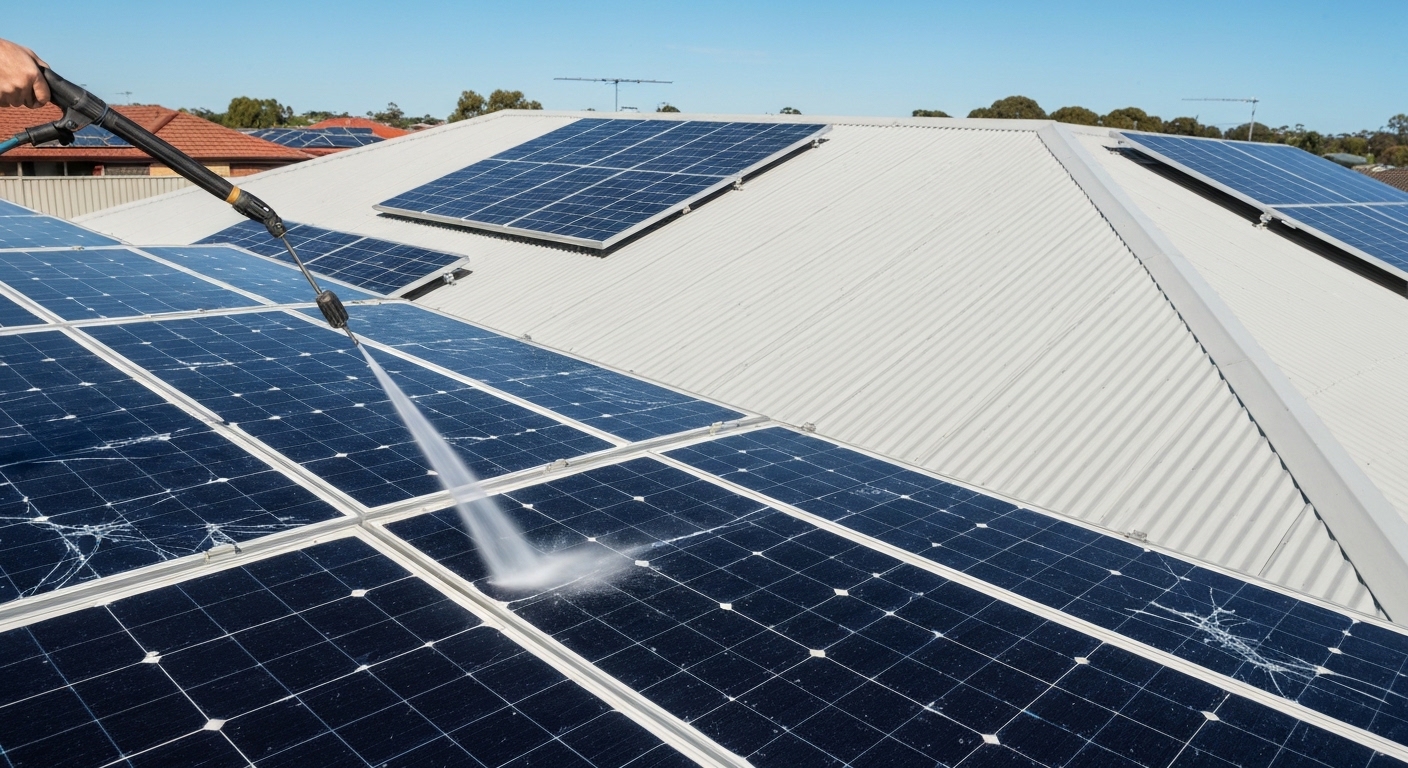
It seems completely logical. You’ve got a pressure washer in the shed, your solar panels are visibly dirty, and blasting them clean in 10 minutes sounds far better than hauling a bucket up a ladder.
But using a pressure washer on solar panels is one of the most common — and potentially costly — DIY cleaning mistakes Australian homeowners make. Here’s exactly what can go wrong, and what to do instead.
How Solar Panels Are Actually Built
To understand why high pressure is dangerous, you need to know what’s inside a solar panel.
A standard photovoltaic panel is a laminated sandwich:
- Tempered glass (top layer) — 3–4mm, with anti-reflective coating
- EVA (ethylene vinyl acetate) encapsulant — clear polymer film, holds cells in place
- Solar cells — mono or polycrystalline silicon
- Second EVA layer
- Backsheet — weatherproof polymer backing
- Aluminium frame — with rubber edge gaskets
- Junction box — on the rear, contains bypass diodes and DC connectors
The weak points for water ingress are:
- Frame gaskets — rubber seals between the glass and aluminium frame
- Junction box seals — where cables exit the back of the panel
- Backsheet edges — at the frame perimeter
What High-Pressure Water Actually Does
Forced Water Ingress
Solar panels have IP65 or IP67 water resistance ratings — but these ratings are tested under standardised low-pressure water exposure (equivalent to heavy rain). A residential pressure washer at 80–100 bar generates many times this pressure.
When you direct a high-pressure jet at the panel edge or frame-glass junction:
- Water is forced past the rubber gasket under pressure
- Moisture infiltrates the EVA encapsulant layer
- Over time, this causes delamination — the layers separate, creating visible bubbles and hazing
- Moisture in the encapsulant accelerates cell corrosion (browning/yellowing of cells)
Anti-Reflective Coating Damage
The nanoscale AR coating on modern panels can be physically abraded by a direct high-pressure water jet, particularly if there’s any grit or sand between the nozzle and the glass. The coating is designed to reduce surface reflection by 3–4% — damage here permanently reduces that benefit.
Junction Box Damage
The junction box on the panel rear is IP65-rated, meaning it’s dust-tight and resistant to water jets — but the rating assumes water at typical angles and pressures. A direct high-pressure jet aimed at cable entry points or the box lid can compromise the seal.
Water in a junction box means:
- Corrosion of electrical contacts
- Potential short circuits
- In worst cases, fire risk
What Your Warranty Actually Says
We reviewed the cleaning guidelines from Australia’s most commonly installed panels:
SunPower (Maxeon): “Clean with lukewarm water and a soft non-abrasive cloth or sponge. Avoid high-pressure water cleaners.”
Canadian Solar: “Clean with a soft cloth or sponge with water. Do not use abrasive cleaners, harsh chemicals, or high-pressure water jets.”
JA Solar: “Wash with clean water and mild soap using a soft brush. High-pressure cleaning is not recommended.”
LG Solar: “Use only a soft brush or cloth with clean water. High-pressure washing may damage the panel and void the warranty.”
The pattern is consistent: every major manufacturer recommends against high-pressure water for panel cleaning.
The Hidden Danger: Damage You Won’t Notice Immediately
The insidious part of pressure-washing damage is that it’s often invisible for years.
Year 1–2: Panel looks clean, output is fine. Micro-damage to gaskets is not yet visible.
Year 3–5: Subtle delamination begins at frame edges. You might notice very faint hazing. Output starts declining slightly faster than expected.
Year 6–8: Visible delamination bubbles, potential moisture marks on cells. Measurable output degradation beyond the rated 0.5%/year. You investigate a warranty claim.
The problem: Your 10 or 25-year product warranty almost certainly has a clause that excludes damage caused by improper cleaning. And by year 6, proving the damage started with cleaning — not a manufacturing defect — becomes very difficult.
You may be left with damaged panels and no warranty coverage.
The Right Way to Clean Solar Panels
Method 1: Soft Brush + Bucket (DIY Best Practice)
For single-storey or accessible panels:
- Fill a bucket with distilled water (or clean rainwater, TDS <50 ppm)
- Add one drop of mild dish soap per 4 litres
- Use a soft-bristle brush (natural or nylon) to scrub panels
- Rinse from top to bottom with clean water from a garden hose on its gentlest setting
- Squeegee or air-dry
Total cost: $30–$60 in equipment. Takes 30–60 minutes for a standard system.
Method 2: Water-Fed Extension Pole
For roof-level panels without needing to climb:
- Purchase a water-fed brush pole (3–6m reach, $80–$200)
- Connect to garden hose or tank water
- Brush and rinse from the ground
- Very low pressure — gravity-fed only
This is also the method professional cleaners use, often with DI water filtration added inline.
Method 3: Professional Cleaning
If panels are hard to access safely, a professional solar cleaner:
- Uses low-pressure, deionised water systems
- Is experienced with panel types and manufacturer cleaning specs
- Carries appropriate insurance if anything goes wrong
- Costs $150–$350 for a standard 6.6kW system — once or twice a year
Can I Use a Pressure Washer at Low Setting?
If you are going to use a pressure washer regardless:
- Maximum 35 bar / 500 psi — most residential washers don’t go this low. Check your model.
- Wide fan tip only — never a pinpoint jet
- Minimum 30cm distance from panel surface at all times
- Never aim at edges, frame junctions, or junction box
- Use the washer for the roof surface (between/around panels), not on the panels themselves
A better approach: use the pressure washer to clean the surrounding roof area, and clean the panels themselves with a soft brush by hand.
Common Pressure Washing Mistakes
| Mistake | Risk |
|---|---|
| Using standard 80–120 bar setting | Water ingress at frame seals |
| Pinpoint jet nozzle | AR coating abrasion, glass stress |
| Aiming at panel edges | Gasket damage, encapsulant moisture |
| Aiming at junction box or cable exits | Electrical damage, fire risk |
| Cleaning in hot afternoon sun | Thermal shock from cold water on 60°C glass |
| Using tank water without TDS check | Mineral deposit contamination |
The Bottom Line
Pressure washers are not the right tool for solar panels. The pressure that makes them efficient at cleaning concrete and decking is precisely what makes them dangerous on laminated glass with sensitive seals.
The good news: solar panels don’t need aggressive cleaning. A soft brush, distilled water, and 30 minutes of gentle effort is all it takes to restore full output on a standard dirty system.
Save the pressure washer for the driveway. Your panels — and your warranty — will thank you.
Why Australian Solar Owners Reach for the Pressure Washer
It’s worth understanding why this mistake is so common. A few legitimate reasons push homeowners toward pressure washers:
Roof access is difficult. A ground-level pressure washer with an extension wand feels safer than climbing a ladder with a bucket. The logic is understandable — but the solution is a water-fed brush pole on a garden hose, not high pressure.
Panels look really dirty. After a bushfire smoke event, a red dust storm, or a summer of bird activity, the accumulated soiling can look severe enough to justify heavy-duty cleaning. In reality, even heavy soiling responds well to a soft brush with soapy water — high pressure isn’t needed to get results.
It worked last time. The damage from pressure washing accumulates invisibly over 3–7 years before manifesting as measurable output loss or visible delamination. If you’ve pressure washed before and panels still appear fine, you may be in the early stages of damage that hasn’t yet become apparent.
Understanding IP Ratings: What They Mean for Cleaning
Solar panels carry IP (Ingress Protection) ratings — typically IP65 or IP67. Understanding these ratings prevents a common misconception.
IP65: Dust-tight + protected against water jets (rain, gentle spray) IP67: Dust-tight + protected against immersion up to 1 metre for 30 minutes
The “water jet” test for IP65 uses a nozzle at 12.5 litres per minute from 1 metre distance — roughly equivalent to a moderate garden hose flow. This is a far cry from 80–120 bar residential pressure washers.
IP ratings are not a green light for pressure washing. They indicate the minimum water resistance under standardised conditions — not the maximum that can be applied safely. Panels rated IP67 can still be damaged by direct high-pressure jets at panel edges.
The Long-Term Financial Cost of Pressure Washing Damage
Let’s quantify what incorrect cleaning can cost over a system’s lifetime:
Scenario: Standard 6.6kW system, pressure washed annually for 7 years
By year 7–10:
- Visible delamination at 2–3 panel corners: replacement cost ~$800–$1,200 per panel
- Measurable output degradation of 15–20% beyond rated: ~$300–$450/year in lost generation
- Warranty claim rejected (improper cleaning): $0 manufacturer contribution
- Total out-of-pocket exposure: $2,000–$5,000+
Compare with professional cleaning every year (no pressure washing):
- Annual cost: $200–$300
- 10-year total: $2,000–$3,000
- Panel condition: Warranty-compliant throughout
- System lifetime: Unaffected
The correct cleaning approach costs less over a decade than a single round of warranty-excluded panel replacement.
Related: What Voids Solar Panel Warranty · DIY Solar Panel Cleaning Risks · Deionised Water for Solar Panels
Frequently Asked Questions
Can you pressure wash solar panels?
Not with a standard high-pressure washer. Solar panel IP ratings typically allow water resistance at low pressure (equivalent to rain or gentle spray), but direct high-pressure water jets can force water past junction box seals, damage the EVA encapsulant layer, and crack anti-reflective coatings. Use low pressure (under 35 bar / 500 psi) from at least 30cm distance if using a washer at all.
Will pressure washing void my solar panel warranty?
Most manufacturers specify ‘soft brush or low-pressure water only’ in their cleaning guidelines. Using a high-pressure washer in a way that causes water ingress or physical damage will void your warranty. Some manufacturers explicitly prohibit pressure washers entirely. Check your panel’s cleaning guide before using any power washing equipment.
What PSI is safe for cleaning solar panels?
If using a pressure washer, stay under 35 bar (500 psi) and maintain at least 30cm distance from the panel surface. Most solar cleaning professionals recommend staying under 20 bar (300 psi). A standard residential pressure washer runs 70–120 bar (1000–1750 psi) — far too high for direct panel cleaning.
What do professional solar cleaners use instead of pressure washers?
Professionals use water-fed poles with deionised water at very low pressure — essentially a gravity-fed soft brush that lifts and rinses debris without forcing water into panel internals. This method is safe, effective, and warranty-compliant.
My neighbour pressure washes their panels every year and has no problems. Why?
Seal and encapsulant damage from high-pressure water often doesn’t manifest immediately. Micro-damage accumulates over multiple cleans. You might not see the effects until year 5–8 when output has dropped noticeably or a junction box starts showing moisture damage. By then, your warranty period may have expired.
Frequently Asked Questions
Not with a standard high-pressure washer. Solar panel IP ratings typically allow water resistance at low pressure (equivalent to rain or gentle spray), but direct high-pressure water jets can force water past junction box seals, damage the EVA encapsulant layer, and crack anti-reflective coatings. Use low pressure (under 35 bar / 500 psi) from at least 30cm distance if using a washer at all.
Most manufacturers specify 'soft brush or low-pressure water only' in their cleaning guidelines. Using a high-pressure washer in a way that causes water ingress or physical damage will void your warranty. Some manufacturers explicitly prohibit pressure washers entirely. Check your panel's cleaning guide before using any power washing equipment.
If using a pressure washer, stay under 35 bar (500 psi) and maintain at least 30cm distance from the panel surface. Most solar cleaning professionals recommend staying under 20 bar (300 psi). A standard residential pressure washer runs 70–120 bar (1000–1750 psi) — far too high for direct panel cleaning.
Professionals use water-fed poles with deionised water at very low pressure — essentially a gravity-fed soft brush that lifts and rinses debris without forcing water into panel internals. This method is safe, effective, and warranty-compliant.
Seal and encapsulant damage from high-pressure water often doesn't manifest immediately. Micro-damage accumulates over multiple cleans. You might not see the effects until year 5–8 when output has dropped noticeably or a junction box starts showing moisture damage. By then, your warranty period may have expired.