Is It Safe to Clean Solar Panels with Rainwater Tank Water?
Many Australians wonder if their rainwater tank is safe to use for solar panel cleaning. The answer depends on your tank setup. Here's what you need to know before you grab the hose.
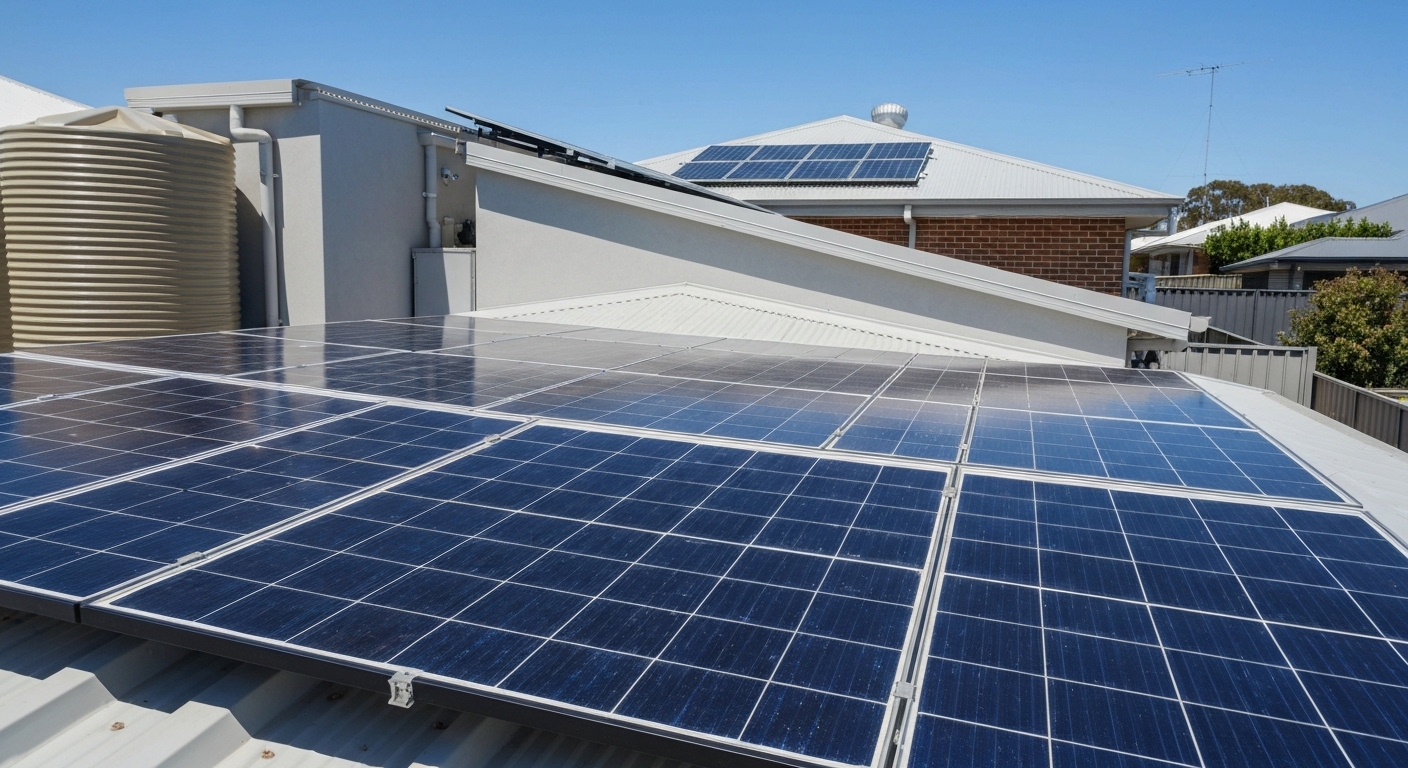
With water costs rising and environmental consciousness growing, many Australian homeowners ask a very practical question: “I’ve got a full rainwater tank — can I use it to clean my solar panels?”
The short answer is yes, in most cases — but there are important caveats about water quality that affect whether your rainwater will clean effectively or potentially make your panels dirtier.
Why Water Quality Matters for Solar Panel Cleaning
You’d be forgiven for thinking water is water. But the dissolved mineral content of your cleaning water directly affects the results.
When water evaporates off a surface, it leaves behind whatever was dissolved in it. Hard water — high in calcium and magnesium — leaves white mineral deposits (limescale) that:
- Reduce light transmission through the glass
- Create visible white streaks and spots
- Bond to the anti-reflective coating and become progressively harder to remove
This is why professional solar cleaners use deionised (DI) water — water that has had all dissolved minerals removed. It leaves zero residue when it evaporates.
Rainwater sits somewhere between tap water and deionised water on the mineral scale — and that’s why it’s potentially useful.
How Australian Tap Water Compares to Rainwater
Water hardness varies significantly across Australian cities:
| Location | Average TDS (ppm) | Hardness |
|---|---|---|
| Sydney | 70–120 ppm | Moderate |
| Melbourne | 20–50 ppm | Soft |
| Brisbane | 40–80 ppm | Moderate |
| Perth | 100–200 ppm | Hard |
| Adelaide | 200–400 ppm | Very hard |
| Darwin | 30–60 ppm | Soft |
Rainwater, before it contacts your roof, is essentially distilled — evaporated from the ocean and precipitated back with minimal mineral content. Freshly collected rainwater typically tests at 5–30 ppm TDS.
For solar panel cleaning, anything under 50 ppm is considered suitable for rinsing. This means clean rainwater is often better than tap water, particularly in hard water cities like Perth and Adelaide.
What Roof-Collected Rainwater Actually Contains
Here’s where it gets complicated. Rainwater collected from a standard residential roof passes over:
- Roof surface contaminants — dust, bird droppings, pollen, leaf matter
- Roofing material residue — galvanised iron roofing can leach zinc; older roofing materials may contain trace lead
- Gutters and tank — algae, sediment, organic matter, potential chemical contamination from firefighting retardants or nearby agriculture
By the time rainwater reaches your tank, it’s no longer 5–30 ppm. Tests of real Australian rainwater tank water typically show 30–150 ppm TDS, with wide variation depending on location, roof type, and tank maintenance.
How to Test Your Tank Water
Before using tank water for solar panel cleaning, invest $15–$20 in a TDS meter (available at hardware stores or online). These pen-shaped devices give an instant digital readout in parts per million.
Interpreting your results:
| TDS Reading | Suitability for Solar Cleaning |
|---|---|
| <30 ppm | Excellent — use freely |
| 30–50 ppm | Good — suitable for rinsing |
| 50–100 ppm | Marginal — use for washing but rinse with cleaner water if possible |
| 100–200 ppm | Poor — will leave spots, especially in summer heat |
| >200 ppm | Don’t use — high risk of significant mineral deposits |
Test from the tap/outlet of your tank, not the inlet. Sample on a day after the tank has been relatively still (not just after heavy rain stirred up sediment).
When Rainwater Tank Water Is Safe to Use
Your tank water is suitable for solar panel cleaning when:
- TDS reads under 50 ppm
- Water is clear with no visible discolouration
- No unusual smell (sulphur, chlorine, organic smell)
- Tank was last cleaned within 3–5 years
- Your roof is coated metal, tiles, or concrete (not galvanised iron)
- No recent firefighting activity in your area
When to Avoid Tank Water for Panel Cleaning
Do not use your tank water for solar panels if:
- TDS is above 100 ppm
- Water has algae growth (green tinge, sliminess)
- You can see sediment or turbidity
- Your roof is old galvanised iron or has recently been treated with moss killer or sealant
- Your tank hasn’t been cleaned in more than 5 years
- You’re in an area with aerial spraying for agriculture or fire suppression
How to Use Rainwater Tank Water Correctly
If your water tests clean, here’s how to use it effectively:
For Accessible Ground-Level or Low-Pitch Panels
- Fill a clean bucket with tank water
- Add one drop of mild dish soap per 4 litres if needed for stubborn grime
- Use a soft-bristle brush or microfibre cloth to wash
- Final rinse with clean tank water from the top of the panel downward
- Squeegee or allow to air-dry
For Roof-Level Panels (Garden Hose Method)
If using a garden hose connected to your tank:
- Use the lowest pressure setting — high pressure can force water under seals
- Never use a pressure washer connected directly to a rainwater tank (debris from tank can damage equipment and panels)
- Clean in early morning to avoid thermal shock and improve drying conditions
An Alternative: Improve Your Tank Water Quality
If your tank water is borderline (50–100 ppm), you can improve it for panel cleaning by:
Filtering: A simple carbon/sediment inline filter reduces TDS and removes organic matter. Basic units cost $30–$80 and connect to your tank outlet.
First-flush diverters: If not already installed, these divert the first 20–40 litres of rain (which carries roof contaminants) away from the tank. Dramatically improves collected water quality.
Tank maintenance: Annual inspection and 3–5 year physical cleaning of the tank interior removes sediment and eliminates biological growth that degrades water quality.
The Bottom Line
Clean rainwater tank water is often better than tap water for solar panel cleaning — especially if you’re in Perth, Adelaide, or other hard-water areas where tap water routinely exceeds 150–300 ppm.
Test your tank water with a TDS meter before your first use. Under 50 ppm and clear? You’ve got a free supply of quality cleaning water right on your property.
Just don’t assume rainwater is always clean. Untested tank water, particularly from poorly maintained systems or galvanised roofs, can actually add contaminants to your panels rather than removing them.
Test first, clean confidently.
Seasonal Considerations for Rainwater Tank Quality
Your tank’s water quality isn’t static — it shifts with the seasons. Understanding when to test (and when to be cautious) saves you from unknowingly depositing contaminants on your panels.
Summer (December–February): Bushfire and dust events significantly increase airborne particulate loads hitting your roof catchment area. After a smoke event or red dust storm, postpone solar panel cleaning from your tank for at least 2–3 good rainfall events to flush the worst contamination through your first-flush diverter. Test TDS before use.
Spring (September–November): High pollen loads from eucalypts and acacias accumulate on roofs. Pollen is organic and relatively benign in small quantities, but it can promote algae growth in tanks over summer if not flushed. Spring is a good time to inspect tank water clarity and test TDS before cleaning season.
Autumn (March–May): Best water quality period in most Australian climates — regular rain has flushed summer accumulations, lower temperatures slow biological growth. If you’re going to stock up on “known good” tank water for panel cleaning, harvest it in autumn.
Winter (June–August): Lower evaporation means less concentration of dissolved solids in the tank. However, cool damp conditions promote algae and bacterial growth in tanks that aren’t being turned over regularly. Check for cloudiness and smell if your tank has been relatively static.
What Happens When You Use High-TDS Water
Understanding the specific failure mode helps explain why water quality matters so much for panels specifically (vs. other surfaces like decking or concrete where you wouldn’t care).
When high-mineral water evaporates from solar glass in Australian summer heat:
- Water contacts glass at 50–70°C surface temperature — evaporation is near-instantaneous in the final rinse stage
- Dissolved minerals precipitate out of solution — calcium carbonate, magnesium sulphate, and sodium chloride crystallise on the glass surface
- Crystals are hydrophobic — they resist rewetting, which means they don’t wash off in the next rainfall
- Progressive accumulation — each clean adds another mineral layer if high-TDS water is used
The result is a whitish haze that’s visible from below on a clear day. Solar assessors call this secondary soiling — you’ve actually made the panels worse than before cleaning.
This is why Adelaide and Perth homeowners (where tap water often exceeds 200–300 ppm) either need to use deionised water or verify their tank water is significantly cleaner than the tap. In both cities, a well-maintained rainwater tank is typically the better choice — if it’s properly maintained and tested.
The Deionised Water Alternative
If your tank water consistently tests above 100 ppm — or you don’t have a rainwater tank — deionised (DI) water is the professional standard.
Options for accessing DI water:
- Buy a DI filter kit (inline hose filter): $50–$120 at solar cleaning suppliers. Connects to your tap or tank outlet. Reduces TDS to near-zero until the resin is exhausted (TDS meter confirms when replacement is needed).
- Purchase pre-filled DI water: Some solar cleaning supply companies sell DI water in 20-litre containers ($15–$30). Impractical for large systems but adequate for spot cleaning.
- Hire a professional who uses a water-fed pole DI system: costs $150–$350 for a standard clean but guarantees zero mineral residue.
For most Australian homeowners with a clean, well-maintained rainwater tank, DI water is an unnecessary expense. Test your tank first — you may already have water that’s cleaner than what many professionals carry on their vans.
Related: How to Clean Solar Panels Safely · Deionised Water for Solar Panels · Rain Harvesting Solar Panel Runoff
Frequently Asked Questions
Can I use rainwater from my tank to clean solar panels?
Generally yes, with some conditions. Rainwater is naturally soft (low in dissolved minerals) which makes it better than tap water in hard water areas. However, if your tank is contaminated, has algae growth, or your roof is galvanised iron, the water quality may be unsuitable for cleaning and could leave deposits.
Will rainwater tank water leave spots on solar panels?
Pure rainwater is very low in dissolved solids and shouldn’t leave significant spots. However, roof-collected rainwater picks up dust, bird droppings, leaf tannins, and sometimes trace metals from iron roofing. Test your tank water with a TDS meter — anything under 50 ppm is suitable for panel cleaning.
What TDS level is acceptable for cleaning solar panels?
Manufacturers and solar cleaning professionals generally recommend water with a Total Dissolved Solids (TDS) level under 50 ppm for final rinsing. Sydney tap water averages 70–120 ppm; Melbourne tap water 20–50 ppm. Rainwater is typically 5–30 ppm if collected cleanly.
What if my rainwater tank has algae or is contaminated?
Don’t use tank water that looks cloudy, smells unusual, or has visible algae growth for solar panel cleaning. Algae spores on panels can accelerate biological growth on glass surfaces, potentially making soiling worse. Have the tank cleaned and disinfected before using the water.
Should I use purified water or deionised water for solar panels?
Deionised (DI) water or reverse osmosis (RO) water is the gold standard for solar panel cleaning, leaving zero mineral residue. Professional solar cleaners use water-fed poles with DI water. For DIY use, clean rainwater is a good substitute in most cases.
Frequently Asked Questions
Generally yes, with some conditions. Rainwater is naturally soft (low in dissolved minerals) which makes it better than tap water in hard water areas. However, if your tank is contaminated, has algae growth, or your roof is galvanised iron, the water quality may be unsuitable for cleaning and could leave deposits.
Pure rainwater is very low in dissolved solids and shouldn't leave significant spots. However, roof-collected rainwater picks up dust, bird droppings, leaf tannins, and sometimes trace metals from iron roofing. Test your tank water with a TDS meter — anything under 50 ppm is suitable for panel cleaning.
Manufacturers and solar cleaning professionals generally recommend water with a Total Dissolved Solids (TDS) level under 50 ppm for final rinsing. Sydney tap water averages 70–120 ppm; Melbourne tap water 20–50 ppm. Rainwater is typically 5–30 ppm if collected cleanly.
Don't use tank water that looks cloudy, smells unusual, or has visible algae growth for solar panel cleaning. Algae spores on panels can accelerate biological growth on glass surfaces, potentially making soiling worse. Have the tank cleaned and disinfected before using the water.
Deionised (DI) water or reverse osmosis (RO) water is the gold standard for solar panel cleaning, leaving zero mineral residue. Professional solar cleaners use water-fed poles with DI water. For DIY use, clean rainwater is a good substitute in most cases.