Solar Panel Cleaning Perth — WA's Unique Dust Challenge
Perth has Australia's highest solar irradiance but also its toughest soiling conditions. Red dust, salt air, and extreme heat make regular cleaning essential for WA homeowners.
Perth is Australia’s solar capital by irradiance. The city receives more peak sun hours per year than any other Australian capital — averaging 5.5–6.0 peak sun hours daily, compared to Sydney’s 4.5–5.0. This means Perth solar systems generate more electricity per kilowatt installed than anywhere else in the country.
That high solar productivity makes the cost of soiling proportionally higher. When Perth panels are dirty, they’re losing output during the most productive hours of the most productive solar city in Australia. Regular cleaning isn’t optional here — it’s essential maintenance on a high-value asset.
Perth’s Unique Soiling Challenges
Perth faces a combination of soiling challenges that makes it one of the most demanding environments for solar panel maintenance in Australia:
1. Red Laterite Dust
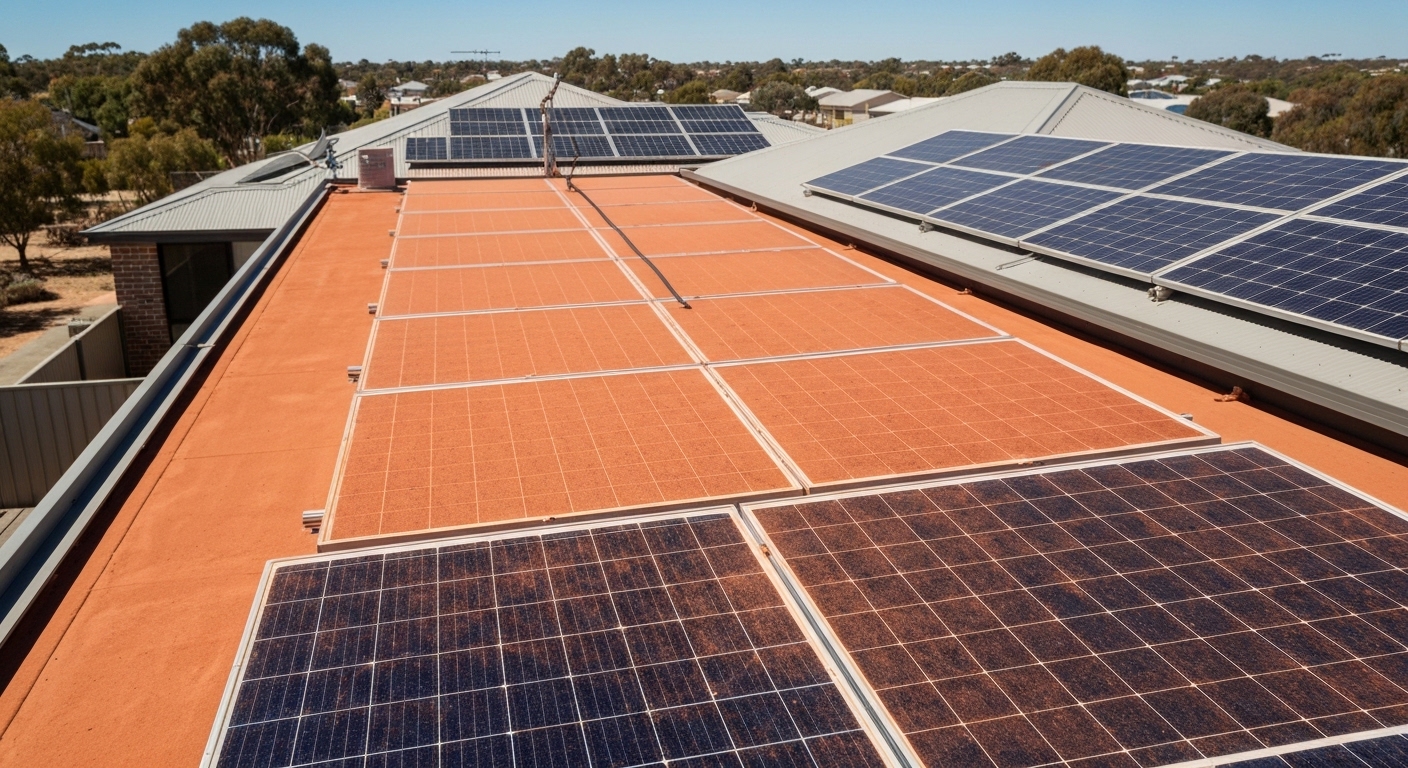
Western Australia’s distinctive red soil — laterite rich in iron oxide and clay minerals — is a constant presence in Perth’s air. During hot easterly wind events (a phenomenon locals call the “Fremantle Doctor in reverse”), red dust from the Darling Escarpment and the wheatbelt is carried into metro suburbs, coating every surface including solar panels.
This red dust is significantly more problematic than the lighter silica dust affecting eastern states because:
- Its clay fraction creates a sticky, hydrophilic film that bonds to glass
- Iron oxide particles are harder to dislodge than silica
- When wet by rain and then dried by Perth’s intense sun, it forms a near-cemented layer
- It cannot be fully removed by rainfall alone — mechanical agitation with soft brushes is required
2. Coastal Salt Spray
Approximately 40% of Perth’s population lives within 5 km of the Indian Ocean. Coastal properties from Two Rocks to Rockingham experience:
- Salt aerosol deposition year-round (strongest from October to April when sea breezes are most active)
- Salt combining with dust to create a particularly adhesive film
- Accelerated aluminium frame corrosion in first-row coastal properties
Salt spray deposits don’t just reduce panel output — they also accelerate degradation of panel frames, mounting hardware, and exposed wiring conduits if not regularly washed off.
3. Extreme Panel Surface Temperatures
Perth’s combination of high UV index (UV 14+ in summer) and low humidity produces panel surface temperatures regularly reaching 70–80°C in summer — among the highest recorded for Australian residential installations. These extreme temperatures:
- Bake soiling layers onto glass faster and more firmly than in cooler climates
- Create greater thermal stress on cell interconnects and encapsulant materials
- Make the timing of cleaning (early morning only) even more critical — see our thermal shock guide
4. Summer Drought Cycles
Perth averages only 50–60mm of rainfall in the November–March period — its driest season coinciding with its highest solar production period. Without regular rainfall to provide even partial cleaning, summer soiling accumulates unchecked during the months when panel output matters most.
Recommended Cleaning Schedule for Perth
| Location | Recommended Frequency |
|---|---|
| Inner metro (east of coast) | Twice yearly (Feb + Aug) |
| Coastal suburbs (within 5km of ocean) | Every 3–4 months |
| Northern suburbs (high construction) | Every 4 months |
| Hills suburbs (Kalamunda, Mundaring) | Once yearly + post-summer check |
| Regional WA (Bunbury, Geraldton, Kalgoorlie) | 3–4 times yearly |
| Pilbara / Kimberley (mining regions) | Monthly inspection, quarterly clean |
Perth Solar Panel Cleaning Costs (2026)
| System Size | Average Perth Metro Price | Notes |
|---|---|---|
| Small (up to 5 kW) | $150–$200 | Basic clean |
| Standard (6–8 kW) | $170–$270 | Clean + inspection |
| Large (9–13 kW) | $260–$380 | Full service |
| Commercial | $350–$700+ | Site-specific |
| Coastal surcharge | +$30–$60 | Salt spray treatment |
| Post-dust-storm emergency | +25–35% premium | Same-week availability |
Note: Outer Perth suburbs (Ellenbrook, Baldivis, Mandurah) typically attract a 10–20% travel premium over inner metro prices.
What Perth Cleaners Should Do Differently
Given Perth’s specific soiling profile, a quality cleaning service should:
-
Use a soft brush, not just water jets — Red laterite dust requires agitation to fully remove. Water-only systems (even deionised) will leave residual red film on Perth panels.
-
Check TDS before and after — Perth reticulated water has varying mineral content; a good operator confirms their output water is under 10 ppm TDS.
-
Treat frames with a light anti-corrosion rinse — especially for coastal properties. Some operators include a diluted frame treatment to slow salt-related aluminium oxidation.
-
Time the clean for early morning — Perth’s intense summer sun means a 9am start can mean panels are already too hot to safely clean with cool water. Good Perth operators start at 7am in summer.
-
Check for bird nesting — Perth has significant populations of rainbow lorikeets, red-tailed cockatoos, and galahs that nest under panels. A Perth clean should always include a subpanel inspection.
The Financial Cost of Perth Panel Neglect
Perth systems generate more electricity per kW than any other Australian capital. This means soiling losses are proportionally larger in dollar terms.
Example — 10 kW system in Balcatta:
- Clean system expected annual generation: ~16,500 kWh
- After 12 months without cleaning (red dust + salt + bird droppings): estimated 20% soiling loss
- Lost generation: 3,300 kWh
- Value at WA Synergy rates (25% self-use at $0.31 + 75% Synergy feed-in at $0.10): ~$495/year lost
Against a $270 professional clean cost, the annual ROI is 83%. No other investment in a Perth home delivers that kind of return.
Perth-Specific Maintenance Calendar
November–December: Pre-summer preparation. Clean before the worst dust season begins. Ensure all clips and bird mesh are secure before summer heat.
January–February: Peak soiling season. Don’t clean during the hottest part of summer heat (panels too hot by 8:30am). Wait for a cooler morning below 30°C ambient.
February–March: Post-dust-season clean. This is the most important clean of the year for most Perth homeowners — it removes the full summer accumulation.
April–May: Autumn inspection. Check for any biological growth beginning to establish as humidity (slightly) rises.
August–September: Pre-spring clean. Remove winter mineral deposits and prepare for the high-production spring period.
Conclusion
Perth’s solar conditions are the most productive and the most demanding in Australia. Red dust, coastal salt, extreme heat, and dry summers combine to create soiling conditions that require at least twice-yearly professional cleaning — and quarterly cleaning for coastal and high-soiling properties.
The ROI is clear: Perth systems lose more in soiling-related output than anywhere else in the country, and professional cleaning returns proportionally more value. Don’t let Perth’s premium solar resource be wasted on dirty panels.
Perth-Specific Soiling Calendar: When to Clean
Understanding Perth’s seasonal soiling pattern helps you book cleaning at the highest-value times:
November–January (Pre-summer / Peak Pollen): Spring pollen from native WA vegetation — banksias, grevilleas, acacias — deposits a sticky film on panels. Combined with the transition to hot dry summer conditions, this is when soiling accumulates fastest. Book a clean in late October/early November before the full heat sets in.
February–April (Post-summer / Dust Season): Perth’s dry summer ends with the last of the dust events. Panels have accumulated months of grime, salt, and pollen. A clean in March/April, timed after the last significant dust event, sets systems up for the peak autumn generation months with maximum efficiency.
May–August (Winter): Perth’s mild, wet winter does provide some natural cleaning from rain. However, winter also brings coastal fog that deposits salt film. Inspect panels in June — if you see visible streaking or salt haze, a clean in early July capitalises on cooler temperatures and maximises spring generation.
For coastal Perth (Cottesloe, Fremantle, Scarborough, Rockingham): Salt film accumulation requires a third annual clean if you’re within 2km of the coast. The salt aero-gel layer in these areas is invisible but measurable — coastal Perth panels typically test 20–30% higher soiling loss than inland suburbs at the same time of year.
Perth Water Quality and Solar Panel Cleaning
Perth tap water is among the hardest in Australia — typically 150–250 ppm TDS, primarily from calcium and magnesium from the Gnangara Mound aquifer and Southern River groundwater sources.
Using Perth tap water for solar panel cleaning without filtration will leave visible white mineral deposits within hours in summer heat. This is a primary reason to insist on deionised water for any professional clean in Perth, and to either filter your water or buy DI water for any DIY cleaning.
DIY DI option for Perth homeowners: A basic inline DI filter ($50–$100, available at solar cleaning suppliers or online) connected to your tap or garden hose output produces near-zero TDS water for panel rinsing. The resin is exhausted after approximately 300–500 litres — a TDS meter will confirm when replacement is needed (reading rises above 30 ppm).
Professional operators in Perth should be using DI systems as standard, not as a premium add-on. If a quote doesn’t mention water quality, ask specifically.
Related: Solar Panel Cleaning Cost Australia 2025 · Best Time to Clean Solar Panels · DIY Solar Panel Cleaning Risks
Frequently Asked Questions
How often should solar panels be cleaned in Perth?
Perth solar panels should be cleaned at least twice a year — in February/March after summer dust season and again in August before spring. Panels near coastal areas (Cottesloe, Fremantle, Rockingham) or in the outer northern suburbs may benefit from quarterly cleaning due to salt spray and construction dust.
How much does solar panel cleaning cost in Perth?
Professional solar panel cleaning in Perth costs $170–$270 for a standard 6.6 kW system in the metro area. Outer suburbs and regional WA attract higher prices due to travel costs. Most operators offer deionised water cleaning as standard.
Why is Perth worse for solar panel soiling than other Australian cities?
Perth has three unique challenges: red laterite dust from the Darling Escarpment carried into suburbs on easterly winds; coastal salt spray affecting properties within 5 km of the ocean; and extremely high panel surface temperatures (regularly 70–80°C in summer) that bake soiling onto glass more aggressively than in southern states.
Do Perth solar panels need cleaning more in summer or winter?
Summer (October–March) is Perth’s peak soiling season — strong hot easterly winds carry red dust from the interior, while high temperatures bake it onto glass. A clean in February–March captures the worst of summer soiling. Winter is WA’s rainy season and panels stay relatively cleaner, though coastal salt deposits continue year-round.
What’s the impact of red dust on Perth solar panels?
Perth’s distinctive red laterite dust has a high iron oxide and clay content that compacts and bonds to panel glass more stubbornly than the lighter silica dust affecting eastern states. Standard water alone is often insufficient; professional operators use soft brush agitation combined with deionised water to fully remove compacted red dust layers.
Frequently Asked Questions
Perth solar panels should be cleaned at least twice a year — in February/March after summer dust season and again in August before spring. Panels near coastal areas (Cottesloe, Fremantle, Rockingham) or in the outer northern suburbs may benefit from quarterly cleaning due to salt spray and construction dust.
Professional solar panel cleaning in Perth costs $170–$270 for a standard 6.6 kW system in the metro area. Outer suburbs and regional WA attract higher prices due to travel costs. Most operators offer deionised water cleaning as standard.
Perth has three unique challenges: red laterite dust from the Darling Escarpment carried into suburbs on easterly winds; coastal salt spray affecting properties within 5 km of the ocean; and extremely high panel surface temperatures (regularly 70–80°C in summer) that bake soiling onto glass more aggressively than in southern states.
Summer (October–March) is Perth's peak soiling season — strong hot easterly winds carry red dust from the interior, while high temperatures bake it onto glass. A clean in February–March captures the worst of summer soiling. Winter is WA's rainy season and panels stay relatively cleaner, though coastal salt deposits continue year-round.
Perth's distinctive red laterite dust has a high iron oxide and clay content that compacts and bonds to panel glass more stubbornly than the lighter silica dust affecting eastern states. Standard water alone is often insufficient; professional operators use soft brush agitation combined with deionised water to fully remove compacted red dust layers.