Solar Panel Cleaning Service vs DIY: Australian Guide 2024
Compare professional solar panel cleaning services vs DIY cleaning. Costs, safety, effectiveness, and when to hire a pro for your Australian solar system.
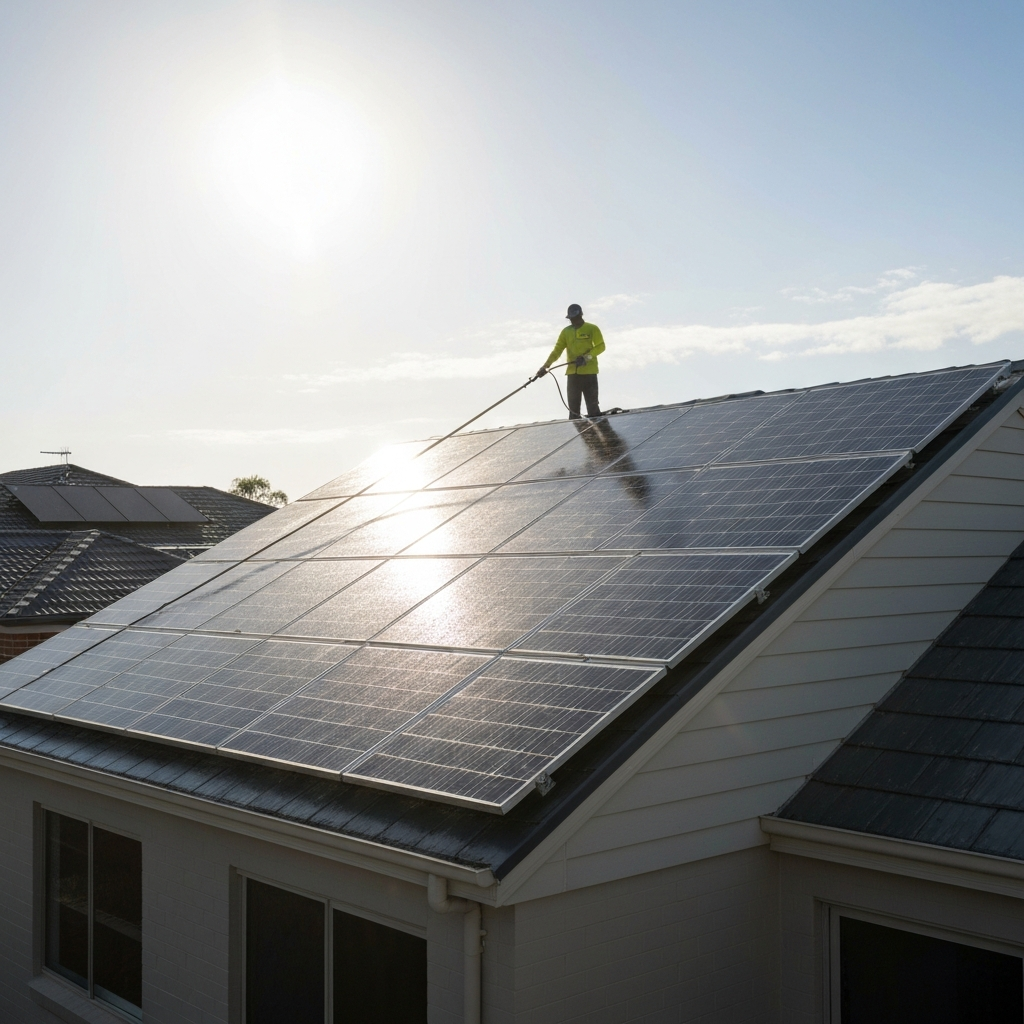
Your solar panels are covered in dust, bird droppings, and pollen. You’re losing energy production every day they stay dirty. Now you’re facing a choice: climb up yourself with a brush and bucket, or pay someone else to do it safely?
This decision isn’t just about saving money. It’s about safety, effectiveness, and protecting your $5,000–$15,000 solar investment.
Australian homeowners lose an average of 15–25% of their solar efficiency due to accumulated dirt and debris (Source: CSIRO, 2023). That’s roughly $200–$400 per year in lost electricity generation for a typical 6.6 kW system.
This guide breaks down exactly when professional solar panel cleaning services make financial sense, when DIY is appropriate, and what you’re really paying for with each option.
Understanding Professional Solar Panel Cleaning Services
Professional solar panel cleaning services in Australia typically charge $150–$400 per visit, depending on your system size, location, and roof accessibility. For detailed pricing breakdowns across different states, see our solar panel cleaning cost guide.
Here’s what you’re actually paying for:
Insurance and liability coverage. Licensed cleaners carry public liability insurance (typically $10–$20 million), protecting you if someone falls from your roof or damages your property. Your home insurance may not cover injuries to unlicensed workers or yourself during DIY cleaning.
Professional equipment. Commercial cleaners use purified water systems (deionised or reverse osmosis), professional-grade soft-bristle brushes, and water-fed poles that extend safely from the ground. This equipment costs $2,000–$8,000 to purchase outright.
Safety compliance. Professional services follow SafeWork Australia regulations, using proper fall protection harnesses, roof anchors, and trained spotters. According to SafeWork NSW, falls from roofs account for 23% of construction fatalities, and similar risks apply to residential roof work (Source: SafeWork NSW, 2024).
Efficiency restoration guarantee. Most reputable services guarantee visible improvement in panel cleanliness and provide before/after energy production comparisons. Many offer money-back guarantees if you don’t see measurable results.
Time savings. Professional teams clean a standard residential system (20–25 panels) in 45–90 minutes, including setup and safety checks. DIY cleaning typically takes 2–4 hours for inexperienced homeowners.
The best services also inspect your system during cleaning, identifying issues like:
- Cracked or damaged panels
- Loose mounting hardware
- Bird nesting underneath (which affects 18% of Queensland systems, according to local installers)
- Inverter faults or connection issues
- Warranty-voiding damage
In Brisbane, Sydney, and Melbourne particularly, professional cleaners often combine solar cleaning with gutter cleaning services, offering package discounts of 15–30%.
The Real Costs of DIY Solar Panel Cleaning
DIY solar panel cleaning looks cheaper on paper. You’ll spend $50–$150 on initial equipment and $5–$15 per cleaning session on water and supplies.
Here’s what you actually need:
Essential equipment:
- Extension pole with soft-bristle brush ($40–$120)
- Purified or deionised water ($8–$25 for 20 litres)
- Bucket or water container ($10–$30)
- Squeegee attachment (optional, $20–$40)
- Non-slip footwear ($60–$150)
Safety equipment (mandatory if accessing roof):
- Stable ladder rated for your weight ($150–$400)
- Safety harness and anchor point ($200–$600 if roof access required)
- Spotter (not a cost, but required for safety)
The upfront investment ranges from $100–$300 for ground-based cleaning, or $500–$1,500 if you need roof access equipment.
Hidden costs most people miss:
Water quality issues. Brisbane, Adelaide, and Perth have particularly hard tap water (150–300 ppm TDS). Using tap water leaves white calcium and mineral deposits that actually reduce panel efficiency by 3–8% (Source: University of Queensland Solar Research, 2023). You’ll need to purchase purified water or install a small deionisation system ($80–$200).
Time value. Four hours of your weekend time has economic value. If you earn $35/hour (approximately median Australian wage), your time cost is $140 per cleaning session — nearly matching professional service prices.
Injury risk. Approximately 6,000 Australians are hospitalised annually from ladder falls, according to the Australian Institute of Health and Welfare (Source: AIHW, 2023). Your out-of-pocket medical costs, even with Medicare, can reach $2,000–$15,000 for serious falls requiring surgery or extended recovery.
Warranty concerns. Some solar panel manufacturers void warranties if damage occurs during non-professional cleaning. Always check your warranty documentation before DIY cleaning. Sunpower, LG, and some Trina Solar warranties specifically mention this restriction.
Missed damage detection. You probably won’t notice hairline cracks, loose connections, or early signs of panel degradation. Professional cleaners identify these issues before they become expensive problems.
For a comprehensive DIY cleaning guide with proper techniques, see our complete DIY solar panel cleaning guide.
Safety Comparison: Professional Service vs DIY
This is where the cost comparison fundamentally changes.
Professional service safety standards:
- All work performed from ground level where possible
- Roof access only with proper fall protection equipment
- Two-person teams with trained spotters
- Compliance with AS/NZS 4536:2017 (working at heights standards)
- $10–$20 million public liability insurance
- Workers compensation coverage
DIY safety reality: Working at heights is the second-leading cause of workplace deaths in Australia (Source: Safe Work Australia, 2024). While you’re not technically “at work,” the physical risks are identical.
When DIY is relatively safe:
- Ground-mounted solar systems
- Single-storey homes with low-pitch roofs (<15° angle)
- Panels within 3 metres of ground level
- Stable, level ground for ladder placement
- Assistance from another adult present
- Cleaning performed from ladder or ground with extension tools — never walking on roof
When you must hire professionals:
- Two-storey homes or roofs above 4 metres
- Steep roofs (over 22.5° pitch)
- Tile or slate roofs (slippery when wet)
- Panels difficult to reach without roof walking
- Your age is over 65 or you have mobility issues
- Wet, windy, or storm conditions
- No suitable ladder anchor points
Perth, Adelaide, and Brisbane have particularly high rates of two-storey homes (42–48% of residential properties), making professional services more crucial in these markets (Source: ABS Housing Data, 2023).
The financial reality of falls: A fall from a standard single-storey roof (3–4 metres) causes serious injury in 62% of cases. Average hospital costs for fall injuries range from $8,000–$45,000. Lost work income during recovery averages $12,000–$35,000 for falls requiring 6–12 week recovery periods (Source: Monash University Accident Research Centre, 2023).
A $200 professional cleaning service starts looking very reasonable when compared to these potential costs.
Effectiveness: Which Method Cleans Better?
Professional solar panel cleaning services deliver measurably better results than most DIY efforts.
Cleaning effectiveness comparison:
Professional service results:
- 95–100% removal of dirt, dust, and debris
- Complete removal of bird droppings and tree sap
- Zero streaking or mineral deposits
- Typically restores 10–25% lost efficiency (Source: Solar Quotes Australia, 2024)
- Results last 6–12 months in urban areas
Typical DIY results:
- 70–90% removal of surface dirt
- Incomplete removal of stubborn deposits
- 15–30% chance of streaking from tap water use
- Restores 8–18% efficiency (depending on water quality and technique)
- Results last 4–10 months
Why professionals clean more effectively:
Water purity. Professional services use deionised or reverse osmosis water with TDS readings below 20 ppm. This water dries without leaving any mineral residue. Most DIY cleaners use tap water or rainwater, which leaves spots that actually reduce light transmission by 2–5%.
Proper technique. Trained cleaners understand optimal brush pressure, cleaning patterns that prevent streaking, and how to clean without damaging anti-reflective coatings. DIY cleaners often scrub too hard (causing microscopic scratches) or too gently (leaving residue).
Complete coverage. Professionals clean panel edges, frames, and underneath lip areas where debris accumulates. DIY cleaners typically focus only on visible glass surfaces, missing 10–15% of light-blocking material.
Panel-specific knowledge. Different panel types require different approaches. Monocrystalline, polycrystalline, and thin-film panels have varying surface treatments. PERC panels, common in newer installations, are particularly sensitive to abrasion.
The efficiency difference translates to real money. A 6.6 kW system in Sydney generating 24 kWh daily when clean might generate only 18–20 kWh when dirty. Professional cleaning restoring full efficiency saves approximately $180–$240 annually (at $0.28/kWh electricity rates). DIY cleaning that restores only 85% of potential saves roughly $140–$180 annually.
Over five years, the difference adds up to $200–$300 — enough to cover 1–2 additional professional cleans.
When DIY Makes Financial Sense
Despite the advantages of professional services, DIY solar panel cleaning is appropriate and cost-effective in specific situations.
DIY is your best option when:
Your system is easily accessible. Ground-mounted systems, carport installations, or single-storey homes with walk-out roof access make DIY safe and practical. Approximately 12% of Australian solar installations are ground-mounted, particularly in rural Queensland and New South Wales (Source: Clean Energy Regulator, 2024).
You have proper equipment already. If you already own extension cleaning tools, a quality ladder, and have access to purified water, your marginal cost per cleaning drops to nearly zero.
You clean frequently. If you live in high-dust areas (near unpaved roads, construction, or agricultural land) requiring quarterly cleaning, four annual DIY sessions at $15 each ($60 total) cost substantially less than four professional visits at $180 each ($720 total). The $660 annual savings justify the equipment investment and time.
Your system is small. Systems under 3 kW (8–10 panels) take 30–45 minutes to clean. The time investment is minimal and professional services often charge similar base rates regardless of size, making small systems less cost-effective to hire out.
You enjoy the task. Some homeowners value the hands-on maintenance aspect and take satisfaction in caring for their investment. If this describes you, and you can work safely, DIY adds lifestyle value beyond pure financial calculation.
Optimal DIY scenarios:
- Single-storey homes in Canberra, Hobart, or regional areas with lower electricity costs
- Ground-mounted systems anywhere in Australia
- Small installations (under 3 kW)
- Properties with easy roof access and gentle slopes
- Homeowners with physical capability and proper safety equipment
- Areas with soft water (Tasmania, parts of Victoria) reducing spotting issues
When Professional Service Is Worth Every Dollar
Professional solar panel cleaning services deliver the best return on investment in these situations:
Your roof is dangerous. Two-storey homes, steep pitches, metal roofs, or tile installations require professional equipment and training. The safety value alone justifies the $180–$250 typical cost.
You notice performance problems. If your monitoring shows unexpected production drops (15% or more compared to previous months with similar weather), professionals can diagnose whether cleaning will solve the issue or if equipment problems exist.
Bird problems are present. Bird droppings are highly acidic and damage panel surfaces if left too long. Professional cleaners properly remove droppings without spreading them or scratching panels. Many also offer bird proofing services to prevent future issues, particularly important in coastal areas and suburbs with large pigeon populations.
You’re preparing to sell. Clean solar panels improve home presentation and demonstrate proper maintenance to buyers. The $200–$300 spent on professional cleaning can add $1,000–$3,000 to perceived home value.
Your warranty requires it. Some premium solar installations include mandatory professional cleaning schedules as warranty conditions. Always check your warranty documentation.
Time is genuinely scarce. If your work schedule, family commitments, or other priorities make a weekend day worth more than the $180–$250 service cost, professional cleaning is simply the smarter economic choice.
Professional services provide best value in:
- Sydney, Melbourne, and Brisbane where two-storey homes dominate
- Coastal areas with salt spray buildup (Gold Coast, Sunshine Coast, Wollongong)
- High-bird-activity suburbs
- Properties with premium solar systems (SunPower, LG, REC panels) where damage risk isn’t worth taking
- Locations with hard water requiring specialised purification equipment
Making Your Decision: Service vs DIY
Here’s a practical framework for choosing the right approach for your situation.
Choose professional solar panel cleaning service if:
- Your roof height exceeds 4 metres or pitch exceeds 22.5°
- You’re over 65 or have any mobility limitations
- You don’t own proper safety equipment and purified water systems
- Your system shows production drops over 15%
- Bird nesting or heavy soiling is present
- Your time genuinely has higher-value alternative uses
- Your warranty requires professional maintenance
Choose DIY cleaning if:
- Your system is ground-mounted or easily accessible
- You have proper equipment and purified water access
- Your roof is single-storey with gentle pitch
- You’re physically capable and safety-aware
- You have a spotter available
- You understand proper cleaning technique
- You can work from ground level with extension tools
Hybrid approach (best for many homeowners): Many Australian homeowners use a combined strategy:
- Professional deep cleaning annually ($180–$250)
- DIY maintenance cleaning quarterly ($10–$15 each)
- Professional cleaning after major dust storms or bird activity
This approach costs approximately $220–$295 annually while maintaining peak efficiency year-round.
A Melbourne homeowner with a 6.6 kW system might spend $240 on one professional clean and $40 on three DIY maintenance cleans ($280 total annually). This recovers approximately $300–$400 in improved generation, delivering $20–$120 net annual benefit while maintaining optimal safety and equipment protection.
Location-Specific Considerations Across Australia
Your location significantly affects whether professional service or DIY makes more sense.
Queensland (Brisbane, Gold Coast, Sunshine Coast): High humidity and bird activity make professional cleaning particularly valuable. Bird droppings accumulate 40% faster in coastal Queensland than southern states (Source: Queensland Solar Industry Association, 2024). Mineral buildup from afternoon storm runoff requires purified water for proper cleaning.
New South Wales (Sydney, Newcastle, Wollongong): Sydney’s two-storey home prevalence (47% of residential properties) makes professional services essential for most homeowners. However, regional NSW properties with ground-mounted systems suit DIY approaches. Coastal areas face salt spray requiring quarterly attention.
Victoria (Melbourne, Geelong): Relatively soft water in Melbourne makes DIY more effective if you have safe access. However, pollen seasons (September–November) cause heavy soiling requiring thorough cleaning. Melbourne’s lower electricity costs ($0.24–$0.27/kWh) reduce financial urgency slightly compared to Sydney or Adelaide.
South Australia (Adelaide): Adelaide’s hard water (TDS 180–280 ppm) makes purified water absolutely essential. DIY cleaning with tap water often makes panels worse. Professional services deliver much better results. Hot, dry summers mean dust accumulation happens fast, particularly in northern suburbs.
Western Australia (Perth): Perth’s hard water (TDS 150–320 ppm depending on suburb) and fine red dust create challenging cleaning conditions. Professional services using proper water systems deliver substantially better results than DIY. However, Perth’s abundant sunshine means even dirty panels generate well, reducing financial urgency.
Tasmania (Hobart, Launceston): Tasmania’s soft water and lower bird activity make DIY highly effective. However, lichen and moss growth in damp conditions requires more aggressive cleaning than mainland locations. Professional services twice yearly work well for most Tasmanian installations.
Getting Maximum Value From Professional Services
If you’ve decided professional solar panel cleaning makes sense, here’s how to ensure you get the best results and pricing:
Get multiple quotes. Obtain 2–3 quotes from licensed, insured cleaners. Prices vary by $50–$150 for identical services. However, don’t choose purely on price — verify insurance coverage and cleaning method.
Bundle services. Many cleaners offer gutter cleaning, window cleaning, or pressure washing simultaneously. Package deals often save 15–30% compared to separate bookings.
Book during off-peak seasons. Demand drops in winter (June–August), particularly in southern states. Many services offer 10–20% winter discounts while cleaning effectiveness remains unchanged.
Join with neighbours. Some services discount 10–15% when cleaning multiple nearby properties in one visit, reducing travel time and equipment setup.
Schedule strategically. Book cleaning for late winter or early spring (August–September) to maximise summer generation when electricity value peaks. A second cleaning in late summer (February–March) captures maximum annual benefit.
Verify credentials before booking:
- Current public liability insurance ($10 million minimum)
- ABN and business registration
- Specific solar panel cleaning experience (not just general pressure washing)
- Understanding of different panel types and warranties
- Use of purified water systems
- Positive reviews on Google, Product Review, or True Local
Warning signs of poor-quality services:
- Prices well below market average (<$120 for standard systems)
- Pressure washing offers (high pressure damages solar panels)
- No mention of purified water use
- Unwillingness to provide insurance certificates
- No references or verifiable reviews
Frequently Asked Questions
Is professional solar panel cleaning worth it in Australia?
Yes, for most homeowners. Professional cleaners restore 10–25% lost efficiency, use purified water to prevent streaking, and carry full insurance. For a standard 6.6 kW system costing $180–$250 to clean, the service typically pays for itself within one billing cycle through improved solar generation.
How much does a solar panel cleaning service cost vs DIY?
Professional cleaning costs $150–$400 depending on system size and location. DIY cleaning costs $50–$150 for initial equipment (extension brush, purified water, safety gear), plus ongoing water costs of $5–$15 per clean. However, DIY doesn’t include insurance coverage or fall protection.
Can I damage my solar panels by cleaning them myself?
Yes. Using abrasive materials, high-pressure washers, or harsh chemicals can scratch protective coatings, crack cells, or void warranties. Walking on panels causes microcracks. Using tap water leaves mineral deposits. Professional cleaners use appropriate tools and techniques to prevent damage.
When should I hire a solar panel cleaning service instead of DIY?
Hire professionals if your roof is two-storey or steep (over 22.5°), panels are difficult to reach, you have mobility concerns, or you lack proper safety equipment. Also consider professionals if you notice bird nesting, heavy soiling, or significant efficiency drops requiring expert assessment.
How often should I use a professional solar panel cleaning service?
Most Australian homes benefit from professional cleaning once annually, with DIY maintenance cleaning quarterly between professional visits. Properties near dust sources, construction, agricultural areas, or with heavy bird activity may need professional cleaning every 6 months. Coastal properties facing salt spray benefit from more frequent attention.
Do professional cleaners guarantee their results?
Reputable services typically guarantee visible improvement in panel cleanliness. Many provide before/after photos and some offer energy production monitoring assistance. Most will return free-of-charge if you’re unsatisfied with results, though specific guarantees vary by company. Always clarify guarantee terms before booking.
Can I clean just some panels myself and hire professionals for difficult areas?
Yes. This hybrid approach makes excellent sense for properties with mixed accessibility. Clean easily-reached ground-level or low-roof panels yourself using proper technique and equipment, while hiring professionals annually for high or difficult sections. This balances safety, cost, and effectiveness.
Conclusion: The Verdict for Australian Homeowners
For most Australian solar owners, a hybrid approach delivers the best balance of safety, effectiveness, and value:
Optimal strategy for typical installations:
- Professional deep cleaning annually ($180–$250)
- DIY maintenance cleaning 2–3 times between professional visits ($30–$45 total)
- Total annual cost: $210–$295
- Recovered generation value: $300–$450
- Net annual benefit: $90–$240
Professional solar panel cleaning services deliver superior safety, better cleaning results, and valuable system inspection. DIY cleaning reduces costs for straightforward situations while maintaining adequate panel performance.
The wrong choice isn’t between professional or DIY — it’s ignoring cleaning altogether. Dirty panels cost you money every single day, with Australian systems losing $15–$35 monthly in generation value when soiled (Source: Solar Analytics, 2024).
Your roof height, physical capability, time value, and local conditions determine which approach makes most sense. However, when in doubt, professional services almost always deliver better risk-adjusted returns than DIY attempts on difficult-to-access installations.
Sources
- Clean Energy Council — Australian solar industry standards and guidelines
- CSIRO Solar Research — Solar panel efficiency and maintenance studies
- SafeWork Australia — Working at heights safety regulations and fall statistics
- Australian Institute of Health and Welfare — Hospital admissions and injury data
- Clean Energy Regulator — Australian solar installation statistics
- Solar Quotes Australia — Consumer solar panel information and efficiency data
Frequently Asked Questions
Yes, for most homeowners. Professional cleaners restore 10–25% lost efficiency, use purified water to prevent streaking, and carry full insurance. For a standard 6.6 kW system costing $180–$250 to clean, the service typically pays for itself within one billing cycle through improved solar generation.
Professional cleaning costs $150–$400 depending on system size and location. DIY cleaning costs $50–$150 for initial equipment (extension brush, purified water, safety gear), plus ongoing water costs of $5–$15 per clean. However, DIY doesn't include insurance coverage or fall protection.
Yes. Using abrasive materials, high-pressure washers, or harsh chemicals can scratch protective coatings, crack cells, or void warranties. Walking on panels causes microcracks. Using tap water leaves mineral deposits. Professional cleaners use appropriate tools and techniques to prevent damage.
Hire professionals if your roof is two-storey or steep (over 22.5°), panels are difficult to reach, you have mobility concerns, or you lack proper safety equipment. Also consider professionals if you notice bird nesting, heavy soiling, or significant efficiency drops requiring expert assessment.