Solar Panel Cleaning vs Replacement: Worth It in 2024?
Is cleaning your solar panels worth it, or should you replace them? Compare costs, efficiency gains, and ROI to make the right choice for your Australian system.
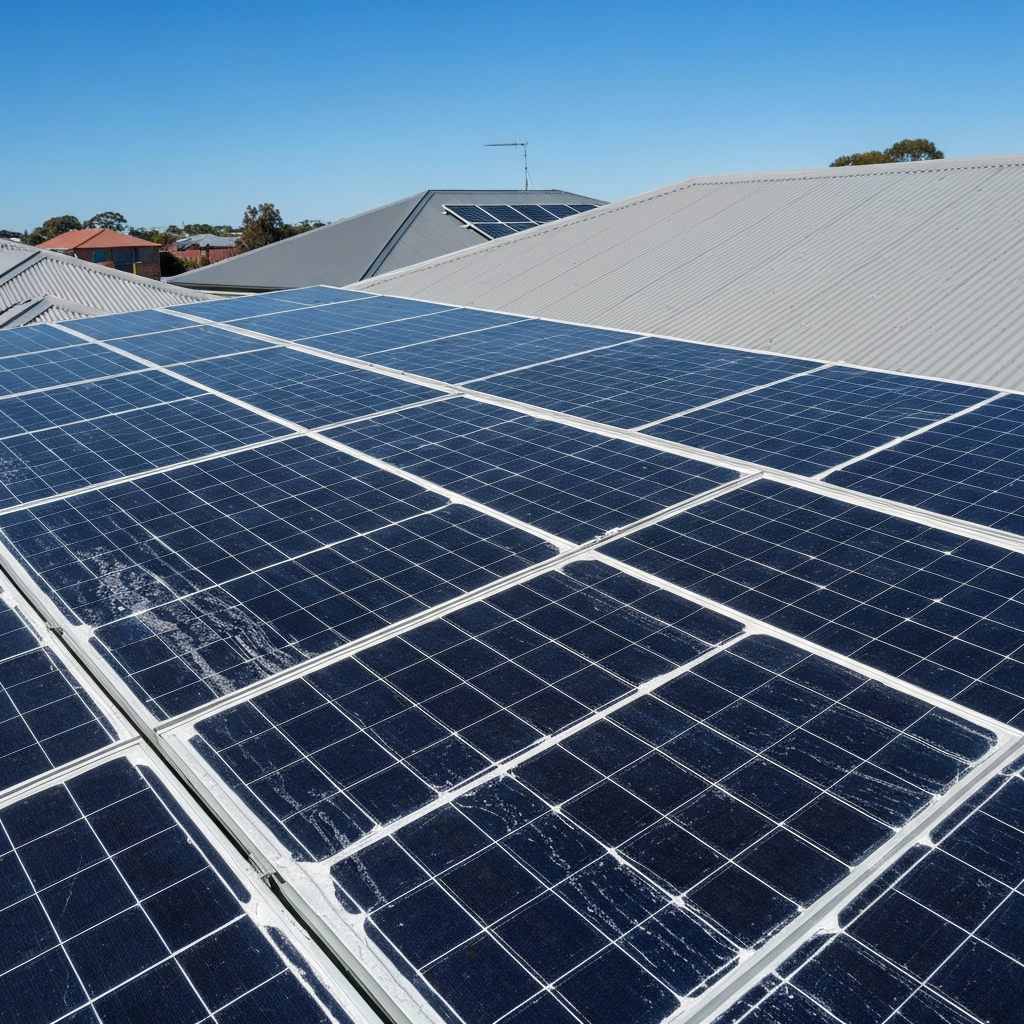
Your solar panels are producing less power than they should. The question keeping many Australian homeowners awake: is it worth paying for cleaning, or should you just replace them?
The answer depends on your panel age, current condition, and local environmental factors. This guide breaks down the real costs, efficiency gains, and return on investment for both options so you can make an informed decision.
The Real Cost of Dirty Solar Panels in Australia
Dirty solar panels aren’t just unsightly — they’re costing you money every single day.
Research from the Australian PV Institute shows that typical residential systems lose 15-25% of their generating capacity due to dust, bird droppings, pollen, and pollution buildup (Source: Australian PV Institute, 2024). In regional areas with limited rainfall, that figure climbs to 30-35%.
For a standard 6.6 kW system in Brisbane producing 26 kWh per day, a 20% efficiency loss means you’re losing approximately 5.2 kWh daily. At current electricity rates of $0.30 per kWh, that’s $1.56 per day or roughly $570 annually in lost production value.
Common contaminants affecting Australian solar panels:
- Red dust and clay particles (particularly in Queensland and Northern Territory)
- Coastal salt spray (Sydney, Melbourne, Perth coastal suburbs)
- Bird droppings and nesting debris
- Tree sap and pollen (especially during spring)
- Industrial pollution and bushfire smoke residue
- Lichen and moss in humid climates
The buildup happens gradually, so most homeowners don’t notice the decline until they check their monitoring app or receive an unusually high electricity bill.
Solar Panel Cleaning Costs vs Efficiency Gains
Professional solar panel cleaning in Australia typically costs $150-$400 for a standard residential system, depending on your location, roof accessibility, and system size.
Here’s what you’re actually paying for:
Standard 6.6 kW system (20 panels):
- Ground-level or single-storey: $150-$220
- Two-storey or steep roof: $250-$350
- Difficult access or heavily soiled: $300-$400
Most professional cleaners use purified water and soft-bristle brushes to avoid scratching the anti-reflective coating on your panels. The entire process takes 45-90 minutes, and you’ll typically see efficiency improvements immediately.
Efficiency recovery after cleaning:
Systems cleaned professionally in Australian conditions typically recover 18-23% of lost output. That means if your dirty panels were producing 20 kWh daily instead of their rated 26 kWh, cleaning should bring them back to 24-25 kWh.
At $0.30 per kWh, recovering 5 kWh daily equals $1.50 per day or approximately $548 annually. Your $200 cleaning investment pays for itself in roughly 5 months.
For detailed pricing across different states and system sizes, check our complete guide on solar panel cleaning costs.
When Cleaning Makes Financial Sense
Cleaning is the obvious choice when your panels are:
Less than 10 years old — Modern panels from reputable manufacturers should still be operating at 90-95% of their original capacity at this age. Any performance drop is almost certainly due to surface contamination, not degradation.
Showing no physical damage — If your panels have intact glass, no visible cracks, delamination, or burn marks, cleaning will restore most of their lost efficiency.
Located in high-soiling environments — Properties near unsealed roads, construction sites, agricultural areas, or flight paths accumulate dirt faster. Regular cleaning (2-3 times annually) maintains optimal output.
Still under warranty — If your system is within its 10-year product warranty period, cleaning maintains your warranty validity while replacement would restart the clock with new costs.
Consider this real example from a Penrith homeowner with a 5 kW system installed in 2020:
- Annual production before cleaning: 6,200 kWh
- Annual production after cleaning: 7,450 kWh
- Efficiency gain: 20%
- Additional annual value: $375
- Professional cleaning cost: $180
- Payback period: 7 months
The numbers become even more compelling if you’re in a high-feed-in-tariff area or using most of your solar production during peak electricity rate periods.
If you’re considering doing it yourself to save money, read about DIY solar panel cleaning risks before you climb on your roof.
Solar Panel Replacement Costs in Australia
Replacing your entire solar system is a significant investment, but it might make sense if your panels are genuinely failing.
Current replacement costs (2024):
- 6.6 kW quality system: $4,500-$7,500 installed
- 8.8 kW system: $6,000-$9,500 installed
- 10 kW system: $7,500-$11,500 installed
These prices include panels, inverter, installation, and electrical certification. You might save 10-15% by keeping your existing inverter if it’s under 5 years old and compatible with new panels.
When replacement makes financial sense:
Your panels are over 15-20 years old and producing <70% of their original rated output even when clean. Modern panels are 15-20% more efficient than systems from 2005-2010, so replacement delivers genuine performance gains.
You’re experiencing physical degradation — visible cracks, discolouration, delamination where the layers separate, or “snail trails” (brown lines indicating moisture ingress). These issues won’t improve with cleaning.
Your system uses outdated technology like 250W panels with micro-inverters that are failing. Replacing with modern 400-450W panels and a quality string inverter improves reliability and production.
You’re planning to add battery storage or increase system size. Upgrading panels simultaneously makes installation more cost-effective than doing it separately later.
Example replacement scenario:
A Canberra property installed a 3 kW system in 2008 with 250W panels. The system now produces just 2.1 kW at peak (70% of original), even after professional cleaning showed minimal contamination.
Replacement with a modern 6.6 kW system costing $5,800 would:
- Increase daily production from 8 kWh to 26 kWh
- Add $1,970 in annual electricity savings (at $0.30/kWh)
- Qualify for STCs (Small-scale Technology Certificates) reducing upfront cost by approximately $1,800
- Pay for itself in 2-3 years
The key difference: this is degradation-related underperformance, not soiling. Cleaning won’t fix it.
Calculating Your Return on Investment
Making the right choice requires honest assessment of your current system’s condition and potential gains from each option.
Step 1: Determine your actual output loss
Check your monitoring system or have a professional assess whether your underperformance is due to dirt or degradation. A clean panel test (measuring output immediately after cleaning one panel vs an untouched panel) reveals the truth.
If cleaning one panel improves output by 15% or more, soiling is your problem. If improvement is <5%, you’re likely dealing with panel degradation.
Step 2: Calculate cleaning ROI
Use this formula: (Annual production increase in kWh × electricity rate) ÷ cleaning cost = payback period in years
For most Australian systems, professional cleaning pays for itself in 4-8 months when panels have moderate to heavy soiling.
Step 3: Calculate replacement ROI
(Net replacement cost after rebates) ÷ (annual production increase in kWh × electricity rate) = payback period in years
Replacement typically pays for itself in 3-6 years if your system is genuinely degraded and you’re upgrading to significantly larger capacity.
Real scenario comparison — Adelaide home with 5 kW system from 2012:
Current production: 16 kWh daily (should be 20 kWh for age)
Option A: Professional cleaning ($220)
- Expected recovery: 3 kWh daily
- Annual value: $329
- Payback: 10 months
- Total benefit over next 5 years: $1,425
Option B: Replace with 6.6 kW system ($5,200 after STCs)
- Production increase: 10 kWh daily (from 16 to 26 kWh)
- Annual value: $1,095
- Payback: 4.7 years
- Total benefit over next 5 years: $3,275 (minus initial investment = net loss initially, benefit long-term)
In this case, cleaning makes sense as an immediate action, while budgeting for replacement in 2-3 years when the panels reach 15 years of age.
How Australian Climate Affects This Decision
Your location significantly impacts both cleaning frequency needs and panel degradation rates.
High-soiling environments requiring frequent cleaning:
Western Sydney, Penrith, and areas near the Blue Mountains accumulate red dust rapidly. Properties here benefit from cleaning 2-3 times annually, with each cleaning recovering 20-30% efficiency.
Coastal areas (Gold Coast, Perth northern beaches, Adelaide coastal suburbs) suffer from salt spray buildup. Salt is hygroscopic — it attracts moisture — causing accelerated soiling and potential long-term corrosion issues.
Regional Queensland and Northern Territory locations near unsealed roads or agricultural operations may need quarterly cleaning during dry seasons.
Low-soiling environments:
Inner Melbourne and Hobart with frequent rainfall naturally rinse panels. Annual cleaning is usually sufficient unless panels are shaded by trees that drop sap or attract birds.
Climate-related degradation:
Tropical Queensland systems experience faster degradation from heat and humidity. Panels rated for 0.5% annual degradation might decline 0.7-0.8% annually in Cairns or Darwin.
Coastal salt exposure accelerates junction box corrosion and frame oxidation, particularly on aluminium-framed panels. Systems over 12 years old in these areas warrant closer inspection.
Bushfire-affected regions (Blue Mountains, Adelaide Hills, Perth Hills) accumulate ash and particulate matter that’s highly abrasive. Professional cleaning is essential — DIY attempts often scratch panels.
Understanding how often to clean solar panels in your specific climate helps you budget accurately for maintenance.
Warning Signs Your Panels Need More Than Cleaning
Sometimes the problem isn’t dirt — it’s damage or degradation that cleaning can’t fix.
Physical damage indicators:
Micro-cracks — Small hairline fractures in cells, often only visible in direct sunlight at certain angles. They cause progressive performance loss and can’t be repaired.
Hot spots — Areas that heat excessively due to cell failure or shading. These appear as dark patches on thermal imaging and indicate permanent damage.
Delamination — Separation of the protective layers, appearing as bubbling or cloudiness inside the panel. This allows moisture ingress and accelerates degradation.
Burn marks — Brown or black discolouration around cells or junction boxes, indicating electrical faults or past overheating events.
Performance indicators:
Individual panel output varies by more than 10% between panels in the same conditions (check your monitoring system if you have panel-level monitoring).
Your system produces <75% of expected output even immediately after professional cleaning on a clear day.
Inverter repeatedly shows error codes or shuts down during peak production hours.
Output has declined steadily over the past 2-3 years despite regular cleaning.
When to get a professional assessment:
If you notice any physical damage or your cleaned system still underperforms by more than 15%, have a qualified solar electrician conduct a full system assessment before making any decisions.
They’ll use thermal imaging, I-V curve testing, and individual panel output measurements to identify whether you need replacement, repair, or just better cleaning.
Many solar companies in Australia offer free system health checks, particularly if you’re considering upgrading with them.
The Middle Ground: Targeted Panel Replacement
You don’t always need to replace your entire system. Sometimes targeted replacement of failing panels makes financial sense.
When partial replacement works:
Your monitoring shows 2-3 panels significantly underperforming while others remain healthy. Replacing just the failing panels costs $200-$400 per panel installed, far less than full system replacement.
Storm damage or falling branches have cracked specific panels. Insurance often covers this, making partial replacement cost-effective.
Your panels are still good, but your inverter is failing. Replacing just the inverter ($1,200-$2,500) extends your system life by 10+ years.
Compatibility considerations:
New panels must match the electrical characteristics (voltage and current) of your existing panels to avoid mismatch losses. Your installer can identify compatible options.
Panel sizes have increased — modern panels are physically larger. Verify your roof can accommodate replacement panels in the same mounting positions.
Mixing different panel ages on the same string (series connection) can reduce overall system performance. Your installer might recommend rewiring panels into separate strings if doing partial replacement.
Making Your Decision: A Practical Framework
Here’s a straightforward decision tree based on Australian solar industry standards:
If your system is 0-7 years old: Clean it. Unless you have visible physical damage, cleaning will restore performance. Replacement makes no financial sense.
If your system is 8-12 years old: Clean it first, then measure improvement. If you gain back >15% efficiency, continue regular cleaning. If improvement is <5%, start budgeting for replacement in the next 2-3 years.
If your system is 13-18 years old: Assess degradation rate. If you’re still getting >80% of original output when clean, continue cleaning and plan replacement in 2-5 years. If output is <75% when clean, replacement now likely offers better ROI.
If your system is 19+ years old: Replace it. Even if panels are still functioning, they’re operating well below modern efficiency standards. The production increase from new panels typically justifies replacement costs.
Special circumstances:
You’re planning to add battery storage within 12 months — consider replacing panels simultaneously to optimise the entire system.
You’re selling your property — professional cleaning ($200) adds more perceived value than the cost, while replacement ($6,000+) rarely increases sale price enough to justify the expense.
You’re experiencing frequent soiling — invest in bird proofing if birds are nesting under panels, or consider automated cleaning systems if you’re in extreme soiling environments.
Long-Term Maintenance Strategy
The most cost-effective approach combines regular cleaning with strategic replacement planning.
Years 1-10: Professional cleaning annually (or 6-monthly in high-soiling areas). Budget $150-$250 per year. Monitor production monthly to establish your baseline performance.
Years 10-15: Increase monitoring frequency to monthly. Schedule professional assessment every 2-3 years to track degradation rates. Continue regular cleaning while starting to research replacement options and pricing.
Years 15-20: Assess replacement timing based on production data, electricity costs, and available rebates. Clean panels 6 months before considering replacement to eliminate soiling as a variable in your measurements.
Years 20+: Plan for replacement. Modern systems will produce 40-60% more power per panel and qualify for government rebates. The improvement justifies investment.
Record keeping matters:
Maintain a log of cleaning dates and production before/after each cleaning. This data helps you optimise cleaning frequency and proves valuable if warranty claims arise.
Document any repairs, assessments, or unusual events (hailstorms, nearby bushfires, etc.) that might affect panel condition.
Keep your original system specifications and installation documents — you’ll need these when planning replacements or selling your property.
Frequently Asked Questions
How much efficiency do dirty solar panels lose in Australia?
Dirty solar panels in Australian conditions typically lose 15-25% of their output capacity. In dusty regional areas like Western Sydney or mining regions in Western Australia, losses can reach 30-35% during prolonged dry periods. Regular cleaning restores most of this lost capacity within hours.
When should I replace solar panels instead of cleaning them?
Replace panels when they’re over 15-20 years old with visible degradation (cracks, delamination, burn marks), producing <70% of original output even when clean, or when cleaning costs would exceed 40% of replacement value over the remaining lifespan. Otherwise, cleaning is more cost-effective.
Does cleaning solar panels void the warranty?
Professional cleaning using approved methods won’t void your warranty. DIY cleaning can void warranties if you use abrasive materials, high-pressure washers, or cause damage. Always check your manufacturer’s guidelines before cleaning or hire certified professionals.
How long do solar panels last in Australia?
Quality solar panels last 25-30 years in Australian conditions, though efficiency gradually declines by 0.5-0.8% annually. Panels in harsh coastal or tropical environments may degrade slightly faster. Most manufacturers offer 25-year performance warranties guaranteeing 80-85% output.
Can I claim solar panel cleaning on insurance?
Standard home insurance doesn’t cover routine maintenance like cleaning. However, if storm damage or falling debris requires both cleaning and repairs, the repair costs (including necessary cleaning) are usually covered under building insurance. Check your specific policy details.
Is solar panel cleaning tax deductible?
For residential properties, cleaning is considered routine maintenance and isn’t tax deductible. For rental investment properties or business premises, solar panel cleaning is deductible as a maintenance expense. Keep receipts and consult your accountant for specific advice.
Sources
- Australian PV Institute — Solar panel performance and degradation research in Australian climates
- Clean Energy Council — Solar system standards, installer accreditation, and consumer guidelines
- Solar Choice — Solar panel pricing data and market analysis for Australian systems
- Bureau of Meteorology — Climate data affecting solar panel soiling rates across Australian regions
Frequently Asked Questions
Dirty solar panels in Australian conditions typically lose 15-25% of their output capacity. In dusty regional areas like Western Sydney or mining regions in Western Australia, losses can reach 30-35% during prolonged dry periods. Regular cleaning restores most of this lost capacity within hours.
Replace panels when they're over 15-20 years old with visible degradation (cracks, delamination, burn marks), producing <70% of original output even when clean, or when cleaning costs would exceed 40% of replacement value over the remaining lifespan. Otherwise, cleaning is more cost-effective.
Professional cleaning using approved methods won't void your warranty. DIY cleaning can void warranties if you use abrasive materials, high-pressure washers, or cause damage. Always check your manufacturer's guidelines before cleaning or hire certified professionals.
Quality solar panels last 25-30 years in Australian conditions, though efficiency gradually declines by 0.5-0.8% annually. Panels in harsh coastal or tropical environments may degrade slightly faster. Most manufacturers offer 25-year performance warranties guaranteeing 80-85% output.