Deionised Water for Solar Panels: Why It Matters and Where to Get It in Australia
Why purified and deionised water is the professional standard for solar panel cleaning in Australia — and your practical options for getting it without spending a fortune.
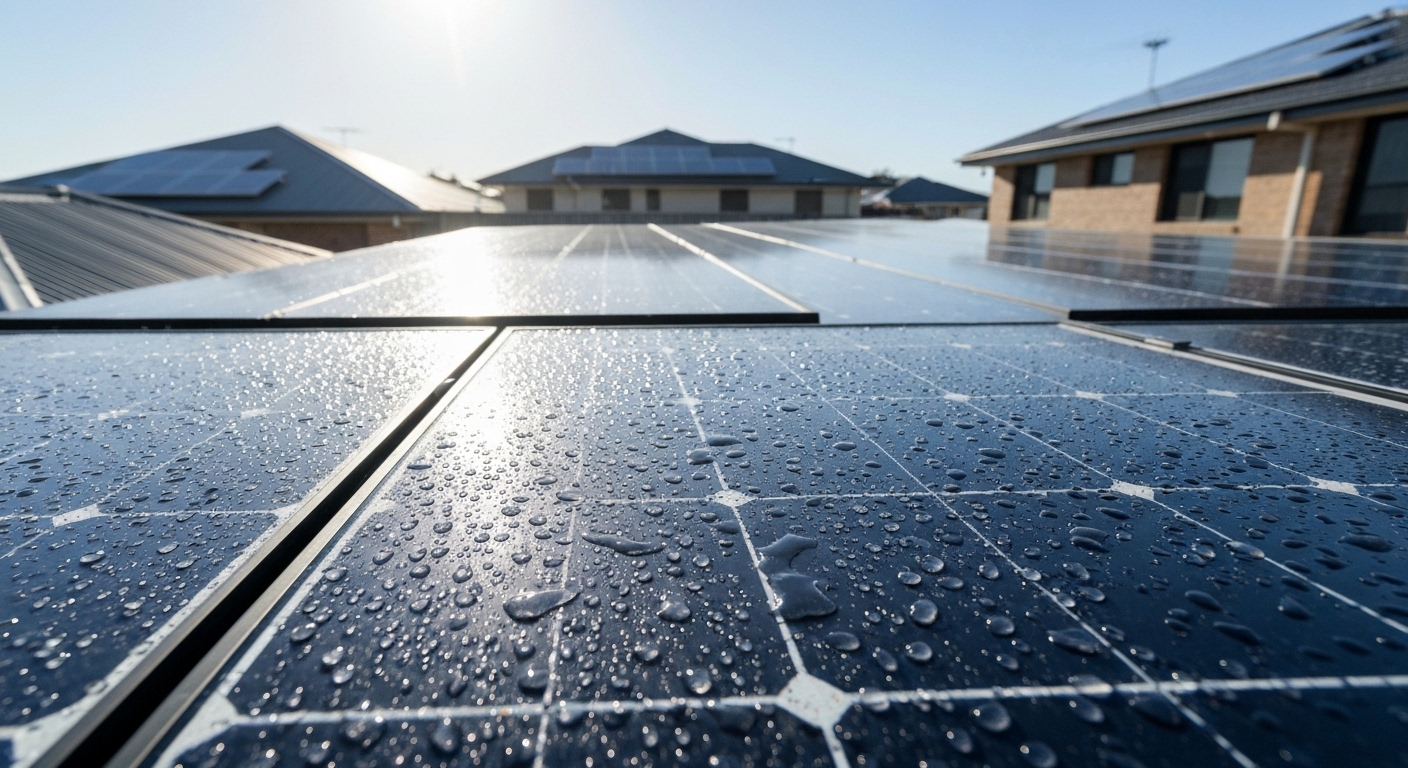
Ask any professional solar panel cleaner what single thing separates a good result from a mediocre one, and the answer is almost always the same: the water.
You can use the right brush, the right technique, and the right time of day — and still leave your panels covered in white mineral haze if you use tap water. That haze doesn’t just look bad. It measurably reduces panel efficiency, and it accumulates with every successive tap-water cleaning.
Using deionised water for solar panels is the professional standard throughout Australia — and it’s easier and more affordable to obtain than most homeowners realise. This guide explains the chemistry behind why water quality matters for solar panel cleaning, gives you the Australian tap water context, and runs through every practical option for getting deionised water without overcomplicating it.
Why Deionised Water Is Essential for Solar Panel Cleaning
Tap water contains dissolved minerals — predominantly calcium carbonate, magnesium sulphate, sodium chloride, and silica, in varying quantities depending on your water source and treatment system. These are measured as Total Dissolved Solids (TDS) in parts per million (ppm).
When water evaporates from a warm panel surface (which happens quickly on an Australian day), these minerals are left behind as a crystalline residue — the white spots you see on windows left to air-dry. On solar panels, deionised water eliminates this problem entirely because it contains virtually no minerals to leave behind.
The Clean Energy Council’s maintenance guidelines note that water quality is a critical factor in professional solar panel cleaning, with purified water recommended for optimal results.
1. Optical Efficiency Loss from Mineral Deposits
The white mineral deposits scatter and reflect incoming light, reducing the amount of photons that reach the solar cells below. Studies by CSIRO’s renewable energy division show that heavy mineral spotting can reduce panel output by 2–5% on its own — on top of any soiling that prompted the cleaning in the first place.
2. Compounding Effect of Repeated Tap Water Use
Each successive cleaning with tap water adds another mineral layer. A panel that has been “cleaned” with tap water ten times over five years may have a significant mineral crust that actually makes it harder to clean properly — and requires professional-grade treatment to remove.
3. Glass Coating Degradation
Modern solar panels use an anti-reflective (AR) glass coating that is mildly porous at the nano-scale. Minerals deposited in this coating can be difficult to fully remove and, over time, can alter the optical properties of the glass surface. Research from the Australian PV Institute indicates that mineral build-up on AR coatings can create permanent optical degradation if left untreated.
Understanding TDS Levels: What You Need to Know
Professional standard: Below 10–20 ppm TDS for final rinse water when using deionised water.
At this level, water dries clean — no visible residue under normal conditions. This is what deionised water achieves and why it’s the gold standard for solar panel cleaning.
Acceptable for low-risk use: 50 ppm or below, IF panels are squeegeed dry immediately after rinsing (don’t let it air-dry).
Problematic: Above 100 ppm without squeegee — visible spotting in warm-weather conditions.
Severely problematic: Above 200 ppm — guaranteed mineral deposits even with careful technique.
Australian Tap Water: TDS by City and Region
Understanding your local water quality helps you choose the right deionised water solution for solar panel cleaning.
| City | Typical TDS Range (ppm) | Risk Level | Deionised Water Recommendation |
|---|---|---|---|
| Melbourne | 25–65 | Low | Optional but recommended for best results |
| Hobart | 20–50 | Low | Optional but recommended for best results |
| Darwin | 30–80 | Moderate | Recommended |
| Sydney | 80–120 | Moderate | Strongly recommended |
| Canberra | 60–100 | Moderate | Strongly recommended |
| Brisbane | 50–120 | Moderate | Strongly recommended |
| Perth | 120–220 | High | Essential — visible spotting likely without DI water |
| Adelaide | 150–400 | High | Essential — deionised water strongly recommended |
> Adelaide’s water supply, sourced from the Murray-Darling basin, has naturally high mineral content. Adelaide homeowners cleaning with tap water can develop visible white haze on panels after just 1–2 cleanings. Deionised water is particularly important in South Australia.
According to data from the Bureau of Meteorology’s water quality monitoring program, Australian capital cities show significant variation in TDS levels, with Adelaide and Perth consistently recording the highest mineral content.
Where to Get Deionised Water: Six Practical Options
Option 1: Inline Deionisation (DI) Filter — Best for Most Homeowners
A DI filter is a small inline unit that connects between your garden tap and hose. It contains ion-exchange resin that removes minerals as water passes through it, reducing TDS from whatever your tap produces to near-zero.
How it works: As water passes through the resin, calcium, magnesium, and other positive ions are exchanged for hydrogen ions; negative ions are exchanged for hydroxide. The result is very pure deionised water (H₂O + trace ions).
Products available in Australia:
- Unger nLite DI Filter Kit — ~$60–$80 (includes cartridge)
- RHG DI Filter — ~$50–$70
- Various imported units on eBay/Amazon AU — $30–$60
Cartridge replacement: Resin becomes exhausted over time. A TDS meter (cheap — $15–$25) tells you when to replace the cartridge by measuring output water TDS. Replace when output TDS rises above ~20 ppm. One cartridge typically covers 3–8 residential cleaning sessions depending on your source water hardness.
Annual operating cost: ~$25–$60 in cartridge replacements for 1–2 cleaning sessions per year.
Verdict: ✅ Best value and most convenient option for Australian homeowners who clean their own panels and want reliable deionised water.
Option 2: Reverse Osmosis (RO) System
A reverse osmosis system forces water through a semi-permeable membrane, removing 90–99% of dissolved minerals. It’s the same technology used in commercial water filtration and produces high-quality deionised water.
Pros:
- Unlimited purified water (produces as much as you want)
- Dual-purpose: also usable for drinking water, appliances
- Low running cost once installed
- Typically produces 10–30 ppm TDS output (near-deionised quality)
Cons:
- Expensive to install ($300–$800 under-sink + plumber cost)
- Slow production rate (most units produce 50–200 litres per day)
- Wastes some water in the rejection stream (typically 3–4 litres rejected per 1 litre purified)
Verdict: ✅ Excellent if you already have one or want dual-purpose. Not worth buying purely for solar cleaning.
Option 3: Pre-filled Distilled or Deionised Water (Drums/Jugs)
Available at:
- Bunnings (automotive section, 20L drums, “distilled water” or “battery water”) — approximately $8–$12 per 20L
- Woolworths/Coles/IGA (1L and 5L distilled water, used for irons/humidifiers) — $2–$5 per litre (more expensive per litre)
- Car wash suppliers and trade distributors — cheapest per litre for larger quantities
- Aquarium supply shops — carry high-purity RO and deionised water
Typical usage: A standard 20-panel (6.6 kW) system requires approximately 10–20 litres for a full clean (rinse + scrub + final rinse). One 20L drum per cleaning is sufficient for most systems.
Annual cost (once-yearly cleaning): $8–$15 per session.
Verdict: ✅ Best option for occasional cleaners — no equipment to buy or maintain. Convenient source of deionised water.
Option 4: Rainwater Tank (Tested and Verified)
Rainwater is naturally very low in minerals (TDS typically 5–30 ppm when freshly collected), making it suitable for solar panel cleaning IF:
- Your tank is clean and regularly maintained
- You’re using water that isn’t from the “first flush” (initial rain carries roof dirt — proper first-flush diverters handle this)
- There’s no significant bird activity on your roof contributing waste to the tank
- You’ve tested your tank water TDS (a $15–$25 TDS meter does this in seconds)
For homeowners with good-quality rainwater tanks, this is effectively free purified water comparable to deionised water. See our rainwater tank safety guide for tank maintenance considerations.
Verdict: ✅ Free and effective if your tank is well-maintained and tested. Not suitable as-is for neglected tanks.
Option 5: Water-Fed Pole Systems with Built-in DI
Professional cleaners often use water-fed poles — extension poles with an internal water channel that feeds DI-filtered water directly to the brush head. These combine filtration and delivery in one system, producing deionised water on-demand.
Available for DIY use ($150–$400+), but the upfront cost only makes sense for homeowners cleaning regularly or doing multiple properties.
Verdict: ✅ Excellent for multi-storey homes or frequent cleaners. Overkill for once-yearly maintenance.
Option 6: Mobile Deionised Water Delivery Services
Some Australian water treatment companies offer bulk deionised water delivery in 200L–1000L quantities. This is typically cost-effective only for commercial solar installations or solar farms.
Typical cost: $100–$300 per delivery (minimum quantities apply)
Verdict: ❌ Not practical for residential use.
How to Test Your Water Quality
A TDS meter is a small handheld device that measures dissolved solids in water. They cost $15–$25 on Amazon AU or eBay and are invaluable for:
- Testing your DI filter output (confirm it’s producing proper deionised water)
- Testing your rainwater tank (is it actually clean?)
- Testing your tap water (understand your baseline)
- Knowing when to replace your DI cartridge
Every homeowner who cleans their own panels should own one — it’s the only way to verify you’re actually using deionised water.
How to use:
- Turn on the meter and rinse the probe with clean water
- Submerge the probe tip in the water sample
- Wait 5–10 seconds for the reading to stabilise
- Record the ppm reading
Target readings:
- Deionised water from DI filter: 0–10 ppm
- Acceptable for solar panels: 0–20 ppm
- Borderline acceptable: 20–50 ppm (squeegee required)
- Not recommended: 50+ ppm
City-Specific Recommendations for Deionised Water
| City | Recommendation |
|---|---|
| Melbourne / Hobart | DI filter or tank water preferred; tap water acceptable if squeegeed immediately, but deionised water delivers better results |
| Sydney / Brisbane / Canberra | DI filter or pre-filled drums recommended for proper deionised water quality |
| Perth / Adelaide | DI filter or pre-filled drums essential — do not use tap water; deionised water is critical in these regions |
| Darwin | DI filter recommended; tank water (if tested) is a good deionised-equivalent option |
The Cost-Benefit Analysis of Deionised Water
Many homeowners wonder whether investing in deionised water for solar panel cleaning is worth the cost. The mathematics are compelling:
Scenario: 6.6kW system in Adelaide (high TDS area)
- Average output loss from mineral spotting: 3–4% (conservative estimate)
- Annual generation: ~10,000 kWh
- Lost generation: 300–400 kWh
- Value of lost generation (at $0.25/kWh): $75–$100 per year
- Cost of deionised water solution (DI filter): $60 initial + $30/year ongoing
- Net benefit: $15–$40 per year (after first-year cost recovery)
In moderate TDS areas (Sydney, Brisbane), the payback period is longer but still positive over a 5-year horizon.
Beyond the direct financial return, deionised water prevents the long-term mineral build-up that can cause permanent AR coating degradation — protecting your panel investment.
Common Mistakes When Using Deionised Water
Even when using deionised water for solar panels, technique matters:
Mistake 1: Not testing DI filter output — Resin becomes exhausted over time. Always verify your filter is producing true deionised water (0–20 ppm) before each cleaning session.
Mistake 2: Using hard water for the scrub phase — Some cleaners use tap water for scrubbing and only switch to deionised water for the final rinse. This works but wastes deionised water. The optimal approach is to use deionised water throughout for best results.
Mistake 3: Letting deionised water pool — Even deionised water can leave water marks if allowed to pool and evaporate slowly in crevices. Use a squeegee or allow panels to air-dry at an angle.
Mistake 4: Cleaning in direct hot sun — This causes even deionised water to evaporate too quickly, potentially leaving faint streaks. Early morning or late afternoon is optimal.
For more detail on proper technique, see our guide on how to clean solar panels safely.
What About Using Detergents with Deionised Water?
If you need to use a cleaning solution for stubborn soiling (bird droppings, sap, heavy dust), the final rinse with deionised water becomes even more important. Any detergent residue left on panels will attract dust and reduce efficiency.
Always finish with a pure deionised water rinse — no soap, no chemicals. For guidance on safe cleaning products, see our article on best solar panel cleaning products in Australia.
Conclusion
Getting the water right is the easiest upgrade most DIY solar cleaners can make — and it dramatically improves results. Using deionised water for solar panels is the professional standard for good reason: it eliminates mineral spotting, protects AR coatings, and ensures your cleaning efforts actually improve panel performance rather than degrading it over time.
An inline DI filter ($50–$80) is the best investment for anyone cleaning their own panels, paying for itself in improved output within one or two cleaning sessions. If you’re not ready to invest in a filter, pre-filled distilled water drums from Bunnings are a cheap per-session alternative that delivers professional-quality deionised water.
For Adelaide and Perth homeowners in particular, deionised water isn’t optional — it’s essential. The high TDS levels in these cities guarantee mineral spotting without proper water purification.
Last updated: April 2026. TDS readings reflect typical ranges — check your local water utility’s annual report for specific figures for your area.
Sources
-
Clean Energy Council (2024). “Solar PV System Maintenance Guidelines.” Clean Energy Council Australia. https://www.cleanenergycouncil.org.au
-
CSIRO Energy (2023). “Impact of Soiling and Cleaning Methods on Solar Panel Performance in Australian Conditions.” CSIRO Renewable Energy Division.
-
Australian PV Institute (2024). “Anti-Reflective Coating Degradation in Solar Panels: Long-term Performance Study.” Australian Photovoltaic Institute Technical Report.
-
Bureau of Meteorology (2025). “Australian Water Quality Monitoring Report 2024–2025.” Australian Government Bureau of Meteorology.
-
Sydney Water, Melbourne Water, SA Water, Water Corporation WA (2024–2025). “Annual Water Quality Reports.” Various state water utilities.
Frequently Asked Questions
Why use deionised water on solar panels?
Deionised water has had all dissolved minerals removed (TDS near zero). When it evaporates, it leaves no residue. Tap water contains calcium, magnesium, and other minerals that form white spots on glass when they dry, reducing panel efficiency and compounding with repeated cleaning.
What TDS level is safe for solar panel cleaning?
Professionals target below 10–20 ppm TDS for the final rinse. Water below 50 ppm TDS will leave minimal spotting if it dries quickly. Most Australian tap water ranges from 25 ppm (Melbourne) to 400+ ppm (Adelaide) — all benefit from purification before use on panels.
Can I use rainwater to clean solar panels?
Rainwater is generally suitable if collected from a clean tank, as it has low mineral content (typically 5–30 ppm TDS). However, first-flush contamination, bird waste in tanks, and biological growth can introduce contaminants. Test your tank water TDS before relying on it.
Where can I buy deionised water in Australia?
Deionised water is available at most Bunnings stores (in the automotive section), large supermarkets (as ‘distilled water’), car wash equipment suppliers, and online retailers. An inline DI filter ($50–$80) that connects to your garden hose is the most economical long-term solution for producing deionised water at home.
How much efficiency do solar panels lose from tap water residue?
Studies show that heavy mineral spotting from tap water can reduce panel output by 2–5% on its own. The compounding effect of repeated tap water cleaning creates a mineral crust that further degrades efficiency and can alter the optical properties of the anti-reflective glass coating over time.
Frequently Asked Questions
Deionised water has had all dissolved minerals removed (TDS near zero). When it evaporates, it leaves no residue. Tap water contains calcium, magnesium, and other minerals that form white spots on glass when they dry, reducing panel efficiency and compounding with repeated cleaning.
Professionals target below 10–20 ppm TDS for the final rinse. Water below 50 ppm TDS will leave minimal spotting if it dries quickly. Most Australian tap water ranges from 25 ppm (Melbourne) to 400+ ppm (Adelaide) — all benefit from purification before use on panels.
Rainwater is generally suitable if collected from a clean tank, as it has low mineral content (typically 5–30 ppm TDS). However, first-flush contamination, bird waste in tanks, and biological growth can introduce contaminants. Test your tank water TDS before relying on it.
Deionised water is available at most Bunnings stores (in the automotive section), large supermarkets (as 'distilled water'), car wash equipment suppliers, and online retailers. An inline DI filter ($50–$80) that connects to your garden hose is the most economical long-term solution for producing deionised water at home.
Studies show that heavy mineral spotting from tap water can reduce panel output by 2–5% on its own. The compounding effect of repeated tap water cleaning creates a mineral crust that further degrades efficiency and can alter the optical properties of the anti-reflective glass coating over time.