Lichen vs Moss on Solar Panels — Identifying and Removing Both
Lichen and moss look similar but require different treatments. Learn to identify which biological growth is on your solar panels and the safest removal approach for each.
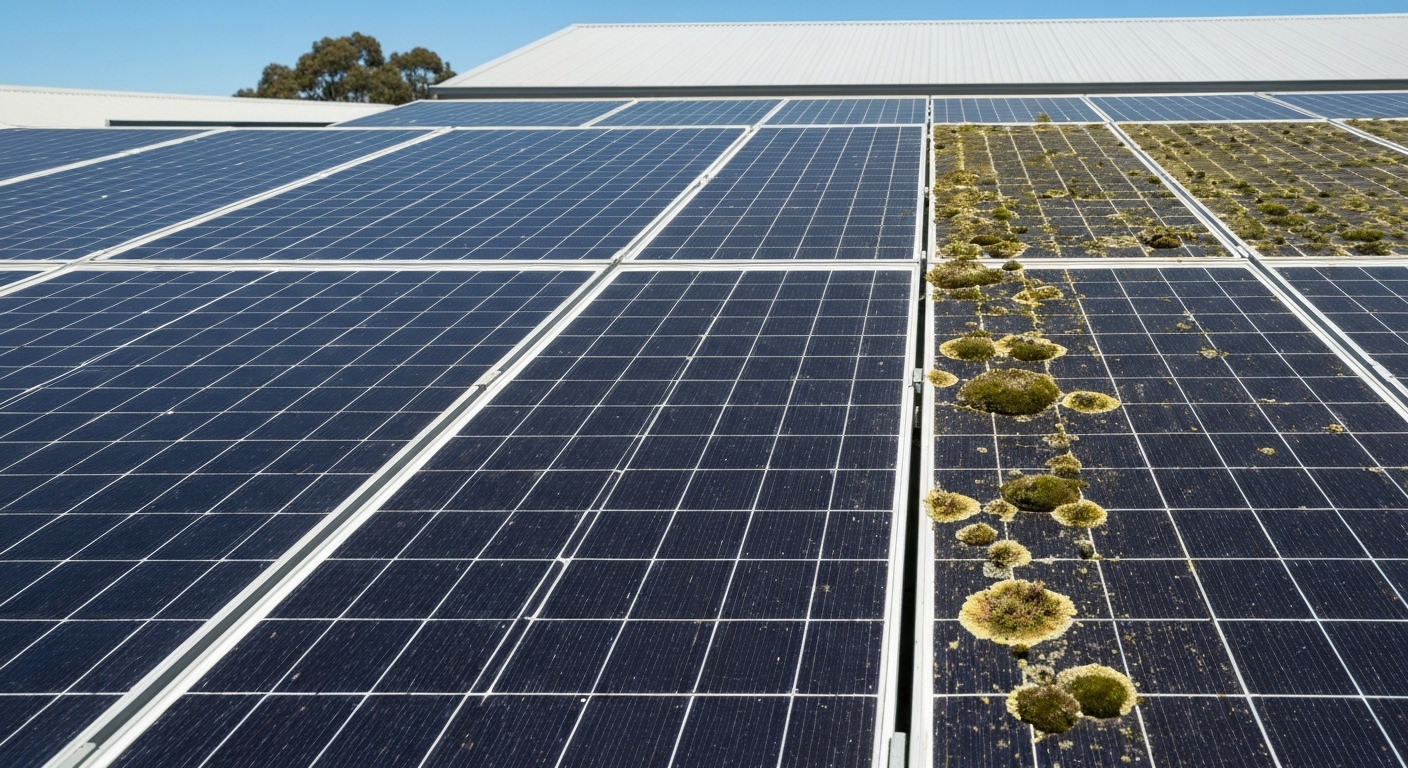
If you’ve noticed green, grey, or orange patches on your solar panels and aren’t sure what you’re looking at, you’re not alone. Many Australian solar owners confuse lichen and moss — two very different types of biological growth that require different treatment approaches.
Getting the identification right matters, because treating lichen like moss (or vice versa) either won’t work or risks panel damage.
What Is Moss? How It Gets on Solar Panels
Moss is a non-vascular plant belonging to the division Bryophyta. Unlike flowering plants, moss doesn’t have true roots, stems, or leaves — it attaches to surfaces via tiny hair-like structures called rhizoids and absorbs moisture directly through its leaf-like surface.
How moss establishes on solar panels:
- Airborne moss spores land on panel glass or aluminium frames
- Moisture from dew, rain, or humidity allows spores to germinate
- Growth begins at the panel edges, in frame channels, or in shaded areas where moisture persists
- Over months, moss forms visible cushion-like growths
Visual identification of moss:
- Soft, cushion-like texture — visibly three-dimensional even from the ground
- Typically bright or dark green when wet, brown when dry
- Usually starts at panel edges and frame channels, then spreads inward
- Can be lifted slightly with a fingernail if easily accessible
Where moss is most common in Australia:
- Shaded panels (north-side installations or panels under overhanging trees)
- Southern-facing roof sections in VIC, TAS, and SA where winter sun is low
- Panels with significant moisture retention (low-pitch, surrounded by high-moisture areas)
- Coastal humid areas in QLD and NSW
What Is Lichen? Why It’s a More Serious Problem
Lichen is not a single organism — it’s a symbiotic partnership between a fungus and a photosynthetic partner (either algae or cyanobacteria). The fungus provides structure and absorbs water and minerals; the algae or cyanobacteria photosynthesize and provide nutrition.
This partnership makes lichen extraordinarily resilient. Lichen can survive conditions that would kill most other organisms — extreme drought, UV radiation, and temperature extremes. It’s this toughness that makes it so difficult to remove from solar panels.
How lichen establishes on solar panels:
- Lichen spores (or fragments) arrive via wind or bird activity
- The fungal component begins growing on the glass or frame surface
- Slow colonisation over weeks to months, initially invisible to the naked eye
- At 1–5mm size, it becomes faintly visible as a discolouration
- Mature lichen (months to years old) is firmly bonded to the glass, producing organic acids
Visual identification of lichen:
- Flat, tightly adhered to the surface — doesn’t lift when touched
- Variable colours: grey, orange, yellow-green, dark green, black
- Crustose lichen: crust-like, fused to glass, grey or green-grey
- Foliose lichen: slightly raised leaf-like lobes, usually grey-green, at panel edges
- Fruticose lichen: shrubby or hair-like, more common on frames than glass
- Cannot be removed by rubbing with a finger — it’s bonded to the glass
Side-by-Side Comparison
| Feature | Moss | Lichen |
|---|---|---|
| Texture | Soft, cushion-like, 3D | Flat, crusty, tightly bonded |
| Colour (wet) | Bright green | Grey, orange, dark green |
| Colour (dry) | Brown, shrunken | Little change — very drought-tolerant |
| Removal difficulty | Moderate (water + brush) | Hard (requires acid or biocide) |
| Mechanism of damage | Shading, moisture retention | Acid etching of AR coating |
| Permanence of damage | Usually reversible | Can be permanent (etching) |
| Growth speed | Fast in moist conditions | Slow and steady |
| Common locations | Edges, frames, shaded areas | Any glass surface, especially old panels |
How to Remove Moss from Solar Panels
Moss removal is relatively straightforward:
Step 1: Wait for or induce wet conditions. Wet moss is far easier to remove. Spray with distilled water and wait 5–10 minutes.
Step 2: Use a soft-bristle brush (dedicated solar brush or soft car wash brush) to gently lift the moss. Work from the top of the panel downward.
Step 3: Rinse with deionised or distilled water to remove loosened fragments and any residue.
Step 4: For stubborn moss that has dried to a crust, apply a diluted mixture of water and a pH-neutral solar panel biocidal treatment. Allow to soak for 15–20 minutes before brushing.
Prevention: After removal, a single application of a solar-specific anti-soiling treatment creates a hydrophilic surface that discourages moss re-establishment. Trimming overhanging branches reduces spore load and moisture.
How to Remove Lichen from Solar Panels
Lichen requires a different, more patient approach:
Step 1: Apply a purpose-made lichen treatment for solar panels, or a diluted white vinegar solution (1:4 vinegar to water) to the affected area. Never use undiluted vinegar or stronger acids.
Step 2: Allow the solution to dwell for 15–30 minutes. The goal is to break the chemical bond between the lichen and the glass — this cannot be rushed.
Step 3: Gently agitate with a soft circular scrubbing motion. Do not use long strokes or significant pressure. If lichen doesn’t release, apply more solution and wait longer.
Step 4: Rinse thoroughly with deionised water. Inspect — dead lichen turns white or orange. Live lichen (green) needs another treatment cycle.
Step 5: Repeat as needed. Established lichen often requires 2–4 treatment cycles over several days. Complete removal in a single session is often not achievable.
Professional treatment: For severe lichen coverage (over 15% of panel surface) or panels still under warranty, professional biocidal cleaning is recommended. Commercial operators use stronger, panel-safe formulations and equipment that applies consistent solution coverage.
After-Removal Inspection for Permanent Damage
Once biological growth is removed, inspect the glass surface carefully in direct sunlight. Look for:
- Haze or milky appearance — indicates AR coating etching from lichen acid
- Dark spots or rings — indicates deeper glass etching under established colonies
- Micro-pitting — visible as a slightly rough or uneven surface under raking light
If etching is visible and significant, have a solar technician assess whether the panels warrant an insurance or warranty claim. In severe cases, panel replacement may be the only way to fully restore performance.
When to Call a Professional
Consider professional biological growth treatment if:
- Lichen covers more than 20% of any panel’s surface
- Multiple treatment cycles haven’t produced visible improvement
- Panels are on a steep roof or at height above single-storey (safety risk)
- Panels are under warranty and you’re concerned DIY treatment could void coverage
- You cannot determine whether the growth is moss or lichen from ground level
Treatment Product Guide: What Works for Lichen vs. Moss
The right product depends on which biological growth you’re dealing with:
For lichen: White vinegar (50/50 dilution with distilled water) is the go-to DIY solution. It’s mildly acidic, safe for panel glass and aluminium frames at working dilution, and kills lichen over 48–72 hours. Commercial biocidal cleaners formulated for solar panels work faster and are worth using for established colonies. Avoid bleach — it’s effective but damages frame oxidation layers and rubber gaskets.
For moss: Moss responds well to physical removal once it’s dry (it releases more easily than when wet). After physical removal, apply a diluted vinegar or commercial biocidal solution to kill remaining spores and prevent re-establishment. Dry moss can be brushed away gently; wet moss tends to smear across the glass.
For mixed growth (both lichen and moss present): Treat in two stages: physical removal of moss first, then chemical treatment of lichen. Attempting both simultaneously with a scrubbing approach risks spreading lichen spores into cleaned areas.
Products to avoid on panel glass: Bleach, pool algaecide, sodium hydroxide-based cleaners, high-pH industrial degreasers, or any abrasive compound. All of these carry risks to the anti-reflective coating, aluminium frames, or rubber seals that outweigh their cleaning effectiveness.
Prevention: Keeping Biological Growth Off Solar Panels Long-Term
Treating an established colony is a repetitive task. Prevention requires addressing the underlying conditions that allow biological growth to establish:
Trim overhanging vegetation. Trees within 5 metres of your panel array drop spores, create shade (ideal for lichen), and increase humidity around panels from transpiration. Regular pruning is the single most effective long-term prevention measure in tree-rich suburbs.
Apply an anti-soiling coating. Products like HydroPhil and similar hydrophilic glass coatings create a surface that water sheets off more completely, removing biological spores before they can establish. These need reapplication every 1–2 years but significantly reduce the frequency of biological growth in humid environments.
Schedule annual wet-season inspections. In lichen and moss-prone areas (coastal QLD, SE Victoria, Tasmania), inspect panels in late autumn/early winter when growth conditions peak. Catching spore establishment early — before any visible growth — means a simple rinse is enough, rather than multi-cycle chemical treatment.
Maintain regular cleaning frequency. Lichen and moss both require extended uninterrupted contact with a surface to establish. Annual cleaning disrupts this process; panels that are cleaned once or twice a year rarely develop entrenched biological colonies.
Related: How to Remove Lichen from Solar Panels · How Often to Clean Solar Panels · Solar Panel Cleaning Cost Australia
Frequently Asked Questions
What is the difference between lichen and moss on solar panels?
Moss is a non-vascular plant that grows as a soft green cushion and can be removed relatively easily once wet. Lichen is a composite organism (fungus + algae or cyanobacteria) that bonds directly to the glass surface and requires acid treatment or specialised biocidal cleaners to fully remove. Lichen causes glass etching; moss primarily causes shading.
Is lichen or moss more damaging to solar panels?
Lichen is significantly more damaging. It produces organic acids that etch and permanently degrade the anti-reflective coating on panel glass. Moss is easier to remove and less likely to cause permanent surface damage, though it still reduces output through shading.
How do I know if I have lichen or moss on my solar panels?
Moss appears as raised, soft, green or brown cushion-like growth — it has visible texture from ground level. Lichen appears flat and tightly adhered, often grey, orange, or dark green, with a crust-like or leaf-like appearance depending on type. If you can’t easily see it from the ground, a photo from a safe angle using a zoom lens helps with identification.
How do you remove moss from solar panels?
Wet moss thoroughly with water, allow it to soften for 5–10 minutes, then gently lift with a soft brush. Rinse with deionised water. Moss is much easier to remove than lichen — it rarely requires chemical treatment unless it has been established for a long time and has dried to a crust.
Can lichen permanently damage solar panels?
Yes. Lichen produces oxalic and citric acids as metabolic byproducts that slowly etch the anti-reflective coating on panel glass. This etching is irreversible and permanently increases light reflection, reducing energy production. Panels with several years of untreated lichen growth can suffer 5–15% permanent efficiency loss even after the lichen is removed.
Frequently Asked Questions
Moss is a non-vascular plant that grows as a soft green cushion and can be removed relatively easily once wet. Lichen is a composite organism (fungus + algae or cyanobacteria) that bonds directly to the glass surface and requires acid treatment or specialised biocidal cleaners to fully remove. Lichen causes glass etching; moss primarily causes shading.
Lichen is significantly more damaging. It produces organic acids that etch and permanently degrade the anti-reflective coating on panel glass. Moss is easier to remove and less likely to cause permanent surface damage, though it still reduces output through shading.
Moss appears as raised, soft, green or brown cushion-like growth — it has visible texture from ground level. Lichen appears flat and tightly adhered, often grey, orange, or dark green, with a crust-like or leaf-like appearance depending on type. If you can't easily see it from the ground, a photo from a safe angle using a zoom lens helps with identification.
Wet moss thoroughly with water, allow it to soften for 5–10 minutes, then gently lift with a soft brush. Rinse with deionised water. Moss is much easier to remove than lichen — it rarely requires chemical treatment unless it has been established for a long time and has dried to a crust.
Yes. Lichen produces oxalic and citric acids as metabolic byproducts that slowly etch the anti-reflective coating on panel glass. This etching is irreversible and permanently increases light reflection, reducing energy production. Panels with several years of untreated lichen growth can suffer 5–15% permanent efficiency loss even after the lichen is removed.