Pigeons Under Solar Panels: Scratching Noises, Damage & How to Fix It
That scratching and cooing under your solar panels? It's almost certainly pigeons nesting. Here's what damage they cause, how to remove them, and how to stop them coming back.
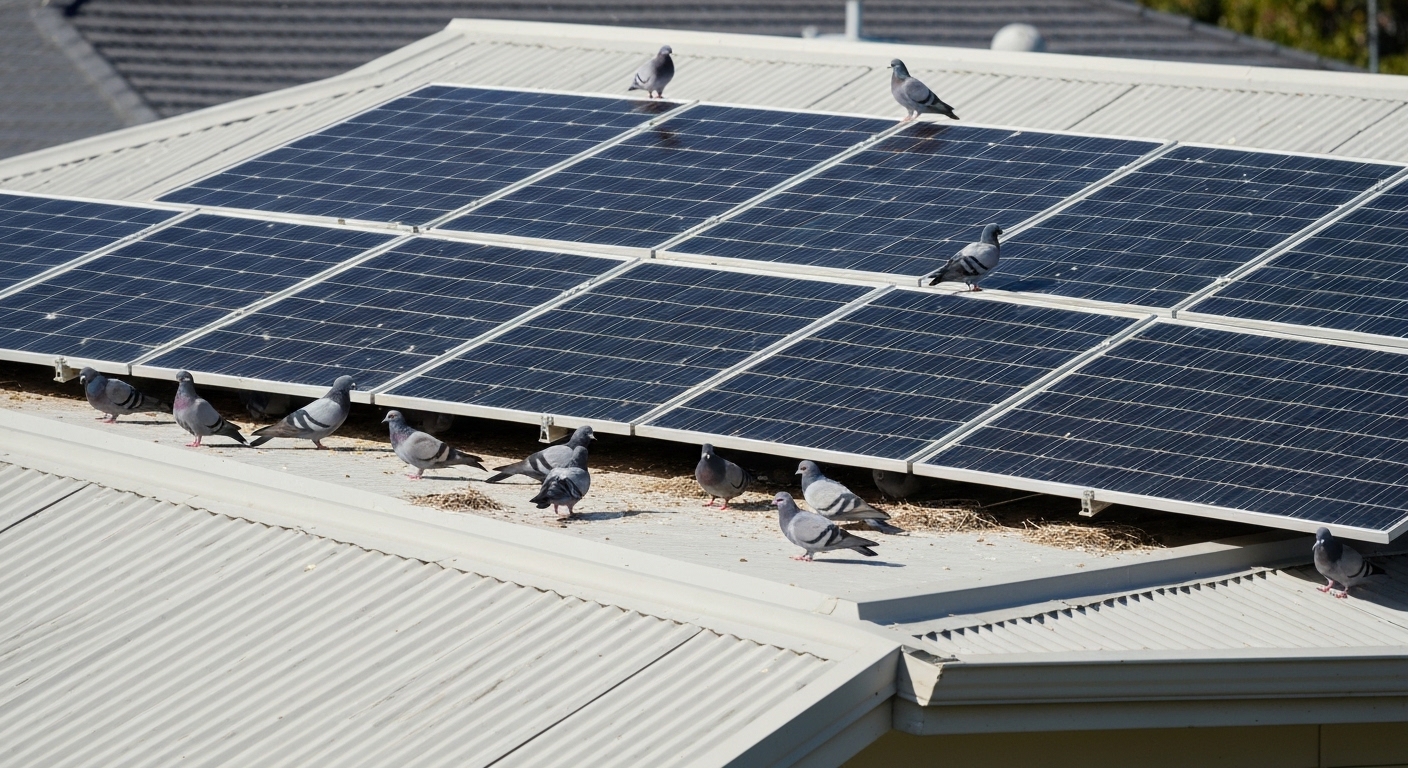
You’re lying in bed at 6am when it starts: a rhythmic scratching, soft cooing, and the unmistakable sound of something settling in for the day directly above your head.
If you have solar panels, there’s a very good chance you have pigeons. And if you have pigeons nesting under your panels, you have a problem that goes well beyond the noise.
Why Pigeons Love Solar Panels
Feral pigeons are cavity nesters — in the wild, they nest on cliff ledges. Urban Australia has replaced those cliffs with rooftops, and solar panels have created an irresistible upgrade: a sheltered, elevated, warm space that’s protected from rain and most predators.
Once a pair establishes under your panels, several things happen:
- They build a nest from twigs, leaves, and debris
- They breed — pigeons produce up to 6 clutches per year in warm climates
- Other pigeons are attracted by the presence of the colony
- They return to the same nesting site year after year
Without intervention, a single pair can become a colony of dozens within 12–18 months.
The Real Damage Pigeons Cause
Most homeowners focus on the noise and the mess on top of panels — but the damage underneath is far more serious.
1. Wiring Damage
Pigeon droppings are highly acidic (pH 3–4.5) and corrode the insulation on DC cables. Exposed wiring under panels is a fire hazard. This is not theoretical — solar fires caused by pest-damaged wiring have been documented by the Clean Energy Regulator.
2. Overheating
Solar panels are designed with air gaps underneath for convection cooling. Pigeon nests block this airflow, causing panels to run hotter. For every 10°C rise above 25°C, panel output drops by approximately 0.4–0.5% — and chronically hot panels degrade faster.
3. Structural Debris Accumulation
Pigeon nesting material — twigs, straw, feathers, droppings — accumulates in gutters and under panels. This traps moisture against the roof surface, accelerating rust in metal roofing and rot in timber substrates.
4. Guano on Panel Surfaces
Unlike diffuse dust, pigeon droppings create hard shadows that can trigger bypass diode activation, reducing output from entire panel strings even if only a few cells are affected.
Signs You Have Pigeons Under Your Panels
- Scratching or cooing sounds from the roof, particularly at dawn and dusk
- Droppings on the roof below panels (white and black streaks on fascia boards)
- Visible nesting material poking out from the sides of panels
- Feathers on the roof or in gutters
- Unexplained drop in solar output — check your inverter’s daily generation
What to Do: A Step-by-Step Approach
Step 1: Inspect First
Before spending money, confirm the problem. Use binoculars from the ground or carefully access the roof (safely) to assess:
- How many birds are present
- Whether there are active nests (eggs or chicks)
- The extent of any debris or damage
If you see chicks or eggs: In Australia, feral pigeons are not protected, so you can legally remove these. However, if you suspect any native species (magpies, doves), stop and contact your state Environment department.
Step 2: Clear the Nests and Debris
Remove all nesting material from under the panels. This job typically requires:
- Two people for safety on the roof
- Gloves and a dust mask (pigeon droppings carry Histoplasma and Cryptococcus fungi)
- Bags for debris disposal
- A soft brush to clear remaining material
Do not let debris wash into gutters — it will cause blockages and potentially contaminate rainwater tanks.
Step 3: Clean the Affected Area
Once clear, clean the underside area and top of the roof with a mild disinfectant solution. Rinse panel surfaces that have droppings on them using distilled water and a soft cloth.
Step 4: Install Bird Mesh (The Permanent Fix)
The only reliable long-term solution is solar panel bird mesh — a galvanised or stainless steel wire mesh that clips to the perimeter of your panel array, closing the gap between the panels and the roof.
Quality products to look for:
- Corrosion-resistant (galvanised or stainless steel, not painted mild steel)
- UV-stabilised clips — plastic clips degrade in Australian UV
- No-drill installation — mesh should clip onto panel rails, not be screwed through frames
Professional installation takes 1–3 hours for a standard system and typically costs $300–$800.
Step 5: Add Deterrents (Optional Layer)
For persistent pigeons, mesh alone may need reinforcement:
- Plastic spikes on ridge caps and panel edges — cheap but effective for landing deterrence
- Reflective tape or flash tape — disorients birds with light reflection
- Ultrasonic deterrents — limited evidence for effectiveness with persistent birds
Avoid fake owls as a primary deterrent — pigeons rapidly habituate to stationary decoys within days.
How Much Does Professional Bird-Proofing Cost?
| System Size | Estimated Cost (installed) |
|---|---|
| 10 panels (3–4kW) | $250–$450 |
| 16 panels (6.6kW) | $380–$650 |
| 24 panels (10kW) | $550–$950 |
| 32+ panels (13kW+) | $700–$1,200+ |
Most solar cleaning companies offer bird-proofing as an add-on service. Getting both done in one visit reduces costs and roof traffic.
Will Removing Pigeons Improve My Solar Output?
Yes — measurably. After clearing nests and cleaning affected panels:
- Shading removal from droppings typically recovers 5–20% output loss
- Improved airflow from cleared nests lowers panel operating temperature
- Reduced degradation from less corrosive exposure to droppings
One solar monitoring study by Fronius found that pigeon-affected systems in Sydney’s western suburbs were generating 18% below their expected baseline before remediation.
The Bottom Line
Pigeons aren’t just noisy neighbours — they’re a genuine maintenance and safety issue for solar panel owners. The scratching you hear is the sound of an infestation establishing itself.
The fix is straightforward: remove nests, clean the area, install quality bird mesh. Done once, done properly, it’s a one-time cost that protects a $6,000–$15,000 asset for the life of your system.
Don’t let a $400 mesh job turn into a $2,000 wiring repair.
How to Identify Which Bird You’re Dealing With
Not all scratching under solar panels comes from the same bird. Identifying the species matters because behaviour, timing, and best deterrents differ:
Feral Pigeons (Columba livia):
- Most common culprit in all Australian metro areas
- Build bulky nests from twigs, grass, and debris
- Active year-round; breed multiple times per year
- Noise: low cooing, constant shuffling, wing flaps in early morning
Indian Mynas (Acridotheres tristis):
- Common in QLD, NSW, VIC — introduced pest species
- More aggressive; will displace native birds
- Build denser nests with softer material
- Noise: harsh chattering, louder than pigeons
Common Starlings (Sturnus vulgaris):
- Common in VIC, SA, TAS
- Build large, messy nests quickly
- More likely than pigeons to bring in moisture-trapping materials
- Noise: musical warbling, clicking
Identifying by noise pattern:
- Constant shuffling at dawn/dusk = pigeons
- Loud chattering and fighting = mynas
- Musical calls, rapid movement = starlings
- Heavy thudding, gnawing sounds at night = possum (different solution required)
Knowing which species you have helps you confirm that mesh is the right solution (it is for all of the above), and informs how urgently you need to act — mynas and starlings establish nests faster than pigeons and should be addressed immediately upon detection.
Australian State-by-State: Bird Pressure on Solar Panels
Bird problems with solar panels vary significantly by location. Knowing your state’s risk profile helps you decide how urgently to act:
New South Wales (Sydney basin and coast): Feral pigeons and Indian mynas are the dominant problem species. Sydney’s western suburbs — Parramatta, Penrith, Campbelltown — have particularly high pigeon colony densities. Expect 6–12 months before an unprotected new system is colonised in high-pressure areas.
Victoria (Melbourne metro): Common starlings are the #1 problem in Melbourne’s inner and middle suburbs. They establish faster than pigeons and build denser nests. The cooler climate slows breeding slightly, but well-established starling colonies can produce multiple clutches October through February.
Queensland (SEQ and tropical north): Pigeons are pervasive in greater Brisbane. In Cairns and Townsville, native Torres Strait pigeons (Ducula spilorrhoa) are present — these are protected species and nest removal requires care. Ensure any bird removal contractor in tropical QLD is aware of protected species obligations.
Western Australia (Perth metro): Perth has lower urban bird pressure than eastern capitals, but pigeon colonies around Fremantle, East Perth, and the northern suburbs are well established. The dry climate means nesting material is less vegetation-heavy, so nests are sometimes harder to spot.
South Australia (Adelaide metro): Common mynas are a significant problem in Adelaide’s eastern and northern suburbs. The drier climate reduces biological pest growth on panels, but bird dropping concentrations can be severe under established roost trees.
Insurance and Bird Damage: What’s Covered
A commonly overlooked aspect of bird damage to solar panels is insurance coverage.
Home and contents insurance: Most comprehensive home and contents policies include an “accidental damage” section that may cover sudden bird-caused wiring damage. The key word is “sudden” — a cable chewed by a pigeon during an active nesting season is often claimable. Gradual accumulation of nesting material causing roof damage over months is typically excluded as a “gradual process.”
Solar panel insurance riders: Some insurers offer solar-specific coverage as a policy extension. These often explicitly cover:
- Bird strike damage to panels
- Wildlife damage to wiring
- Cost of professional removal and exclusion
What to document if you have a claim:
- Photos of nesting material before removal
- Photos of any visible wiring damage
- Solar output records showing any performance decline
- Receipt for professional cleaning and bird mesh installation
Speak with your insurer before removing a nest or completing repairs — disturbing the scene before an assessor has reviewed it can complicate a claim.
Related: Solar Bird Proofing Guide Australia · Solar Panel Bird Proofing Cost · How to Remove Bird Droppings from Solar Panels
Frequently Asked Questions
Why do pigeons nest under solar panels?
Solar panels provide the perfect pigeon habitat: shelter from rain, warmth from the panel’s underside, and elevation that keeps predators away. Once one pair establishes a nest, others follow — and they return year after year if not deterred.
What damage can pigeons cause under solar panels?
Pigeons cause multiple types of damage: droppings corrode wiring insulation, nesting material blocks airflow causing panels to overheat, birds can peck at cables, and accumulated debris can trap moisture leading to roof damage beneath panels.
Is it legal to remove pigeon nests from solar panels in Australia?
Under Australian law, pigeons (feral rock doves) are not protected native wildlife. You can legally remove nests and eggs. However, native birds like magpies, sulphur-crested cockatoos, and rainbow lorikeets are protected — don’t disturb their nests without checking with your state wildlife authority.
Will bird mesh void my solar panel warranty?
Quality bird mesh installed by a professional solar cleaner should not void your warranty. Avoid drilling into panel frames — mesh should clip onto the panel rails. Always check with your installer before adding any accessories.
How much does pigeon-proofing solar panels cost in Australia?
Professional solar bird mesh installation typically costs $300–$800 for a standard 6.6kW system, depending on roof access and the number of panels. This is a one-time cost that pays for itself by preventing damage and maintaining efficiency.
Frequently Asked Questions
Solar panels provide the perfect pigeon habitat: shelter from rain, warmth from the panel's underside, and elevation that keeps predators away. Once one pair establishes a nest, others follow — and they return year after year if not deterred.
Pigeons cause multiple types of damage: droppings corrode wiring insulation, nesting material blocks airflow causing panels to overheat, birds can peck at cables, and accumulated debris can trap moisture leading to roof damage beneath panels.
Under Australian law, pigeons (feral rock doves) are not protected native wildlife. You can legally remove nests and eggs. However, native birds like magpies, sulphur-crested cockatoos, and rainbow lorikeets are protected — don't disturb their nests without checking with your state wildlife authority.
Quality bird mesh installed by a professional solar cleaner should not void your warranty. Avoid drilling into panel frames — mesh should clip onto the panel rails. Always check with your installer before adding any accessories.
Professional solar bird mesh installation typically costs $300–$800 for a standard 6.6kW system, depending on roof access and the number of panels. This is a one-time cost that pays for itself by preventing damage and maintaining efficiency.