Professional vs DIY Solar Panel Cleaning: The True Cost Comparison
Thinking about cleaning your own solar panels? Here's the honest cost and risk comparison — equipment, insurance, WorkSafe requirements, warranty implications, and when DIY makes sense.
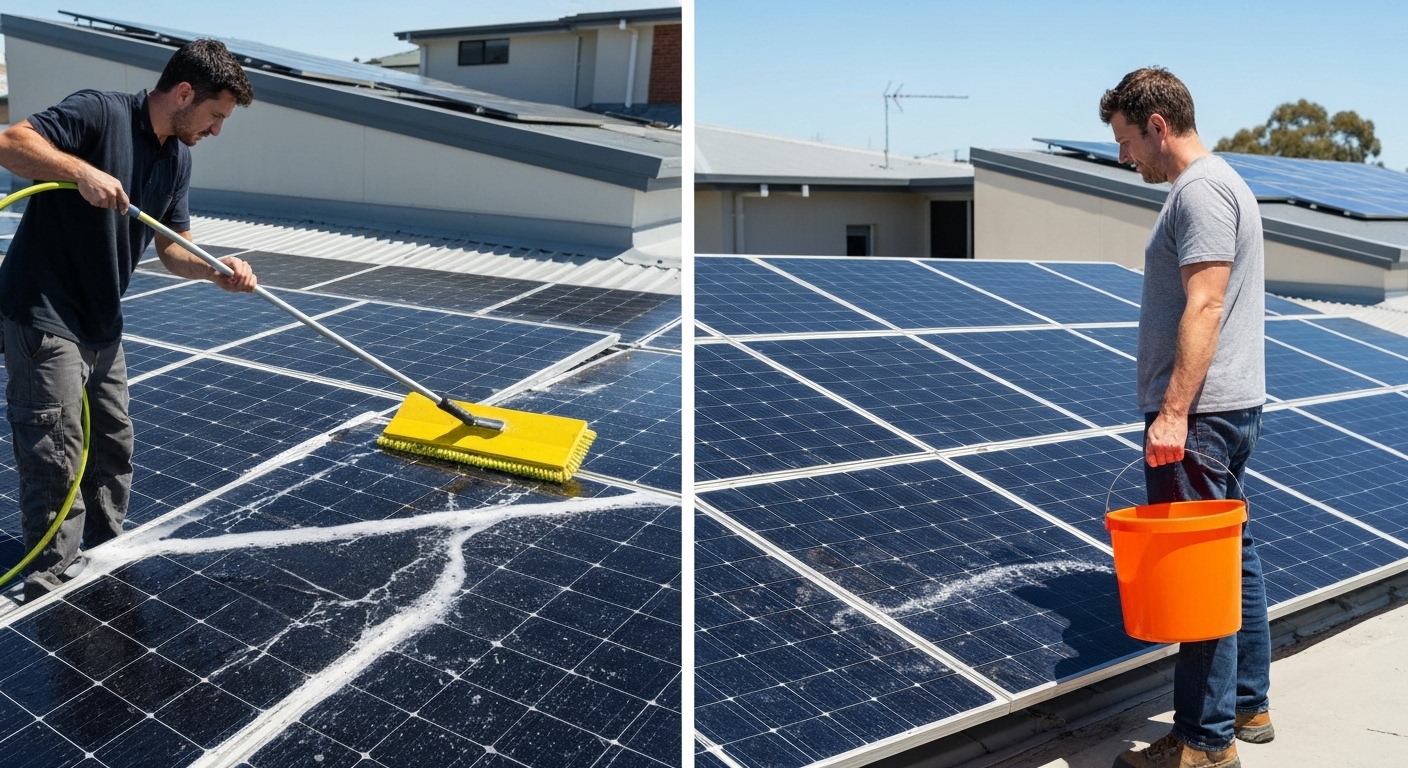
Every year, thousands of Australian solar panel owners face the same question: should I pay someone to clean my panels, or just do it myself?
It seems simple. Solar panels are glass and aluminium. Water and a soft brush seems sufficient. But the full cost-benefit picture is more nuanced than it first appears — and for many homeowners, the DIY option carries risks that don’t show up in the initial calculation.
This guide breaks down the true cost of both options so you can make an informed decision.
The Real Costs of DIY Solar Panel Cleaning
Equipment Costs
To clean solar panels properly and safely, you need:
| Equipment | Cost | Notes |
|---|---|---|
| Water-fed extension pole | $60–$120 | Essential for safe reach; 4–6m recommended |
| Soft brush head / microfibre sleeve | $20–$40 | Must be soft — no abrasives |
| TDS meter | $20–$40 | Checks water quality before use |
| Deionised water supply | $5–$20/session | Or suitable rainwater if TDS <50ppm |
| Stable ladder (if not owned) | $80–$200 | Must be rated for your roof height |
| Non-slip roof boots | $40–$80 | Critical safety item |
| Total first-time setup | $225–$500 | Ongoing cost: ~$5–20 per clean (water only) |
Note: Tap water in hard water areas (most of inland Australia, parts of WA and SA) should NOT be used — it leaves mineral deposits that reduce output. Always check your tap water TDS; anything above 100 ppm requires alternative water.
Time Costs
A standard 6.6 kW system (around 20 panels) takes:
- Setup, ladder positioning, safety check: 20–30 min
- Active cleaning: 45–90 min depending on soiling level
- Rinse, pack down, inspection: 15–20 min
- Total: 1.5–2.5 hours
At an opportunity cost of $30–$50/hour (rough hourly rate for most working Australians), that’s $45–$125 in time value per clean.
Safety Risk: The Hidden Cost
This is the calculation most DIY guides skip.
In 2023–24, Safe Work Australia recorded 23 fatalities from falls on roofs and from heights during non-trade residential work. The median roof height at which fatal falls occur is 3.1 metres — roughly one-storey height, reachable by a standard ladder.
Falls from roofs don’t just kill — they result in serious injuries (broken pelvis, spinal injuries, head injuries) requiring extended rehabilitation. The economic cost of a serious fall injury easily reaches $50,000–$200,000+ in medical costs, lost income, and reduced capacity.
This isn’t alarmism — it’s the reason Australian WorkSafe regulators are explicit about roof access requirements. The relevant framework is:
Safe Work Australia: Working at Heights Code of Practice
- Any work at height above 2 metres requires appropriate fall prevention
- Risk assessment must be conducted before access
- For heights above 3m, edge protection or fall arrest systems are required in professional contexts
Homeowners doing DIY are exempt from the professional workplace requirements, but the physics of a fall are the same.
The risk-adjusted cost of DIY on a two-storey home or steep roof is effectively infinite — no cost saving justifies a fatal fall. On a single-storey home with gentle pitch and safe ladder access, the risk is manageable for a physically capable adult who follows safe practices.
The Real Costs of Professional Solar Cleaning
What You Pay
| System Size | Professional Clean Cost |
|---|---|
| 3 kW (~10 panels) | $130–$180 |
| 6.6 kW (~20 panels) | $180–$280 |
| 10 kW (~30 panels) | $250–$380 |
| 13.3 kW+ (40+ panels) | $320–$500+ |
Per-panel rate: $8–$13 depending on location, access, and soiling level.
What You Get
A reputable professional clean includes things DIY can’t replicate:
Equipment professionals bring:
- Water-fed poles with built-in deionised water filtration (TDS typically <10ppm)
- Appropriate PPE and fall arrest equipment for any roof type
- Pre-clean and post-clean inverter output comparison (better operators)
Expertise professionals bring:
- Identification of cracked cells, delamination, snail trails, or hotspot discolouration
- Nest detection and removal reporting
- Recognition of loose wiring, damaged seals, or corroding frames
- Knowledge of which cleaning products are safe for which panel types
A professional cleaner might spot a failing bypass diode that’s costing you $150/year in lost generation — something you’d walk straight past on a DIY clean.
Insurance and liability: Professional cleaners carry public liability insurance (minimum $5–10 million). If something goes wrong — a panel is scratched, a tile is cracked, or an accessory is damaged — they’re covered. DIY has no such protection.
Warranty Implications: The Often-Overlooked Factor
Most Australian solar panel warranties (typically 10–12 years product warranty, 25 years performance warranty) include cleaning requirements. The key points:
What voids warranties:
- Using pressure washers above manufacturer specifications (typically >35 bar / 500 psi)
- Using abrasive cleaning products or pads
- Introducing water into junction boxes or connector areas
- Using cleaning agents not approved by the manufacturer
What doesn’t void warranties:
- Soft brush cleaning with purified water, following manufacturer guidelines
- Professional cleaning that adheres to the same guidelines
The risk: if a panel fails and the manufacturer suspects improper cleaning contributed, they can reject a warranty claim. This is rare, but a denied warranty claim on a failed panel worth $300–$800 is a significant outcome.
Professional cleaners work within manufacturer guidelines by default. DIY operators may not know what those guidelines are.
Direct Cost Comparison Over 5 Years
Assumptions: 6.6 kW system, 2 cleans per year, Sydney location, homeowner values time at $40/hour.
| Cost Item | DIY (5 years) | Professional (5 years) |
|---|---|---|
| Equipment (one-time) | $300 | $0 |
| Water/consumables | $100 | $0 |
| Time cost (10 cleans × 2hr × $40) | $800 | $0 |
| Professional fees (10 cleans × $230) | $0 | $2,300 |
| Total | $1,200 | $2,300 |
On pure cost, DIY wins by ~$1,100 over 5 years. But add the risk factors:
- One missed crack detection costs $300–$800+ in panel replacement
- One denied warranty claim: $300–$1,500
- One fall injury: immeasurable
The WorkSafe Requirements Explained
Under the Safe Work Australia Model Code of Practice for Construction Work (Working at Heights):
- Above 2m: Risk assessment required, appropriate controls in place
- Above 3m (pitched roof access): Edge protection systems or personal fall arrest systems required
- Two-storey (above 4m): Scaffold, elevated work platform, or harness system required
These requirements apply to trade workers, not private homeowners. However, state-based work health and safety legislation means that anyone undertaking rooftop work as a contractor on a property — even a small business doing solar cleaning — must comply.
What this means for hiring: When you hire a solar cleaner, ask:
- Do they carry public liability insurance? (minimum $5M)
- Are their workers trained in working at heights?
- Do they use fall arrest equipment for steep or multi-storey roofs?
Anyone who says “we don’t need harnesses — we’re quick up there” is both legally non-compliant and a liability risk for your property.
When DIY Is the Right Choice
DIY solar panel cleaning is appropriate when:
✅ Single-storey home, roof pitch under 20° ✅ Safe, stable ladder access available ✅ You have the physical capability and confidence for roof access ✅ Water quality is known and suitable (TDS <50 ppm) ✅ Panels are not heavily soiled or showing biological growth ✅ You’re willing to invest in proper equipment
DIY is NOT appropriate when:
❌ Two-storey home or steep pitch (>25°) ❌ Rental property (contractor rules apply) ❌ Heavy bird dropping accumulation or lichen growth ❌ You’re unsure about what you’re looking at on the panel surface ❌ You don’t own or won’t buy suitable extension poles and soft brushes
The Bottom Line
Professional cleaning wins on safety, quality, and warranty protection. DIY wins on long-term cost — but only if you’re genuinely in the low-risk single-storey category and invest in proper equipment.
For two-storey homes or steep roofs: always use a professional. The safety risk is not worth the cost saving.
For single-storey, low-pitch homes: DIY is a viable option with the right gear, suitable water, and safe roof access. Budget one professional inspection annually to catch what your eye might miss.
Sources
- Safe Work Australia: Model Code of Practice — Construction Work (Working at Heights) (2022)
- Australian Institute of Health and Safety: Falls from Height Statistics Report (2024)
- Clean Energy Council: Solar Panel Warranty and Maintenance Guidelines (2024)
- Choice Australia: Solar Panel Cleaning Review (2023)
- Solar panel manufacturer cleaning guidelines: LG, Jinko Solar, Canadian Solar (2024 editions)
See also DIY Solar Panel Cleaning Risks, Solar Panel Cleaning Cost Australia 2025, and How to Clean Solar Panels Safely.
Frequently Asked Questions
Is it safe to clean solar panels yourself?
It depends entirely on your roof. Single-storey homes with low-pitch roofs (under 20°) and safe ladder access can be cleaned DIY by a careful, physically capable adult. Two-storey homes, steep roofs over 25°, or any roof without adequate fall protection should only be accessed by trained workers under Australian WorkSafe requirements. Falls from roofs are the leading cause of construction fatalities in Australia.
What equipment do I need to clean solar panels myself?
Minimum: extension pole (3–5m), soft brush head or microfibre sleeve, deionised water source or low-TDS rainwater, and a stable ladder. Do not use tap water in hard water areas (causes mineral spotting), pressure washers (warranty risk), or abrasive pads. Total equipment cost: $80–$200. A TDS meter ($20–$40) is also recommended.
Will DIY cleaning void my solar panel warranty?
Not automatically — most manufacturers allow owner cleaning if you follow their guidelines (soft brush, purified water, no pressure washing). However, using incorrect products, high pressure, or causing physical damage during DIY cleaning can void your warranty. Always check your specific panel manufacturer’s cleaning guidelines before proceeding.
What are the legal requirements for cleaning solar panels on a roof in Australia?
Under the Safe Work Australia Model Code of Practice (Working at Heights), anyone working at height above 2 metres in a workplace context must follow fall prevention measures. For private homeowners doing DIY, there is no legal prohibition but the practical safety requirements are the same. For rental properties, the work is considered a trade activity and should be done by a licensed contractor.
How much does professional solar cleaning cost vs DIY?
Professional cleaning for a standard 6.6 kW system costs $180–$280. DIY equipment costs $80–$200 upfront, then essentially nothing per clean (water cost only). The break-even point is 1–2 DIY cleans — after that, DIY is cheaper purely on cost. However, most homeowners factor in time, safety risk, and quality outcome when making the decision.
Frequently Asked Questions
It depends entirely on your roof. Single-storey homes with low-pitch roofs (under 20°) and safe ladder access can be cleaned DIY by a careful, physically capable adult. Two-storey homes, steep roofs over 25°, or any roof without adequate fall protection should only be accessed by trained workers under Australian WorkSafe requirements. Falls from roofs are the leading cause of construction fatalities in Australia.
Minimum: extension pole (3–5m), soft brush head or microfibre sleeve, deionised water source or low-TDS rainwater, and a stable ladder. Do not use tap water in hard water areas (causes mineral spotting), pressure washers (warranty risk), or abrasive pads. Total equipment cost: $80–$200. A TDS meter ($20–$40) is also recommended.
Not automatically — most manufacturers allow owner cleaning if you follow their guidelines (soft brush, purified water, no pressure washing). However, using incorrect products, high pressure, or causing physical damage during DIY cleaning can void your warranty. Always check your specific panel manufacturer's cleaning guidelines before proceeding.
Under the Safe Work Australia Model Code of Practice (Working at Heights), anyone working at height above 2 metres in a workplace context must follow fall prevention measures. For private homeowners doing DIY, there is no legal prohibition but the practical safety requirements are the same. For rental properties, the work is considered a trade activity and should be done by a licensed contractor.
Professional cleaning for a standard 6.6 kW system costs $180–$280. DIY equipment costs $80–$200 upfront, then essentially nothing per clean (water cost only). The break-even point is 1–2 DIY cleans — after that, DIY is cheaper purely on cost. However, most homeowners factor in time, safety risk, and quality outcome when making the decision.