What Voids Your Solar Panel Warranty? A Complete Guide for Australian Owners
Cleaning mistakes, installation errors, and maintenance decisions that can silently void your solar panel warranty — and what to do to protect your investment.
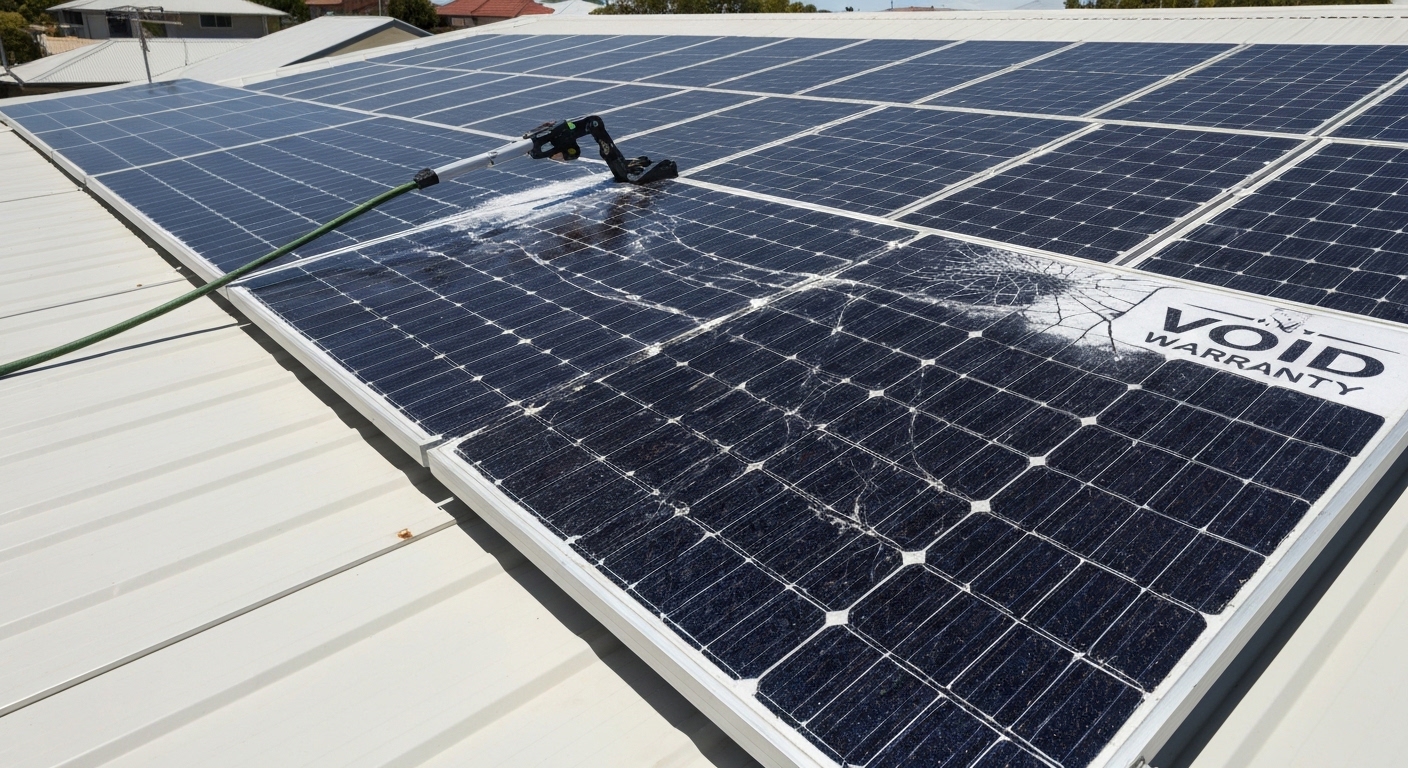
Australia’s solar panels represent a $4,000–$15,000 investment for most households. They come with a 25-year performance warranty designed to guarantee strong output for decades. But many homeowners don’t realise that common maintenance decisions can quietly void these warranties. This leaves you with no recourse if panels fail early.
According to the Clean Energy Council, over 3.6 million Australian homes had rooftop solar installed by 2025. Yet warranty disputes remain a common issue. This guide covers exactly what voids your solar panel warranty based on actual terms used by major brands sold in Australia.
Key Takeaways
- Pressure washing is the most common warranty-voiding mistake
- Using wrong cleaning products can damage panels permanently
- Walking on panels almost always voids warranties
- Only CEC-accredited installers should do electrical work
- Australian Consumer Law provides extra protection beyond manufacturer warranties
- Keep all paperwork — installation records, service logs, and receipts
The Two Types of Solar Panel Warranty
Before diving into what voids your solar panel warranty, understand what coverage you actually have:
1. Product (Materials & Workmanship) Warranty
This covers defects in the panel itself. These include delamination, cell cracking, frame corrosion, and junction box failure.
- Typical duration: 10–15 years (some brands offer 25 years)
- Most vulnerable to: cleaning damage, physical impact, installer errors
2. Performance (Power Output) Warranty
This guarantees the panel will produce at least a certain percentage of its rated output after a set number of years.
- Typical terms: ≥90% output at year 10, ≥80% at year 25 (varies by brand)
- Most vulnerable to: degradation beyond specified rates
Most warranty claims following maintenance incidents fall under the product warranty, not performance.
7 Things That Void Your Solar Panel Warranty
1. Pressure Washing
This is the single most common mistake. Pressure washing can void your solar panel warranty. Here’s what the major brands say:
| Brand | Pressure Washing Policy |
|---|---|
| LG Solar | Explicitly prohibited; “high-pressure water” listed under exclusions |
| SunPower | Manual states maximum 35 bar — most domestic washers operate at 100–150 bar |
| Jinko Solar | Recommends “soft cloth and warm water”; pressure washing not approved |
| Canadian Solar | ”Do not use high-pressure water cleaners” — listed as grounds for voiding product warranty |
| REC Group | Approved cleaning section specifies no mechanical force beyond soft brush |
The physics are clear. Water forced at high pressure into the micro-gaps around cells, sealants, and junction boxes can cause serious problems. These include:
- Moisture ingress leading to cell corrosion
- Delamination of EVA encapsulant
- Frame seal damage
- Junction box water intrusion
For the full breakdown, see our pressure washing guide.
2. Abrasive Cleaning Tools
Scratching the anti-reflective (AR) coating on your panels doesn’t just reduce efficiency. It can void your solar panel warranty if the damage is linked to the cleaning method. Prohibited tools include:
- Metal brushes or scrapers
- Steel wool or abrasive pads
- Hard-bristle brooms
- Standard household scrubbing sponges
- Any implement that leaves visible marks on glass
The AR coating reduces reflective losses from about 4% to about 1.5%. Damage to it is measurable and permanent.
3. Unapproved Chemical Cleaners
Every major panel manufacturer specifies approved cleaning chemicals in their maintenance guide. Common violations that can void your solar panel warranty:
Ammonia-based cleaners (Windex, similar glass cleaners): Ammonia degrades the EVA (ethylene vinyl acetate) encapsulant. This bonds cells to the glass backsheet. Long-term exposure can accelerate yellowing and delamination. Most warranties explicitly exclude “chemical damage.”
Undiluted acidic cleaners: While dilute vinegar is sometimes discussed as a cleaning option, undiluted acidic products can etch glass coatings. They can also corrode aluminium frames. See our vinegar cleaning analysis.
Bleach and oxidising agents: These attack aluminium frame anodisation. They can corrode connections.
Petroleum solvents: WD-40 and similar products leave hydrocarbon films. These attract dust and can seep into junction areas.
Safe alternative: pH-neutral solar-specific cleaners diluted in purified water, or purified water alone.
4. Unauthorised Modifications
Any modification to the panels themselves can void your solar panel warranty. This includes drilling, adding brackets, extending cables, or attaching bird proofing directly to the panel frame in unapproved ways.
Specific examples:
- Drilling into the panel frame for any reason
- Attaching third-party rail systems directly to panel frames
- Covering panels with any material (even temporarily)
Bird proofing mesh, when installed correctly, clips to the roof mounting rails — not the panel frames. Always confirm this with your installer.
5. Incorrect Installation
If your installer made errors during installation, this can void your solar panel warranty. Wrong tilt angle, inadequate ventilation gap, or using the wrong mounting hardware can all cause premature failure. The manufacturer may point to installer error as a warranty exclusion.
This is why CEC (Clean Energy Council) accredited installers matter. They provide their own workmanship warranty (minimum 5 years under Australian Consumer Law standards). The installation is done to manufacturer specifications.
Red flags for installation warranty risk:
- Installer not CEC-accredited
- Panels mounted flush to roof with no gap (ventilation required — typically 50–100 mm)
- Any evidence of microcracks from transport or improper handling during installation
According to Clean Energy Council data, non-compliant installations account for approximately 15% of early system failures in Australia.
6. Walking or Standing on Panels
Solar panel glass is strong when properly framed. But it is not designed to be walked on. Most manufacturers explicitly state that foot traffic will void your solar panel warranty.
Stepping on a panel can cause:
- Immediate visible cracking
- Invisible microcracks that lead to cell degradation over months
- Hotspot formation in cracked cells (efficiency loss and potential fire risk)
Never step on a panel during cleaning, maintenance, or for any other reason.
7. Neglecting Required Maintenance
Some manufacturers include a clause stating the warranty is conditional on “proper maintenance being performed.” If you allow panels to go uncleaned for multiple years, soiling can cause measurable structural damage. For example, bird droppings can etch glass or damage mounting areas. A manufacturer could argue the warranty terms were not met.
In practice, this is rare as a warranty denial trigger. But it’s another reason why regular maintenance matters beyond just output efficiency.
What Does NOT Void Your Solar Panel Warranty
To be clear, these normal activities are generally fine:
- Regular professional cleaning using approved soft-brush, purified water methods ✅
- Careful DIY cleaning following manufacturer guidelines ✅
- Checking panel output via your inverter app ✅
- Reporting suspected faults to your installer ✅
- Bird proofing installation on mounting rails (not panel frames, by qualified installer) ✅
- Normal weathering — hail damage below the maximum impact spec in the warranty, UV yellowing within normal degradation rates ✅
Australian Consumer Law: An Important Protection
Even if a manufacturer attempts to void your solar panel warranty based on a technicality, the Australian Consumer Law (ACL) provides additional protection. Under ACL, major goods sold in Australia carry statutory guarantees around acceptable quality and fitness for purpose. These cannot be waived by warranty terms.
If a panel fails for a genuine manufacturing defect, you may still have ACL protections. This applies even if a manufacturer tries to deny your claim because you once used a slightly incorrect cleaning product.
The ACCC has been increasingly active in this area. According to their 2024 consumer protection report, solar equipment disputes represented one of the top ten complaint categories for household goods.
Key resources:
- Your state Consumer Affairs body (Consumer Affairs Victoria, NSW Fair Trading, etc.)
- The ACCC (for systemic issues or larger disputes)
- The Clean Energy Regulator (for installation and compliance matters)
How to Protect Your Warranty: A Checklist
✅ Keep all installation paperwork, warranty documents, and serial numbers
✅ Document your cleaning schedule (dates, method, provider if professional)
✅ Only use cleaning products and methods listed as approved in your panel’s maintenance guide
✅ Never use a pressure washer — not even “on low”
✅ Use a CEC-accredited installer for any additional panels, modifications, or inverter upgrades
✅ Report any physical damage (hail, cracks, loose wiring) promptly — delays can complicate warranty claims
✅ Check your inverter app at least monthly to catch unexplained output drops early
How to Check Your Specific Warranty Terms
Most Australian homeowners have never read their solar panel warranty document. Here’s how to find yours:
Step 1: Locate your solar system documentation. This should have been provided by your installer at commissioning. Typically it comes in a folder or emailed PDF that includes panel datasheets and warranty certificates.
Step 2: If you can’t find the documents, identify your panel brand and model. Look at the panel nameplate (visible on the back of one panel, or from your installation certificate). Common brands installed in Australia include SunPower, Canadian Solar, JA Solar, Trina Solar, Jinko Solar, LG (discontinued), REC Solar, and Longi.
Step 3: Go directly to the manufacturer’s Australian support page. Download the product warranty document for your panel model. Search “[Brand] [Model] warranty PDF” — most manufacturers publish these publicly.
Step 4: In the warranty document, search for the section covering “exclusions” or “conditions of warranty.” The cleaning requirements are typically in this section. Note:
- Approved cleaning methods
- Any frequency requirements
- Prohibited products or methods
- Whether maintenance records are required
Step 5: If anything in the document is unclear, call the manufacturer’s Australian support line. Document the call with date, time, and what you were told.
Understanding What Voids Your Solar Panel Warranty Under ACL
Consumer guarantees under the ACL apply to solar panels purchased after 1 January 2011. These guarantees include that goods must:
- Be of acceptable quality
- Be durable and free from defects for a reasonable time
- Match descriptions provided by the seller
These guarantees cannot be excluded by a manufacturer’s warranty terms. They apply regardless of what the product warranty says.
For solar panels — with a reasonable expected lifespan of 25 years — the ACL’s “acceptable quality” standard may provide protection even for panels outside their product warranty period. This applies if they fail prematurely due to a manufacturing issue that proper maintenance would not have caused.
If you believe a warranty claim has been improperly denied, contact the Australian Competition and Consumer Commission (ACCC) or your state’s consumer protection agency.
Real-World Examples: What Voids Solar Panel Warranty Claims
Based on industry data from Australian solar warranty disputes:
Case 1: Pressure washer damage
A Sydney homeowner used a 2000 PSI pressure washer to clean panels. Within six months, three panels showed junction box moisture and delamination. The manufacturer denied the claim after inspection revealed water damage patterns consistent with high-pressure cleaning.
Case 2: Chemical cleaner damage
A Brisbane resident used Windex weekly for two years. The EVA encapsulant yellowed prematurely. Performance dropped 15% in year 3. The warranty claim was denied due to evidence of ammonia damage.
Case 3: Walking on panels
A Melbourne homeowner stepped on panels to install Christmas lights. Microcracks appeared in four panels. Output dropped 20%. The manufacturer’s inspection revealed fracture patterns consistent with point-load pressure. Claim denied.
These real examples show how common mistakes can void your solar panel warranty permanently.
Conclusion
Your solar panel warranty is a long-term asset worth protecting. The most common ways Australian homeowners accidentally void their solar panel warranty — pressure washing, harsh chemicals, abrasive tools — are all entirely avoidable with the right knowledge and equipment.
Clean gently, document everything, and treat your panels as the precision optical instruments they are. 25-year warranties are only valuable if you maintain the conditions that keep them valid.
Remember: understanding what voids your solar panel warranty helps you protect your investment. When in doubt, consult your manufacturer’s documentation or hire a professional cleaning service that follows approved methods.
Sources
-
Clean Energy Council (2025). “Solar PV and Battery Installation Statistics.” Australian rooftop solar installation data and industry standards. Available at: cleanenergycouncil.org.au
-
Australian Competition and Consumer Commission (2024). “Consumer Protection Report: Solar Equipment Disputes.” ACCC annual report on consumer complaints and warranty issues related to solar installations. Available at: accc.gov.au
-
Canadian Solar, Jinko Solar, REC Group, SunPower, LG Solar (2023-2025). “Product Warranty Documentation.” Manufacturer warranty terms and maintenance requirements for solar panels sold in Australian market. Individual warranty documents available from manufacturer websites.
-
Australian Consumer Law (2011, updated 2024). “Consumer Guarantees for Solar Installations.” Statutory guarantees under the Competition and Consumer Act 2010. Available at: consumerlaw.gov.au
Last updated: April 2026. Warranty terms vary by brand and product. Always consult your specific panel documentation for authoritative guidance.
Related: Solar Panel Warranty Cleaning Requirements · Pressure Washing Solar Panels · DIY Solar Panel Cleaning Risks
Frequently Asked Questions
Does DIY cleaning void solar panel warranty?
DIY cleaning generally does not void your warranty if you follow the manufacturer’s approved cleaning method. Most manufacturers specify: soft brush, low-pressure water, no chemicals. Using a pressure washer, abrasive tools, or unapproved chemicals can void the product warranty.
Does pressure washing void solar panel warranty?
Yes — in most cases. The majority of solar panel manufacturers (LG, SunPower, Jinko, Canadian Solar, REC) specifically exclude damage from high-pressure water in their product warranties. Even ‘low-pressure’ settings on domestic washers can exceed safe limits.
What chemicals void solar panel warranties?
Ammonia-based cleaners (like Windex), harsh detergents, bleach, acidic cleaners (including undiluted vinegar), solvents, and petroleum-based products. Most warranties specify only pH-neutral cleaning agents in purified water, or water alone.
How long are solar panel warranties in Australia?
Australian solar panels typically carry two types of warranty: a 10–12 year product (materials and workmanship) warranty, and a 25–30 year performance warranty guaranteeing minimum output degradation (usually 80–82% at year 25). Inverters typically carry 5–10 year warranties.
Does walking on solar panels void the warranty?
No. Walking or standing on solar panels almost always voids your warranty. The glass is not designed for foot traffic. Stepping on panels can cause immediate visible cracks or invisible microcracks that lead to cell degradation and potential hotspots.
What if my warranty claim is denied unfairly?
If a manufacturer incorrectly denies your warranty claim, you have protections under Australian Consumer Law (ACL). Solar panels must be of acceptable quality and last a reasonable time. Contact the ACCC or your state consumer protection agency if you believe a claim was improperly denied.
Frequently Asked Questions
DIY cleaning generally does not void your warranty if you follow the manufacturer's approved cleaning method. Most manufacturers specify: soft brush, low-pressure water, no chemicals. Using a pressure washer, abrasive tools, or unapproved chemicals can void the product warranty.
Yes — in most cases. The majority of solar panel manufacturers (LG, SunPower, Jinko, Canadian Solar, REC) specifically exclude damage from high-pressure water in their product warranties. Even 'low-pressure' settings on domestic washers can exceed safe limits.
Ammonia-based cleaners (like Windex), harsh detergents, bleach, acidic cleaners (including undiluted vinegar), solvents, and petroleum-based products. Most warranties specify only pH-neutral cleaning agents in purified water, or water alone.
Australian solar panels typically carry two types of warranty: a 10–12 year product (materials and workmanship) warranty, and a 25–30 year performance warranty guaranteeing minimum output degradation (usually 80–82% at year 25). Inverters typically carry 5–10 year warranties.
No. Walking or standing on solar panels almost always voids your warranty. The glass is not designed for foot traffic. Stepping on panels can cause immediate visible cracks or invisible microcracks that lead to cell degradation and potential hotspots.
If a manufacturer incorrectly denies your warranty claim, you have protections under Australian Consumer Law (ACL). Solar panels must be of acceptable quality and last a reasonable time. Contact the ACCC or your state consumer protection agency if you believe a claim was improperly denied.