Solar Panel Bird Proofing Cost Australia 2025: What to Expect
Thinking about bird-proofing your solar panels? Here's the complete breakdown of bird mesh costs across Australia in 2025 — by system size, installation type, and what's included.
If you’ve found pigeon droppings on your solar panels, you’re not alone. Many Australian homeowners hear scratching under their panels at dawn or spot birds nesting on their roof. Solar panel bird proofing is a smart investment, not an optional extra.
This guide breaks down the actual solar panel bird proofing cost in Australia for 2025. You’ll learn what affects the price, how to compare quotes, and when DIY makes sense versus professional installation.
What Is Solar Panel Bird Proofing?
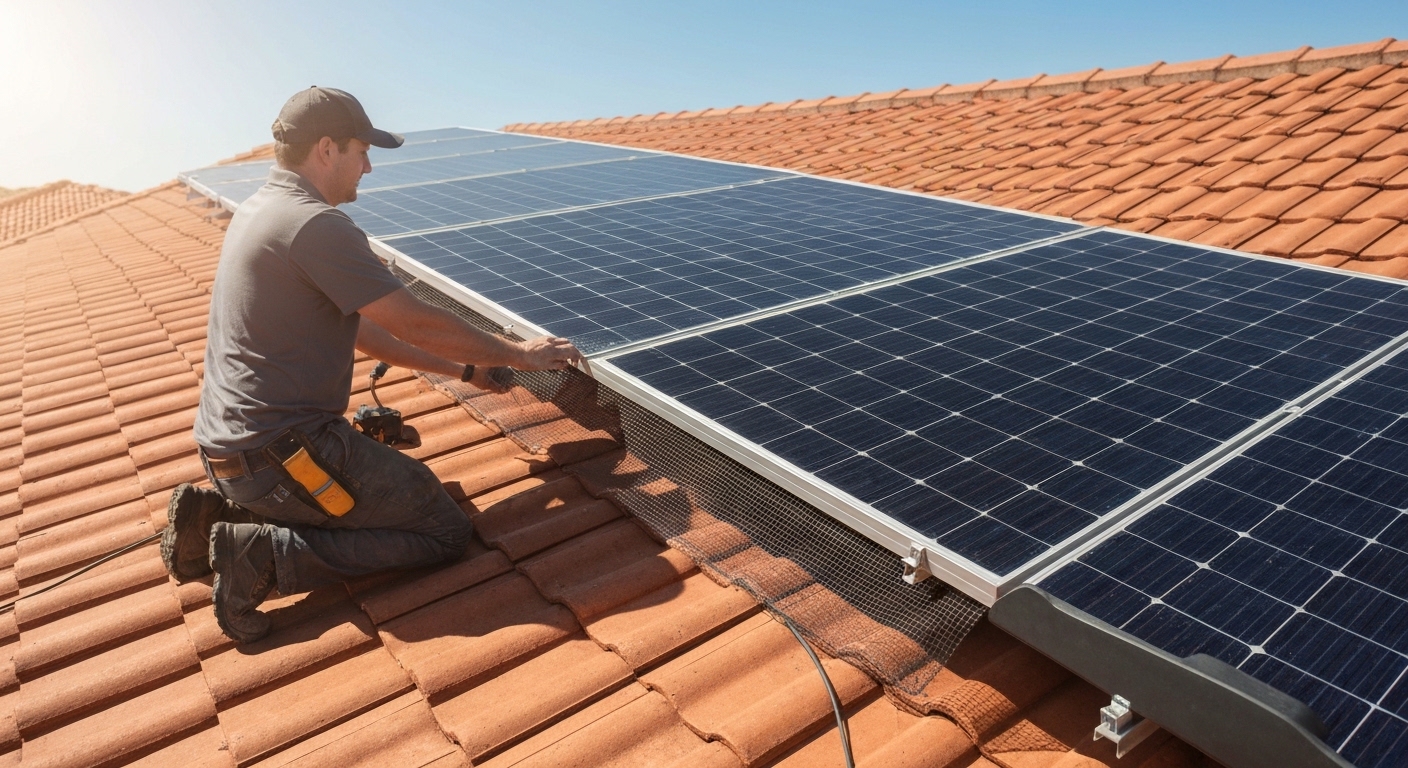
Bird proofing for solar panels uses bird mesh. This is a galvanised or stainless steel wire mesh system. It closes the gap between your panel array and the roof surface.
Without mesh, this gap becomes an ideal nesting spot. It’s elevated, sheltered, warm, and safe from predators. Birds love it. With mesh installed around the edges, birds can’t access the space.
A complete bird proofing job typically includes:
- Nest and debris removal — clearing existing nests, feathers, and droppings
- Pest inspection — checking for wiring damage and bird activity levels
- Cleaning — washing panel undersides and affected roof areas
- Mesh installation — clip-on mesh around the full panel perimeter
- Spike installation (optional add-on) — anti-roosting spikes on ridge caps
Solar Panel Bird Proofing Cost by System Size
Below are 2025 prices for professional installation. These include mesh materials, labour, and debris removal. All prices include GST.
| System Size | Panel Count | Solar Panel Bird Proofing Cost |
|---|---|---|
| Small (3–4kW) | 8–12 panels | $200–$400 |
| Standard (5–6.6kW) | 13–16 panels | $320–$580 |
| Large (8–10kW) | 20–26 panels | $480–$800 |
| Extra-large (13kW+) | 32–40 panels | $700–$1,200 |
Average solar panel bird proofing cost for a standard 6.6kW system: $380–$580
These prices assume:
- Single-storey roof with reasonable access
- Standard pitch (15–35 degrees)
- No major existing damage requiring repair
What Affects Solar Panel Bird Proofing Cost?
Roof Access Difficulty
Single-storey homes with ground access use standard pricing. Two-storey homes add $100–$200 for elevated access equipment. Steep roofs (over 35 degrees) or complex layouts add $100–$300.
Existing Infestation Severity
Active nests, chicks, or heavy debris buildup add $50–$150 to the job. Some companies charge separately for pest cleaning versus mesh installation.
Mesh Material Quality
Three quality tiers exist:
Economy (painted mild steel):
- Cost: $80–$120 less than premium
- Lifespan: 3–5 years in most Australian conditions
- Not recommended for coastal areas (rusts quickly) or high-UV regions
Mid-range (galvanised steel):
- The industry standard
- Lifespan: 8–12 years
- Suitable for most Australian climates
Premium (stainless steel or powder-coated galvanised):
- Cost: $50–$100 more than mid-range
- Lifespan: 15–20 years
- Best for coastal, tropical, or harsh UV environments
Always ask which material your quote includes. The difference isn’t always clear upfront. This affects your total solar panel bird proofing cost.
Panel Configuration
Panels in multiple separate rows cost more to mesh. Split systems on different roof faces have more perimeter to cover. More mesh runs mean higher costs.
Bundled vs. Standalone Solar Panel Bird Proofing
Best value: Bundle bird proofing with a cleaning service.
When a solar cleaning company visits for an annual clean, adding bird mesh saves money. You avoid a separate call-out:
- Separate call-out: $80–$150 in call-out fees alone
- Bundled with clean: typically $50–$80 discount on combined service
Ask when booking your annual clean if bird proofing can be added. This reduces your solar panel bird proofing cost significantly.
DIY Solar Panel Bird Proofing Cost
For handy homeowners with safe roof access, DIY bird mesh is possible.
DIY costs:
| Item | Cost |
|---|---|
| Bird mesh roll (25m, galvanised) | $40–$80 |
| Stainless steel clip set (50 clips) | $25–$50 |
| Safety equipment (if not owned) | $80–$200 |
| Total DIY materials | $80–$200 |
DIY caveats:
- Roof safety is the primary risk. Use appropriate fall protection equipment.
- Clip attachment must be correct. Too tight clips stress panel frames. Too loose clips allow birds to push through.
- Do not drill into panel frames. This voids warranties on virtually all panels.
- Mesh must cover the full perimeter without gaps. Even 10cm gaps allow pigeon access.
If you’re not fully confident in roof safety, the professional installation cost is far less than a fall-related injury.
Getting Quotes for Solar Panel Bird Proofing
When requesting quotes, ask these questions:
- What material is the mesh? (Specify galvanised or stainless steel)
- What type of clips are used? (UV-stabilised plastic or stainless steel)
- Does the quote include nest removal and cleaning?
- Is installation drill-free? (Clips onto panel rails only, no frame penetration)
- What warranty do you offer on the installation? (Look for at least 2 years)
- Are you RCSA accredited or equivalent? (Pest control component)
Get at least two quotes for any job over $400. Solar panel bird proofing costs vary significantly between companies. Sometimes prices differ by 40–50% for identical work.
State-by-State Solar Panel Bird Proofing Cost Variations
Labour rates and material costs vary across Australia:
| State | Average 6.6kW Install Cost |
|---|---|
| NSW (Sydney metro) | $380–$600 |
| VIC (Melbourne metro) | $350–$560 |
| QLD (Brisbane/SEQ) | $360–$580 |
| WA (Perth metro) | $400–$650 |
| SA (Adelaide metro) | $320–$520 |
| ACT (Canberra) | $350–$580 |
| TAS (Hobart) | $300–$500 |
| NT (Darwin) | $420–$700 |
Regional and rural areas generally add 10–30%. Travel costs and reduced competition drive this increase.
Return on Investment: Is Solar Panel Bird Proofing Worth It?
Is bird proofing worth the cost? Let’s calculate for a typical 6.6kW system owner in Brisbane.
Without bird proofing (over 5 years):
- Annual droppings-related output loss: ~8% = $240/year in electricity
- Annual cleaning cost (more frequent due to birds): +$200/year
- Wiring inspection after pigeon infestation: $150 (once)
- Total 5-year cost: (~$2,150)
With bird proofing (over 5 years):
- Installation cost: $500 (once)
- Annual cleaning cost (standard, less frequent): $150/year
- Total 5-year cost: $1,250
5-year saving: ~$900 — and the mesh lasts 10–15 years.
The ROI is strongest in areas with high bird activity. Coastal NSW/QLD, Sydney western suburbs, and Melbourne’s outer ring see the best returns. Without protection, pigeon colonies establish quickly in these areas.
Red Flags When Comparing Solar Panel Bird Proofing Quotes
Not all bird proofing installations are equal. Watch for these warning signs:
“Painted mild steel mesh” — Many budget providers use painted steel mesh at a lower price. In Australian UV and coastal conditions, paint degrades within 2–3 years. The mesh corrodes and clips fail. Request hot-dip galvanised or stainless steel explicitly.
“Chicken wire” or large-gauge mesh — Standard chicken wire has 50mm hexagonal gaps. These are large enough for juvenile pigeons and all sparrows to pass through. Solar bird mesh should use maximum 20–25mm hexagonal openings.
No mention of nest removal — If a quote doesn’t include inspecting and clearing existing nests, you risk trapping birds inside. Ensure debris removal is included in your solar panel bird proofing cost.
Drilling into panel frames — Some installers drill small holes to anchor mesh. This voids the warranty on virtually all panels. Specify: clips onto panel rails only, no penetration of frames.
No installer warranty — Reputable companies offer at least a 2-year installation warranty. This covers clip retention and mesh integrity. If no warranty is offered, walk away.
Combining Bird Proofing with Other Solar Services
Bird proofing delivers the best value when bundled with complementary solar maintenance:
Bird proofing + annual clean (most popular bundle):
- Combined cost saving: $80–$150 versus separate call-outs
- Both jobs completed in a single roof access
- Bird proofing prevents re-soiling of freshly cleaned panels immediately
Bird proofing + inspection + clean:
- Full system inspection during installation checks for wiring issues
- Ideal if there’s been an active pigeon colony for more than one nesting season
- Expect to pay $500–$900 for this full-service bundle on a standard system
Bird proofing + possum exclusion:
- If both pigeons and possums have been active (common in suburban QLD and NSW)
- Combined exclusion at perimeter addresses both species
- Possum exclusion adds $100–$200 to a bird proofing job when done simultaneously
When requesting quotes, always ask about combination discounts. This can significantly reduce your solar panel bird proofing cost.
Maintenance After Solar Panel Bird Proofing
A quality bird mesh installation is largely maintenance-free. A brief annual check extends its life:
- Inspect clips — UV-stabilised plastic clips should show no cracking or brittleness. Stainless steel clips: check for any rust (shouldn’t occur but worth verifying)
- Check mesh tension — mesh should be taut with no gaps at corners. Loose sections allow persistent birds to push through
- Clear debris from mesh surface — leaves and organic material accumulate on mesh edges. Clear to prevent moisture retention and corrosion
- Verify full perimeter — check all four sides of the array. Birds are surprisingly good at finding the one spot where mesh wasn’t attached correctly
In tropical or high-corrosion environments (coastal, Darwin/Top End), check more frequently. Every 6 months for the first few years is recommended.
The Bottom Line on Solar Panel Bird Proofing Cost
Solar panel bird proofing costs $300–$800 for most Australian homes. It’s a one-time investment that pays for itself many times over.
The key is getting quality materials. Use galvanised or stainless steel mesh with UV-stable clips. Professional installation shouldn’t compromise your panel warranty.
Get it done once, done right. You’ll never deal with pigeon nesting under your panels again.
Sources
-
Clean Energy Council — Australian solar installation standards and warranty guidelines. cleanenergycouncil.org.au
-
RCSA (Roofing and Cladding Safety Association) — Safe work practices for roof access and solar panel maintenance. rcsa.com.au
-
Australian Bureau of Statistics — Regional pricing data and construction costs by state (2024-2025). abs.gov.au
-
SolarQuotes — Industry pricing benchmarks and consumer survey data for solar maintenance services. solarquotes.com.au
Related: Solar Bird Proofing Guide Australia · Pigeons Under Solar Panels · Solar Panel Cleaning Cost 2025
Frequently Asked Questions
How much does solar panel bird proofing cost in Australia?
Bird mesh installation for a standard 6.6kW system (around 16 panels) typically costs $350–$650 installed by a professional. Smaller 10-panel systems run $250–$450; larger 20+ panel systems $550–$950+. DIY mesh kits cost $80–$150 in materials but require safe roof access and some skill to install correctly.
What is included in solar bird proofing installation?
A professional bird proofing installation typically includes: inspection of existing pest activity, removal of any current nests and debris, cleaning of panel undersides and affected roof area, installation of galvanised or stainless steel mesh clips around panel perimeter, and a basic test to confirm secure attachment. Some companies include re-securing of loose panel mounts if found.
Is bird proofing worth the cost?
Yes, in most cases. One pigeon nesting season under panels can cause $200–$500 in cleaning and wiring inspection costs, plus ongoing output losses from droppings. A single $400 bird proofing installation prevents this recurring cost for 10–15 years — a strong ROI for any homeowner who has experienced or is at risk from bird activity.
Can I claim bird proofing on my solar panel warranty?
Solar warranties don’t typically cover bird proofing as an expense, but bird damage to wiring is sometimes covered under home insurance (check your policy). Installing bird mesh proactively is considered proper maintenance — it won’t void your panel warranty if installed using clip-on systems that don’t drill into panel frames.
How long does bird mesh last on solar panels?
Quality galvanised or stainless steel mesh with UV-stabilised clips lasts 10–15 years in typical Australian conditions. Lower quality painted steel mesh or plastic-coated wire may degrade in 3–5 years in harsh UV/coastal environments. Always specify stainless steel or hot-dip galvanised mesh for Australian conditions.
How long does bird proofing installation take?
Most solar panel bird proofing installations take 1.5–3 hours depending on system size and roof complexity. A standard 6.6kW system on a single-storey home typically takes 2 hours. This includes nest removal, cleaning, and full mesh installation. Two-storey homes or complex roof layouts may take up to 4 hours.
Is bird proofing safe for my solar panels?
Yes, when done correctly. Professional installers use clip-on systems that attach to panel mounting rails without drilling into frames. This method is completely safe and doesn’t void warranties. Avoid any installer who suggests drilling into your solar panel frames, as this will void most manufacturer warranties immediately.
Frequently Asked Questions
Bird mesh installation for a standard 6.6kW system (around 16 panels) typically costs $350–$650 installed by a professional. Smaller 10-panel systems run $250–$450; larger 20+ panel systems $550–$950+. DIY mesh kits cost $80–$150 in materials but require safe roof access and some skill to install correctly.
A professional bird proofing installation typically includes: inspection of existing pest activity, removal of any current nests and debris, cleaning of panel undersides and affected roof area, installation of galvanised or stainless steel mesh clips around panel perimeter, and a basic test to confirm secure attachment. Some companies include re-securing of loose panel mounts if found.
Yes, in most cases. One pigeon nesting season under panels can cause $200–$500 in cleaning and wiring inspection costs, plus ongoing output losses from droppings. A single $400 bird proofing installation prevents this recurring cost for 10–15 years — a strong ROI for any homeowner who has experienced or is at risk from bird activity.
Solar warranties don't typically cover bird proofing as an expense, but bird damage to wiring is sometimes covered under home insurance (check your policy). Installing bird mesh proactively is considered proper maintenance — it won't void your panel warranty if installed using clip-on systems that don't drill into panel frames.
Quality galvanised or stainless steel mesh with UV-stabilised clips lasts 10–15 years in typical Australian conditions. Lower quality painted steel mesh or plastic-coated wire may degrade in 3–5 years in harsh UV/coastal environments. Always specify stainless steel or hot-dip galvanised mesh for Australian conditions.
Most solar panel bird proofing installations take 1.5–3 hours depending on system size and roof complexity. A standard 6.6kW system on a single-storey home typically takes 2 hours. This includes nest removal, cleaning, and full mesh installation. Two-storey homes or complex roof layouts may take up to 4 hours.
Yes, when done correctly. Professional installers use clip-on systems that attach to panel mounting rails without drilling into frames. This method is completely safe and doesn't void warranties. Avoid any installer who suggests drilling into your solar panel frames, as this will void most manufacturer warranties immediately.