Solar Panel Cleaning in Melbourne: Costs, Timing, and What to Watch For (2025)
Melbourne-specific guide to solar panel cleaning — pricing by suburb, seasonal timing around pollen and dust, and what local homeowners need to know about maintaining their system.
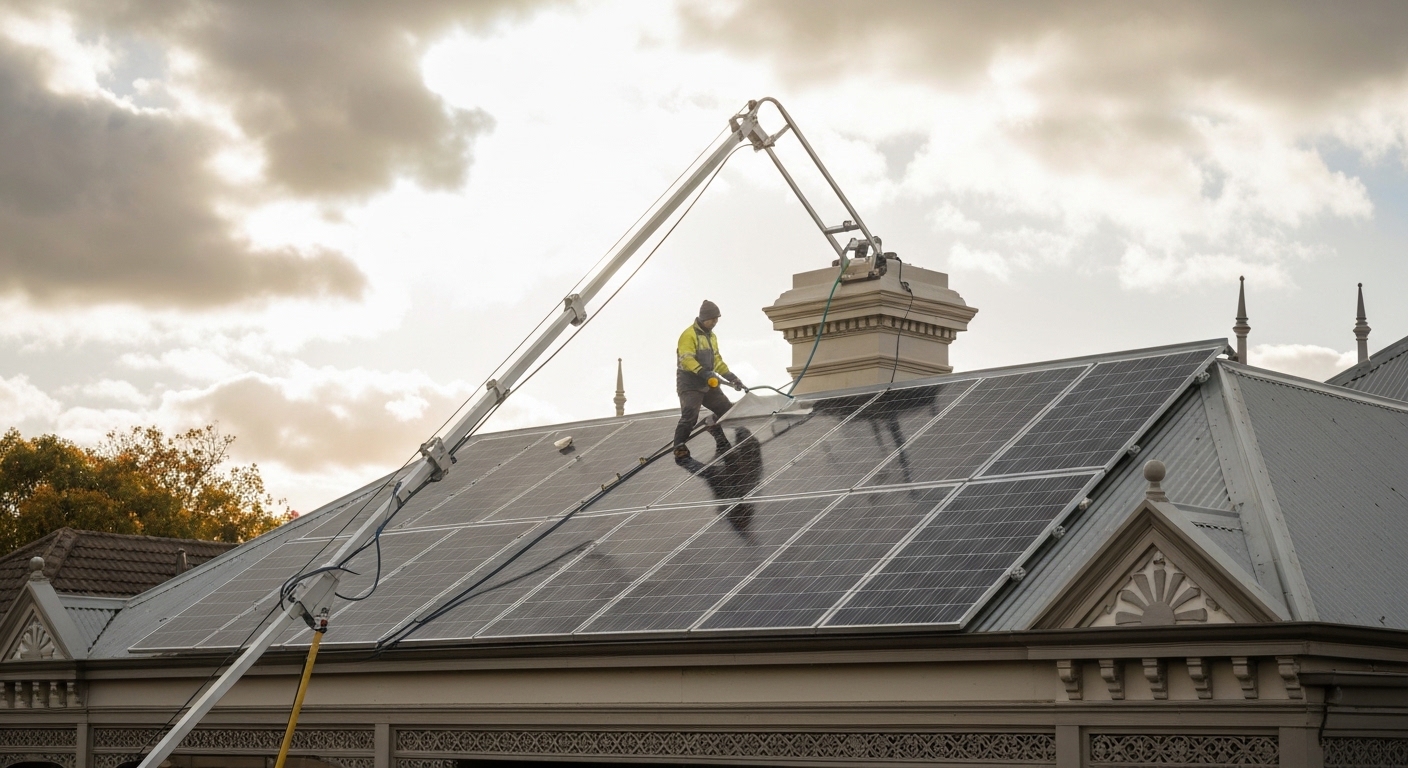
Melbourne is one of Australia’s sunniest cities by annual hours. But it also sits in one of the world’s highest pollen-count zones. The city experiences significant seasonal variation in bird activity. And it has unique dust sources that affect solar panel efficiency throughout the year.
For Melbourne’s 450,000+ solar households, understanding when and how often to clean is crucial. It’s the difference between capturing your system’s full potential and quietly losing 10–20% of output to accumulated grime.
What Solar Panel Cleaning in Melbourne Costs (2025)
Melbourne’s solar panel cleaning market is competitive. This is especially true in the outer east, south-east, and northern growth corridors. Inner city suburbs command premium pricing due to parking challenges, multi-storey access requirements, and travel efficiency.
| System Size | Panels | Melbourne Price Range |
|---|---|---|
| 3 kW | ~10 panels | $130 – $185 |
| 6.6 kW | ~20 panels | $190 – $260 |
| 10 kW | ~30 panels | $260 – $380 |
| 13.3 kW | ~40 panels | $330 – $500 |
Solar Panel Cleaning Melbourne: Pricing by Region
| Region | Price Modifier |
|---|---|
| Inner North (Fitzroy, Brunswick, Northcote) | Base + $15–$30 (access, parking) |
| Inner South (South Yarra, Prahran, Hawthorn) | Base + $10–$25 |
| Inner West (Footscray, Seddon, Yarraville) | Base |
| Outer East (Knox, Maroondah, Yarra Ranges) | Base – $5 to Base |
| South East (Dandenong, Casey, Cardinia) | Base – $5 to Base |
| Bayside (Brighton, Sandringham, Hampton) | Base + $10–$20 (salt spray premium) |
| Mornington Peninsula | Base + $20–$40 (travel distance) |
| Northern Growth (Whittlesea, Hume, Melton) | Base to Base – $10 |
Melbourne’s Specific Solar Panel Soiling Challenges
1. Plane Tree and Rye Grass Pollen (The Big Problem)
Melbourne consistently ranks as having some of the world’s worst pollen conditions. London Plane trees line iconic boulevards like Swanston Street and Royal Parade. They shed heavy pollen through September and October. This pollen lands on every horizontal surface, including solar panels.
Rye grass pollen from the Gippsland and Yarra Valley farming areas peaks from October to December. It has a distinctive sticky quality. This makes it harder to remove from glass than most other pollen types.
Impact: A Melbourne system cleaned in August can have measurable pollen coating within 4–6 weeks. For maximum efficiency, plan your annual solar panel cleaning in Melbourne for late November or early December (after the pollen peak). Or choose April–May (autumn, more stable weather).
2. Thunderstorm Asthma Risk Areas
The November 2016 thunderstorm asthma event showed how massive rye grass pollen loads in the air can be. For solar owners, high-pollen days mean panels in south-east suburbs (Dandenong, Frankston, Cranbourne corridor) accumulate film much faster than inner north areas.
3. Dust from the North-West
Melbourne receives hot, dry north-westerly winds — the infamous “northerlies”. These carry fine mineral dust from central Victoria and the Mallee. Major dust events deposit visible reddish-brown layers on panels. North-west-facing panels are particularly affected.
Significant north-westerly events in summer and early autumn (January–March) can reduce output by 8–15% within days of cleaning.
4. Yarra and Port Phillip Bay Moisture
Inner suburbs near the Yarra River and bay-adjacent suburbs (Williamstown, Newport, St Kilda, Albert Park) experience higher humidity. Morning dew and coastal moisture are common. This promotes faster biological growth on panel surfaces — including algae and pollen bonding.
5. Bird Activity
Melbourne has a robust urban bird population. Key offenders for solar panel fouling include:
- Indian Myna (invasive, aggressive, abundant across all Melbourne suburbs — worst in established inner-north and inner-east)
- Sulphur-Crested Cockatoo (chews panel wiring — a separate issue from soiling)
- Pigeon (roof-nesting, produces high volumes of acidic waste)
- Common Corella (increasingly common in outer north and west)
Suburbs near Princes Park, Brimbank Park, Westgate Park, and the Dandenong Ranges foothills have above-average bird fouling rates.
Best Solar Panel Cleaning Schedule for Melbourne Homeowners
| Situation | Recommended Schedule |
|---|---|
| Standard inner/middle suburb | Once per year — April–May |
| Near parkland, boulevard trees, or waterways | Twice per year — November/December + April/May |
| Bayside (coastal) | Twice per year — spring + autumn |
| North/west outer suburbs (dust affected) | Once per year — autumn (post-dust season) |
| Near Dandenong Ranges (high humidity + birds) | Twice per year |
Why Autumn Is Melbourne’s Best Solar Panel Cleaning Window
April–May in Melbourne offers:
- End of pollen season (most pollen deposition complete)
- Cooling temperatures (reduced thermal shock risk during cleaning)
- Pre-winter preparation (captures maximum efficiency through June–August short days)
- Off-peak availability for cleaners (faster booking, sometimes lower pricing)
- Lower UV index (comfortable working conditions, reduces premature water drying)
Melbourne Water Quality Note
Melbourne’s water supply comes predominantly from the Thomson, O’Shaughnessy, and Cardinia catchments. It has naturally low mineral content — typically 25–65 ppm TDS (total dissolved solids), according to Melbourne Water quality reports. This is good news for DIY cleaners. Melbourne tap water is among the lowest-risk in Australia for mineral spotting.
That said, water quality varies by suburb and network. Hot panels can still produce spotting from even low-TDS water. Purified or deionised water is still the professional standard. But Melbourne homeowners have more latitude here than Perth or Adelaide users.
What to Ask When Booking Solar Panel Cleaning in Melbourne
- Do you use purified water? (Desirable, not as critical as in Perth/Adelaide but still recommended)
- Do you carry public liability insurance? (Check ABN + request certificate)
- What’s your method for bird droppings? (Should be: soak, soft brush — not scraping or pressure washing)
- Do you offer a service report? (Any reputable provider should)
- Working at Heights trained? (Required for any work on roofs under Victorian WHS regulations)
DIY Solar Panel Cleaning Considerations for Melbourne Homeowners
Melbourne’s housing stock is diverse. It ranges from inner-city terraces (small, accessible, ground-floor panels common) to large outer-suburban homes with two-storey configurations.
Melbourne-specific DIY tip: Melbourne tap water has lower TDS than most Australian cities. But it still benefits from a cheap inline DI filter for best results. This is particularly true during summer when panels heat up quickly and water evaporates before running off.
Good candidates for Melbourne DIY solar panel cleaning:
- Bungalows and single-storey homes in Brunswick, Preston, Coburg, Footscray, Sunshine, Altona
- Ground-floor townhouses and units with accessible north-facing panels
- Any property where panels can be reached safely by extension pole from the ground
Not suitable for DIY:
- Two-storey homes with panels above first-floor level
- Steep-pitch roofs common in Edwardian and Victorian era properties (inner north, inner east)
- Properties where panels are near hip or gable ends with no safe access point
How Much Output Do Melbourne Solar Systems Lose to Soiling?
Australian research (including ARENA-funded studies) suggests average soiling losses of 8–15% per year under normal conditions. Peaks up to 20–25% can occur after significant pollen or dust events, according to Clean Energy Council documentation.
For a 6.6 kW Melbourne system at a 26 c/kWh self-consumption rate and 8 c/kWh export, recovering 12% output represents approximately $90–$160 per year in electricity value. This means a $220 professional solar panel cleaning in Melbourne pays for itself within one to two billing cycles after a full year of soiling accumulation.
Summary
Melbourne solar panel owners should plan for one professional clean per year in autumn. Consider twice-yearly cleaning for properties near parks, boulevards, or the bay. Budget $190–$260 for a standard 6.6 kW system. Verify insurance and water quality practices before booking. Use your inverter app to track output through the season.
The city’s pollen season is the biggest soiling driver. Time your solar panel cleaning in Melbourne to follow it, not precede it.
Melbourne’s Bay Suburbs: Salt Film and Biological Growth
Homeowners in Melbourne’s bay-side suburbs face a specific combination that inland Melbourne doesn’t. Suburbs like Sandringham, Brighton, Hampton, Beaumaris, and coastal Frankston are affected.
Salt aerosol deposition: Sea spray and salt-laden winds from Port Phillip Bay deposit a thin invisible salt film on panel surfaces year-round. This film doesn’t dramatically reduce output on its own. But it:
- Creates a sticky surface that traps additional airborne particles
- Attracts moisture during dew events, concentrating salt further
- Accelerates corrosion of aluminium frame components over years
Recommended response for bay-side Melbourne solar panel cleaning: Three annual cleans (spring, autumn, mid-winter) with a focus on thorough rinsing using DI water. The DI rinse is particularly important. It avoids re-depositing salt in a concentrated form as water evaporates.
Melbourne’s Pollen Calendar: Aligning Solar Panel Cleaning with Peak Soiling
Understanding Melbourne’s botanical soiling calendar helps time cleaning for maximum effect:
- August–September: Plane trees (along major boulevards), European elms, and oaks begin releasing pollen. Light sticky coating begins accumulating on panels city-wide.
- October: Ryegrass and other grass pollens peak — Melbourne’s notorious high-pollen days during this period. Panel soiling from pollen is at its annual worst.
- November: Pollen load begins to drop. Optimal first clean window — catches the full pollen accumulation in one service.
- February–March: Summer dust and bird dropping accumulation from the long dry period. Optimal second clean window for twice-yearly customers.
Timing your Melbourne solar panel cleaning in November and March captures the two highest-soiling periods of the year. This maximises the output benefit of each service.
Sources
-
Melbourne Water (2024). Water Quality Annual Report 2023-24. Melbourne Water Corporation. https://www.melbournewater.com.au/water-data-and-education/water-quality
-
Clean Energy Council (2023). Solar Panel Maintenance Best Practice Guidelines. Clean Energy Council of Australia. https://www.cleanenergycouncil.org.au
-
ARENA (Australian Renewable Energy Agency) (2022). Soiling Losses in Australian Solar PV Systems: Field Study Results. ARENA Research Reports. https://arena.gov.au
-
Victorian Department of Health (2023). Melbourne Pollen Count and Forecast Data 2022-23. State Government of Victoria. https://www.betterhealth.vic.gov.au
Last updated: April 2026. Price estimates reflect Melbourne market rates. Always request individual quotes from at least two providers.
Related: Solar Panel Cleaning Cost Australia 2025 · How Often to Clean Solar Panels · Choosing a Solar Panel Cleaner Australia
Frequently Asked Questions
How much does solar panel cleaning cost in Melbourne?
Professional solar panel cleaning in Melbourne costs approximately $190–$260 for a standard 6.6 kW system. Inner city and inner north suburbs may be at the higher end; outer suburbs and the east tend to have more competitive pricing.
Does Melbourne’s rain keep solar panels clean?
Partly, but not fully. Melbourne’s rain does remove loose dust but leaves behind pollen residue, bird droppings, and hard mineral spots from tap water runoff. Most Melbourne systems still benefit from one professional clean per year.
When is the best time to clean solar panels in Melbourne?
Late autumn (April–May) is ideal for Melbourne. It follows the pollen season, captures full benefit before winter’s short days, and precedes the worst dust and bushfire smoke period. Avoid cleaning during or just after the spring pollen peak (September–November).
Is bird fouling a problem for Melbourne solar panels?
Yes — Indian Myna birds, pigeons, and Corellas are common across Melbourne suburbs and cause significant fouling. Properties near Yarra River parklands, the Dandenong Ranges foothills, and established elm/plane tree streets have above-average bird dropping rates.
Frequently Asked Questions
Professional solar panel cleaning in Melbourne costs approximately $190–$260 for a standard 6.6 kW system. Inner city and inner north suburbs may be at the higher end; outer suburbs and the east tend to have more competitive pricing.
Partly, but not fully. Melbourne's rain does remove loose dust but leaves behind pollen residue, bird droppings, and hard mineral spots from tap water runoff. Most Melbourne systems still benefit from one professional clean per year.
Late autumn (April–May) is ideal for Melbourne. It follows the pollen season, captures full benefit before winter's short days, and precedes the worst dust and bushfire smoke period. Avoid cleaning during or just after the spring pollen peak (September–November).
Yes — Indian Myna birds, pigeons, and Corellas are common across Melbourne suburbs and cause significant fouling. Properties near Yarra River parklands, the Dandenong Ranges foothills, and established elm/plane tree streets have above-average bird dropping rates.