Solar Panel Cleaning for Rental Properties: Landlord and Tenant Responsibilities
Who is responsible for solar panel cleaning in Australian rental properties? A plain-English guide to landlord and tenant obligations, lease clauses, and best practices.
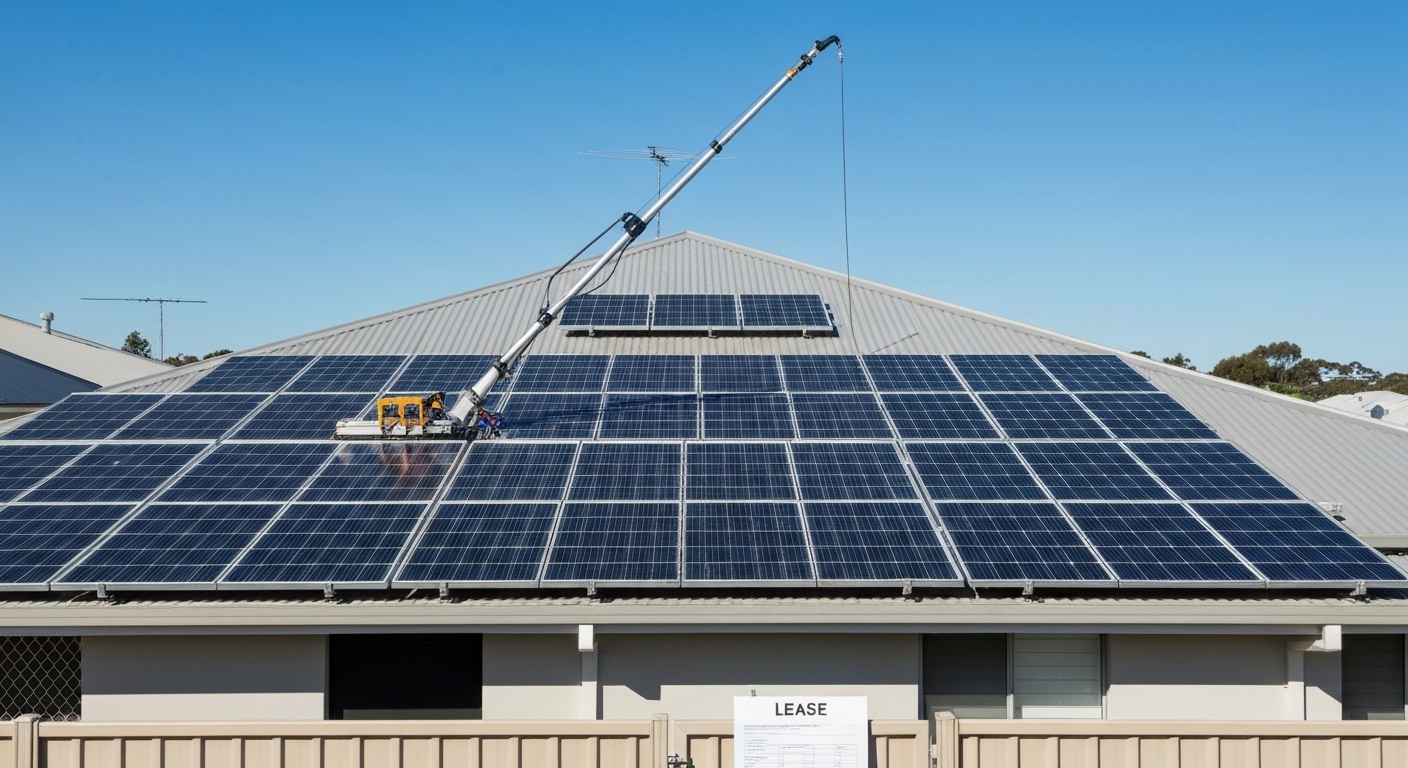
Solar panels on rental properties sit in a legally murky area. Many landlords and tenants navigate this badly. Sometimes it ends in warranty-voided panels, bond disputes, or years of poor system performance that nobody fixed.
This guide clarifies who’s responsible for solar panel cleaning in rental properties across Australian states. It explains what should be in a tenancy agreement. And it gives both landlords and tenants practical guidance for keeping panels clean and functional throughout the tenancy.
Key Takeaways
- Landlords must keep solar panels in working order
- Solar panel cleaning for rental properties is part of routine maintenance
- Tenants can request cleaning if panels are visibly dirty
- The lease should state who pays for cleaning
- Most leases say the landlord pays — check your lease first
- Clean systems earn more from feed-in tariffs and reduce tenant bills
Who is Responsible for Solar Panel Cleaning in Rental Properties?
Solar panels are a fixture attached to the property. They’re like ducted air conditioning or a built-in oven. Under Australian residential tenancy law in all states and territories, the landlord must keep the property (including fixed fixtures) in reasonable repair.
Key principle: If solar panels are part of the property at the start of the tenancy, the landlord is responsible for maintaining them. This applies unless the tenancy agreement specifically assigns maintenance tasks to the tenant.
According to the Clean Energy Council, over 30% of Australian homes now have rooftop solar. As this number grows, rental properties with solar are becoming standard. Clear maintenance responsibilities protect both parties.
State-by-State Responsibilities for Solar Panel Cleaning
| State/Territory | Solar Panel Maintenance Responsibility | Key Notes |
|---|---|---|
| NSW | Landlord (unless lease assigns to tenant) | Residential Tenancies Act 2010 requires landlord to maintain premises in reasonable repair |
| VIC | Landlord | Residential Tenancies Act 1997, as amended — landlord responsible for appliances and fixtures |
| QLD | Landlord | RTRA 2008 — landlord responsible for “reasonable state of repair” |
| WA | Landlord | Residential Tenancies Act 1987 — fixtures maintained by landlord |
| SA | Landlord | Landlord responsible for maintaining all fixtures in working order |
| TAS | Landlord | Residential Tenancy Act 1997 |
| ACT | Landlord | Residential Tenancies Act 1997 |
| NT | Landlord | Residential Tenancies Act 1999 |
> Important: This is general information only. Specific tenancy agreement terms may vary responsibilities. Always consult your state tenancy authority or a lawyer for your specific situation.
What This Means in Practice
Landlord Obligations for Solar Panel Maintenance
If you own a rental property with solar panels, you are responsible for:
- Annual professional cleaning — as part of routine property maintenance
- Inverter servicing — addressing error codes and faults promptly
- Bird proofing — if bird damage or nesting is causing deterioration
- Post-storm inspection — checking for panel damage after severe weather
- Addressing output decline — if tenants report the system isn’t working as expected
Neglecting solar panel cleaning for rental properties isn’t just bad for the asset. Tenants can use it as grounds to escalate to the relevant tenancy tribunal if they’re not receiving the electricity benefit they were promised.
Best practice for landlords: Schedule an annual professional solar panel clean as part of routine property maintenance (alongside gutter cleaning, pest inspection, etc.). Budget $180–$280 for a standard 6.6 kW system.
Research from the CSIRO shows that soiled solar panels can lose 15–25% of their output in Australian conditions. For a typical 6.6 kW system, that’s $150–$300 per year in lost generation value.
Tenant Rights and Responsibilities
If you’re renting a property with solar panels:
- You benefit from the solar electricity generated — either through lower bills or a sub-metered arrangement negotiated with the landlord
- You are responsible for reporting issues — if you notice significantly reduced output, a dashboard alarm, or visible panel damage, notify your property manager in writing
- You are generally NOT responsible for cleaning — unless your tenancy agreement specifically and clearly states otherwise
- Do NOT attempt DIY cleaning — if you use incorrect methods and damage the panels, you may be liable for repair costs. Always request cleaning through your property manager
When Can a Landlord Require Tenants to Clean Solar Panels?
A landlord can assign solar panel cleaning to a tenant IF:
- The tenancy agreement explicitly states this obligation (not just a generic “maintain appliances” clause)
- The panels are safely accessible (single-storey, low pitch, reachable without professional equipment)
- The tenant is not expected to perform tasks that require professional skills or equipment
- The assigned task doesn’t create work health and safety risk to the tenant
Even if a tenancy agreement assigns cleaning to the tenant, the landlord remains responsible for any damage caused by roof inaccessibility, panel fault, or circumstances outside the tenant’s control.
What Should Be in a Rental Agreement
For landlords drafting or reviewing lease agreements:
Recommended clause for solar panel cleaning in rental properties (seek legal review before use):
> “The landlord is responsible for the annual professional cleaning and maintenance of the solar photovoltaic system, including panels and inverter. The tenant agrees to notify the property manager promptly of any visible damage to panels, error codes on the inverter display, or significant unexplained reduction in system output.”
Avoid vague language like “tenant to maintain all appliances”. This is unlikely to be enforceable for solar and creates confusion.
If you intend for the tenant to perform cleaning, use specific language:
> “The tenant is responsible for cleaning solar panels [X times per year] using appropriate soft-brush and purified water techniques. The landlord will provide cleaning equipment at the start of the tenancy. The tenant must not use pressure washers, abrasive cleaning products, or chemical cleaners on panels. Any damage caused by non-approved cleaning methods may be claimed against the tenant’s bond.”
Common Disputes About Solar Panel Cleaning in Rentals
”The solar panels aren’t working and my electricity bills are the same”
This is the most common tenant complaint. Often it’s caused by accumulated soiling, inverter fault, or the tenant never being shown how to monitor the system.
Prevention: At tenancy commencement, the landlord or property manager should:
- Show the tenant how to access the inverter monitoring app
- Explain what normal output looks like seasonally
- Provide a contact for reporting issues
Resolution: Landlord arranges professional clean and/or inverter check within a reasonable timeframe (typically 14–21 days for non-urgent maintenance).
”The tenant tried to clean the panels and scratched them”
Prevention: Clearly state in the tenancy agreement that tenants must not attempt DIY solar cleaning. All maintenance requests should go through the property manager.
Resolution: If damage is proven to be tenant-caused and outside the scope of their tenancy agreement, the landlord can claim repair costs from the bond. But you must prove causation.
”The landlord hasn’t cleaned the panels in three years”
Tenants may have grounds for complaint if a landlord’s failure to maintain panels has materially reduced the solar benefit. This benefit may have been an explicit or implied feature of the tenancy.
Prevention: Annual professional cleaning as standard property maintenance.
Managing Solar Panel Cleaning in Strata Buildings
Where solar panels are on common property (shared roof), maintenance is the responsibility of the owners corporation / body corporate. It’s not individual lot owners or tenants. If you rent a unit and the building has rooftop solar:
- Energy may be distributed to common areas and units via a sub-metering arrangement
- The owners corporation is responsible for panel maintenance
- Raise maintenance concerns with the building manager or strata committee
Practical Landlord Checklist for Solar Panel Maintenance
✅ Schedule annual professional solar panel clean as part of property maintenance calendar
✅ Ensure tenancy agreement has a clear, specific clause on solar responsibilities
✅ Provide tenants with inverter monitoring app access and basic usage guidance at start of tenancy
✅ Respond to tenant maintenance reports within the legally required timeframe for your state
✅ Conduct a solar system health check before re-letting (between tenancies is the ideal cleaning opportunity)
✅ Consider bird proofing if bird activity has been noted — protects long-term asset value
Tax Treatment of Solar Panel Cleaning Costs
For Australian landlords, solar panel cleaning is a legitimate rental property expense. You can deduct it against rental income in the year the expense is incurred.
Key Australian Taxation Office (ATO) guidance:
- Routine maintenance (cleaning, minor repairs): Immediately deductible as a rental deduction
- Capital work (panel replacement, new installation, upgrade): Depreciated under the capital works schedule
- Repairs that are more than maintenance (full wiring replacement after pest damage): May be capital works — seek advice from a tax professional
Keep receipts and invoices for all solar cleaning services. These form part of your rental property expense records. They support deductions on your tax return. For landlords using a property manager, ensure cleaning invoices flow through to your property management account for accurate expense tracking.
Lease Clause Templates for Solar Panel Maintenance
If you’re a landlord renewing a lease or preparing a new tenancy agreement with solar panels on the property, consider adding a specific clause. Here are two practical templates:
Landlord-maintains clause (recommended):
> “The landlord is responsible for the professional cleaning and maintenance of the solar panel system installed at the property. The landlord will arrange and fund professional solar panel cleaning no less than once per 12 months. The tenant agrees to provide reasonable access to the roof and solar system for this purpose upon receiving not less than [24/48] hours written notice.”
Tenant-maintains clause (for informed, capable tenants):
> “The tenant acknowledges the property is fitted with a solar photovoltaic system. The tenant agrees to maintain the solar panels in a clean condition consistent with reasonable residential use, including arranging or performing appropriate cleaning no less than once per 12 months using only methods approved by the panel manufacturer (water and soft brush; no pressure washing or abrasive products). The landlord will reimburse the tenant for documented professional cleaning costs up to [$X] per service upon presentation of a tax invoice.”
Both clauses should reference any specific system documentation provided at the start of the tenancy.
Conclusion
Solar panels on rental properties add value to landlords and real savings to tenants. But only when properly maintained. In Australia, maintenance is the landlord’s default responsibility. Annual professional solar panel cleaning for rental properties is a reasonable and legally prudent standard.
Both parties benefit from clear lease language, good communication, and a landlord who treats solar maintenance as routine asset management.
Landlords who neglect solar panel cleaning risk reduced system performance, unhappy tenants, and potential tribunal disputes. A simple annual clean costs $180–$280 but protects an asset worth thousands.
Related: Solar Panel Cleaning Cost Australia 2025 · What Voids Solar Panel Warranty · Solar Panel Maintenance Checklist Australia
Frequently Asked Questions
Who is responsible for cleaning solar panels in a rental property?
In most Australian states, solar panel cleaning falls under general property maintenance, which is the landlord’s responsibility unless the lease specifically assigns it to the tenant. However, if tenant behaviour causes soiling damage (e.g., using incorrect cleaning products), the tenant may be liable for repair costs.
Can a landlord require tenants to clean solar panels?
Yes, if the lease specifically states this obligation and the panels are accessible and safe to clean. The tenancy agreement must be specific about what’s required. Vague references to ‘maintaining appliances’ are unlikely to be enforceable for solar panel cleaning.
What happens if a tenant damages solar panels while cleaning?
If a tenant attempts DIY cleaning and causes damage — scratched glass, pressure washer damage, or warranty-voiding chemical use — they may be liable for repair or replacement costs. Tenants should request professional cleaning from the landlord rather than attempting it themselves.
Do solar panels affect rental property value?
Yes — solar panels are an increasingly important feature for rental properties in Australia. They reduce tenant electricity costs and are positively associated with rental yield and vacancy rates. Maintaining them properly protects the landlord’s investment and keeps tenants happy.
How much does solar panel cleaning cost for rental properties?
Solar panel cleaning for rental properties typically costs $180–$280 annually for a standard 6.6 kW system. Landlords can claim this as a tax deduction against rental income. The cost is usually lower than the value added to tenant satisfaction and property performance.
How often should landlords arrange solar panel cleaning?
Landlords should arrange professional solar panel cleaning at least once per year. In dusty regions, near industrial areas, or after bushfire season, twice-yearly cleaning may be needed. Regular cleaning maintains system performance and protects your investment.
Sources
-
Clean Energy Council (2024). “Australian Solar Report 2024”. Retrieved from cleanenergycouncil.org.au
-
CSIRO (2023). “Solar Panel Soiling and Performance Degradation in Australian Climates”. Commonwealth Scientific and Industrial Research Organisation.
-
Australian Taxation Office (2024). “Rental properties: Repairs, maintenance and capital expenses”. ato.gov.au/individuals/income-and-deductions/rental-properties
-
Residential Tenancies Authority Queensland (2024). “Landlord Responsibilities for Fixtures and Fittings”. rta.qld.gov.au
-
NSW Fair Trading (2024). “Residential Tenancies Act 2010 — Maintenance and Repairs”. fairtrading.nsw.gov.au
Frequently Asked Questions
In most Australian states, solar panel cleaning falls under general property maintenance, which is the landlord's responsibility unless the lease specifically assigns it to the tenant. However, if tenant behaviour causes soiling damage (e.g., using incorrect cleaning products), the tenant may be liable for repair costs.
Yes, if the lease specifically states this obligation and the panels are accessible and safe to clean. The tenancy agreement must be specific about what's required. Vague references to 'maintaining appliances' are unlikely to be enforceable for solar panel cleaning.
If a tenant attempts DIY cleaning and causes damage — scratched glass, pressure washer damage, or warranty-voiding chemical use — they may be liable for repair or replacement costs. Tenants should request professional cleaning from the landlord rather than attempting it themselves.
Yes — solar panels are an increasingly important feature for rental properties in Australia. They reduce tenant electricity costs and are positively associated with rental yield and vacancy rates. Maintaining them properly protects the landlord's investment and keeps tenants happy.
Solar panel cleaning for rental properties typically costs $180–$280 annually for a standard 6.6 kW system. Landlords can claim this as a tax deduction against rental income. The cost is usually lower than the value added to tenant satisfaction and property performance.
Landlords should arrange professional solar panel cleaning at least once per year. In dusty regions, near industrial areas, or after bushfire season, twice-yearly cleaning may be needed. Regular cleaning maintains system performance and protects your investment.