Solar Panel Cleaning in Sydney: What It Costs and Who to Hire (2025)
Everything Sydney homeowners need to know about solar panel cleaning — average prices, best timing, what to ask providers, and areas with the worst soiling problems.
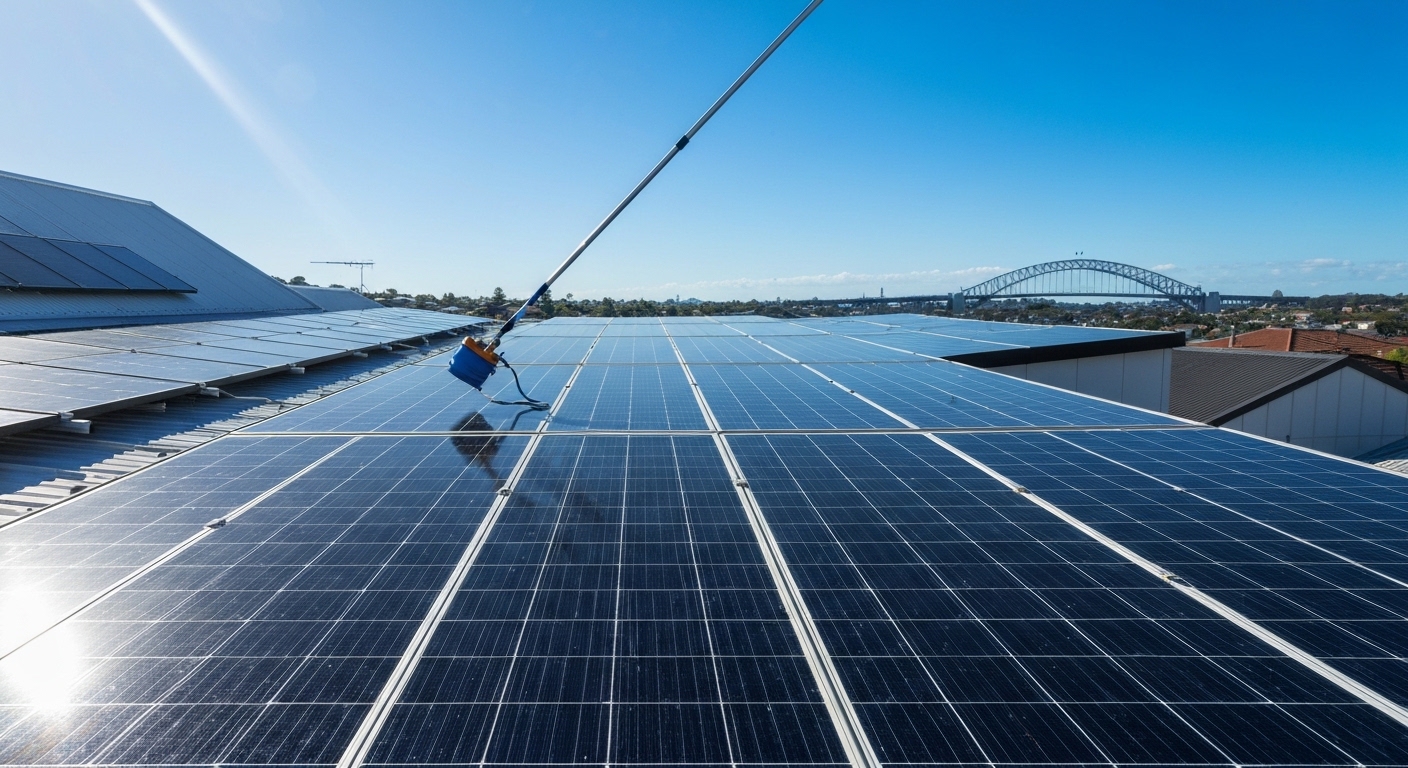
Sydney has more solar panel installations per capita than almost any other city in the world — and a climate that presents some unique challenges for keeping those panels clean. Strong westerly winds bring red-brown dust from the Blue Mountains, coastal suburbs deal with salt spray, and the city’s extraordinary birdlife means panels get fouled faster than most homeowners realise.
According to the Clean Energy Council, Sydney had over 280,000 solar installations as of 2024, making solar panel cleaning Sydney’s fastest-growing maintenance service. This guide is specifically for Sydney homeowners: what solar panel cleaning in Sydney costs in your suburb, when to book, what soiling factors to watch for, and what questions to ask before you hire anyone.
What Solar Panel Cleaning Costs in Sydney (2025)
Sydney pricing is among the higher end nationally, reflecting higher labour costs, competition from established cleaning companies, and the prevalence of two-storey homes in many suburbs. Professional solar panel cleaning Sydney providers typically charge based on system size and roof accessibility.
| System Size | Panels | Sydney Price Range |
|---|---|---|
| 3 kW | ~10 panels | $140 – $190 |
| 6.6 kW | ~20 panels | $200 – $280 |
| 10 kW | ~30 panels | $280 – $400 |
| 13.3 kW | ~40 panels | $360 – $520 |
> Prices include labour, equipment, and purified water rinse. Most Sydney providers include a basic visual inspection. Always confirm what’s included before booking.
Solar Panel Cleaning Sydney: Price Variation by Region
| Region | Typical Price Modifier |
|---|---|
| Inner West, Inner South (Newtown, Marrickville, Leichhardt) | Base + $20–$40 (parking and access) |
| Lower North Shore (Mosman, Neutral Bay, Willoughly) | Base + $30–$50 (multi-storey common) |
| Northern Beaches (Manly, Dee Why, Newport) | Base + $10–$30 (travel for some providers) |
| Eastern Suburbs (Bondi, Randwick, Maroubra) | Base + $10–$30 (salt spray, more calls) |
| Western Sydney (Parramatta, Penrith, Campbelltown) | Base, sometimes Base – $10 (more providers) |
| Hills District (Castle Hill, Baulkham Hills, Kellyville) | Base |
| South West (Liverpool, Fairfield, Campbelltown) | Base – $10 to Base |
Sydney’s Unique Soiling Factors
Research from UNSW’s School of Photovoltaic and Renewable Energy Engineering indicates that Sydney’s urban environment creates distinct soiling challenges that can reduce solar panel efficiency by 15-35% annually if left unaddressed.
1. Dust from the West
Sydney receives significant dust loads during north-westerly wind events, particularly in summer. Dust from western NSW can arrive as a visible reddish-brown layer on panels within hours. Properties in Castle Hill, Penrith, and the Hills District are most affected, but even inner-city suburbs experience measurable soiling after major dust events.
After a dust storm: check your inverter output. If it’s dropped more than 10% versus prior-day averages, your panels need a wash. CSIRO studies show that dust accumulation in western Sydney suburbs can reduce output by 8-12% within just two weeks of a major dust event.
2. Urban Birds
Sydney’s urban birdlife is spectacular — and destructive to solar panels. Rainbow Lorikeets, Australian White Ibis (“bin chickens”), Sulphur-Crested Cockatoos, and Indian Mynas all deposit waste that:
- Contains uric acid (etches glass coatings slowly over years)
- Dries into hard deposits that require soaking to remove
- Creates point shadows that can cause “hot spots” — localised heat damage to individual cells
Suburbs near the Royal Botanic Garden, Centennial Park, and any large tree-lined street are particularly bird-affected. Consider bird mesh installation if you’re spending more than $100/year on fouling-related cleaning surcharges.
3. Coastal Salt Spray
Beachside suburbs within 3–5 km of the coast — Bondi, Bronte, Manly, Cronulla, Narrabeen — experience salt spray deposition. Salt forms an invisible hydrophobic film that reduces water shedding (meaning rain doesn’t self-clean effectively) and, over years, can corrode panel frames and mounting hardware.
According to Australian Standard AS/NZS 5033:2021, coastal homeowners should clean at minimum twice yearly and inspect mounting hardware annually to prevent accelerated degradation.
4. Pollen Season
Sydney’s spring pollen season (August–November) is severe, driven by coastal banksias, grasses, and suburban plantings. Pollen combines with morning dew to form a sticky film on glass surfaces. For homeowners near parklands — Lane Cove, Ku-ring-gai, Centennial Park environs — spring cleaning in late November (after peak pollen) and autumn (April/May) is the most effective schedule.
5. Flight Path Suburbs
Sydney Airport’s flight paths pass over a significant portion of the city’s inner south and south-west. Aviation fuel particulates and exhaust contribute to a fine carbon-based soiling layer on panels in suburbs including:
- Bexley, Bardwell Park, Tempe
- Mascot, Rosebery, Botany
- Dulwich Hill, Marrickville (east-west departures)
- Leichhardt, Lilyfield (NDB approach tracks)
If you live under a flight path, half-yearly cleaning will produce meaningfully better results. Studies measuring airborne particulates in these areas show 40-60% higher carbon deposition rates compared to non-flight-path suburbs.
Best Time to Book Solar Panel Cleaning in Sydney
| Season | Recommendation |
|---|---|
| Autumn (Apr–May) ⭐ | Best time. Dust and pollen settled, before winter sun angles, off-peak pricing |
| Winter (Jun–Aug) | Good — clean panels capture limited winter sun more efficiently. Less competition |
| Spring (Sep–Nov) | Wait until after peak pollen (late November) for best results |
| Summer (Dec–Feb) | High demand, book 2–3 weeks ahead. Clean in morning only — thermal shock risk |
What Professional Solar Panel Cleaning in Sydney Should Include
A reputable Sydney provider should deliver:
- Pre-clean safety check — panel condition, any cracked glass or loose wiring flagged
- Purified or deionised water — not tap water (Sydney tap TDS runs 80–120 ppm — mineral spotting risk)
- Soft-bristle brush agitation — not a pressure washer
- Final rinse and squeegee — streak-free finish
- Post-clean output comparison — most reputable providers check inverter before and after
- Written or emailed service report — dates, findings, any issues flagged
Always ask: “Do you use purified water?” If the answer is no or uncertain, find another provider. The Clean Energy Council recommends only using deionised water for solar panel cleaning to prevent mineral deposits.
Questions to Ask Before You Book Solar Panel Cleaning in Sydney
Before committing to any Sydney solar cleaner, ask:
- Do you carry public liability insurance? (Minimum $10 million — essential for any roof work in NSW)
- Do you use deionised or purified water?
- Do you use a pressure washer? (The correct answer is no)
- Do you provide a written service report?
- Are you Working at Heights certified? (Required under NSW Work Health and Safety Act for work on roofs)
- Do you offer a performance guarantee or re-clean if output doesn’t improve?
A company that pushes back on any of these questions should be avoided.
Red Flags for Sydney Solar Cleaners
- Quotes under $120 for a full 6.6 kW system (below market rate = cutting corners on equipment or insurance)
- Uses a standard garden hose with tap water
- Offers to use a pressure washer “at low setting” — this still voids most panel warranties
- No written quote or contract
- No phone number on website or quote (take the ABN and verify on ABN Lookup)
- Cannot produce an insurance certificate of currency on request
DIY Solar Panel Cleaning in Sydney: Is It Practical?
Sydney’s predominantly suburban housing stock means many homes are double-storey or have medium-to-steep pitched roofs — making DIY cleaning impractical for a significant portion of the city’s solar owners.
DIY solar panel cleaning in Sydney is reasonable if:
- You have a single-storey home with a low-pitch (under 25°) roof
- You can reach panels safely from ground level or a stable single-point ladder
- You have access to a purified water source (DI filter or pre-filled drums from hardware stores)
For everyone else, the $200–$280 professional clean is the better choice when weighed against the risk of a fall or warranty-voiding incident.
Conclusion
Sydney homeowners should plan for at least one professional solar panel clean per year, preferably in autumn. Budget $200–$280 for a standard 6.6 kW system, ask the right questions before booking, and keep an eye on your inverter app to catch soiling-related output drops early.
For bird-affected systems, consider proactive bird proofing mesh installation — the up-front cost prevents ongoing cleaning surcharges and protects your warranty.
Sydney’s Soiling Calendar: When to Book
Sydney’s subtropical-influenced climate creates distinct soiling seasons that should guide your solar panel cleaning schedule:
September–October (Spring Pollen): Sydney’s coastal hinterland — Blue Mountains, Royal National Park edges, and suburban park trees — releases significant pollen during September and October. For homeowners in the Hills District, western suburbs near bushland, and coastal areas with extensive native vegetation, this is the highest-pollen period. A clean in late October, after pollen peaks, captures the full season’s accumulation before summer heat sets in.
January–March (Summer Dust + Bird Peak): Sydney’s dry-hot periods in late summer (often February–March before the autumn rains) allow soiling to accumulate rapidly. Western Sydney — Penrith, Campbelltown, Blacktown — sees more dust from nearby agricultural and semi-rural areas than inner suburbs. Bird activity peaks year-round in Sydney but is most impactful when rainfall is low and panels haven’t been naturally rinsed for weeks.
May–June (Post-Autumn): Sydney’s autumn rainfalls (April–May) provide partial self-cleaning before the cooler months. A post-autumn clean in May resets panels after any accumulated spring/summer soiling that survived the rains, and prepares the system for winter when lower sun angles mean every percentage of output counts.
Sydney Solar Panel Cleaning Checklist: Before You Book
Before booking a solar cleaner in Sydney, use this checklist:
- Does the company hold current public liability insurance (minimum $5M)?
- Are they using deionised water for the final rinse?
- Will the cleaner physically access the roof (not just hose from the ground)?
- Do they include a condition report or at least verbal notes on any issues observed?
- Is the quote inclusive of GST?
- Do they provide a tax invoice (important for landlords and investment properties)?
- Have they completed work in your suburb/postcode before? (Understanding of local soiling conditions)
A professional Sydney solar cleaning service should answer yes to all of the above without hesitation.
Sources
- Clean Energy Council (2024). “Solar Panel Installations by Region: NSW Metropolitan Statistics.” Available at: cleanenergycouncil.org.au
- UNSW School of Photovoltaic and Renewable Energy Engineering (2023). “Urban Soiling Impact on Solar PV Performance in Australian Cities.” Research publication, Sydney.
- Australian Standards (2021). AS/NZS 5033:2021 “Installation and safety requirements for photovoltaic (PV) arrays.” Standards Australia.
- CSIRO Energy (2024). “Particulate Matter and Solar Panel Efficiency: Western Sydney Case Study.” CSIRO Publishing.
- NSW Work Health and Safety Act 2011. “Requirements for Working at Heights.” SafeWork NSW.
Last updated: May 2026. Prices reflect market rates across Sydney’s major cleaning service providers.
Related: Solar Panel Cleaning Cost Australia 2025 · How Often to Clean Solar Panels · Solar Bird Proofing Guide Australia
Frequently Asked Questions
How much does solar panel cleaning cost in Sydney?
In Sydney, professional solar panel cleaning for a standard 6.6 kW (20-panel) system typically costs between $200 and $280. Inner west and north shore suburbs tend to be at the higher end; western Sydney is generally slightly cheaper due to more competition.
How often should I clean solar panels in Sydney?
Once a year is sufficient for most Sydney homeowners. Properties near Parramatta Road, under flight paths (e.g., Bexley, Mascot, Tempe), or close to bushland should consider twice-yearly cleaning due to elevated pollution and pollen loads.
When is the best time to clean solar panels in Sydney?
Late autumn (April–May) is the best time to clean Sydney solar panels. You capture the full benefit before winter’s lower sun angle, avoid spring pollen contaminating freshly cleaned panels, and cleaners are at off-peak availability.
Is bird dropping damage worse in Sydney?
Yes — Sydney has some of the highest urban bird populations in Australia (Rainbow Lorikeets, Sulphur-Crested Cockatoos, Indian Mynas), and rooftop panels are prime roosting targets. Bird fouling in Sydney can cut output by 15–20% in heavily affected systems.
Frequently Asked Questions
In Sydney, professional solar panel cleaning for a standard 6.6 kW (20-panel) system typically costs between $200 and $280. Inner west and north shore suburbs tend to be at the higher end; western Sydney is generally slightly cheaper due to more competition.
Once a year is sufficient for most Sydney homeowners. Properties near Parramatta Road, under flight paths (e.g., Bexley, Mascot, Tempe), or close to bushland should consider twice-yearly cleaning due to elevated pollution and pollen loads.
Late autumn (April–May) is the best time to clean Sydney solar panels. You capture the full benefit before winter's lower sun angle, avoid spring pollen contaminating freshly cleaned panels, and cleaners are at off-peak availability.
Yes — Sydney has some of the highest urban bird populations in Australia (Rainbow Lorikeets, Sulphur-Crested Cockatoos, Indian Mynas), and rooftop panels are prime roosting targets. Bird fouling in Sydney can cut output by 15–20% in heavily affected systems.