Rain Harvesting and Solar Panel Runoff: What Australian Homeowners Need to Know
Solar panel runoff enters rainwater tanks and downpipe systems. Here's what's in it, whether it's safe, and how to manage it correctly under Australian guidelines.
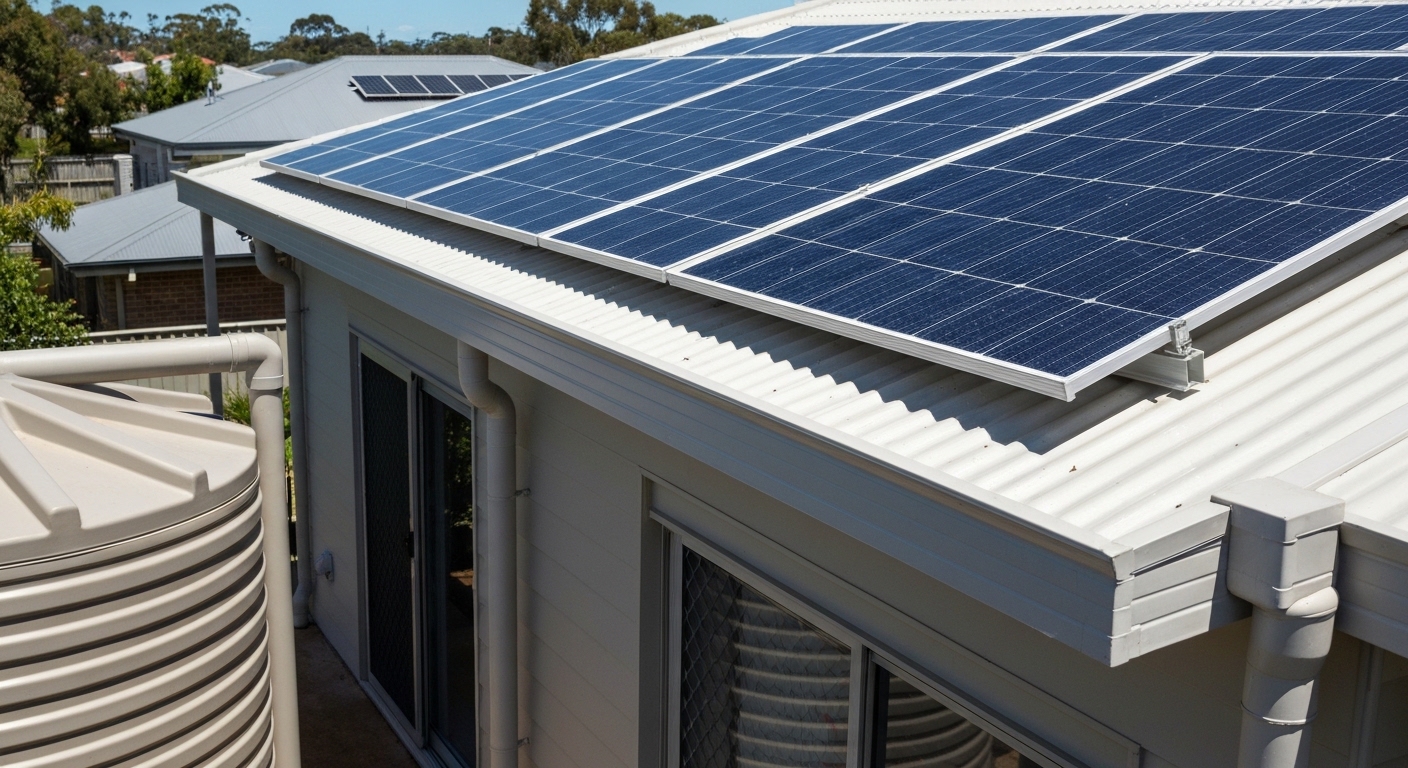
Australia has one of the highest rates of household rainwater tank usage in the developed world. An estimated 2.7 million households use rainwater tanks for drinking, gardening, or toilet flushing. And with 3.7 million rooftop solar systems now installed, the overlap between solar panels and rain harvesting is substantial.
The interaction between solar panels and roof rainwater collection is poorly understood by most homeowners. When rain falls on your solar panels, it picks up whatever sits on the surface — dust, bird droppings, trace metals, and sometimes cleaning residues. That water then flows into your gutters and potentially into your rainwater tank.
This guide explains what solar panel runoff contains, how rain harvesting is affected when panels are installed, and what practical steps you should take to protect your water supply.
Key Takeaways
- Rain harvesting from roofs with solar panels is safe when proper precautions are taken
- Solar panel runoff can carry bird droppings, dust, and trace contaminants into your tank
- A first-flush diverter stops the dirtiest water from the first rain from entering your tank
- Bird exclusion mesh protects both your panels and your water quality
- Test your tank water once a year if you use it for drinking
- Tell your solar cleaner you have a rainwater tank so they use safe products
- Clean your panels regularly to reduce what washes into the tank during rain
What’s Actually in Rain Harvesting Runoff from Solar Panels
When it rains, water runs across the surface of your solar panels and down the roof into gutters, downpipes, and your rainwater collection system. That water picks up whatever sits on the panel surface.
Organic Matter and Biological Contaminants
Bird and possum droppings are the most significant concern for rain harvesting systems. Fresh droppings contain harmful bacteria including Salmonella, Campylobacter, and Chlamydophila psittaci. Accumulated droppings under unprotected solar panels can concentrate these pathogens. When rain washes these deposits into your tank, they create a real health risk.
Dust and airborne particles settle on panels between rain events. This includes road dust, pollen, and in rural areas, agricultural spray drift. While most of these break down naturally, they contribute to tank sediment over time.
Lichen and algae can grow on panel edges and frames, particularly in humid climates or shaded installations. Rain harvesting systems collect these organisms when they wash off during storms.
Trace Metals from Panel Components
Research published in Environmental Science and Technology has identified trace leaching of metals from solar panels during rain events:
- Lead — used in solder joints connecting cell contacts (though lead-free solder is now common in newer panels)
- Silver — present in the metallisation layer of solar cells
- Tin — from solder alloys
- Cadmium — present in very small amounts in some older thin-film panels (rare in Australian residential installations)
Concentrations measured in real-world Australian rain harvesting studies are generally below NHMRC guideline values for drinking water. However, these metals accumulate in tank sediment over years. The Australian Drinking Water Guidelines recommend regular tank cleaning (every 2–3 years) specifically to remove sediment where trace metals concentrate.
Cleaning Product Residues
If your panels have been professionally cleaned, water-soluble residues from cleaning agents may remain on the surface. The risk to rain harvesting depends entirely on what was used:
| Cleaning Method | Risk to Rain Harvesting |
|---|---|
| Deionised water only | None — safe for all tank systems |
| Mild detergent solution | Low — most surfactants degrade within hours if rinsed well |
| Vinegar or acid-based cleaners | Moderate — can affect pH; divert first rain after cleaning |
| Commercial solar concentrate | Varies — always request product safety information |
Always tell your solar panel cleaner that you have a rainwater tank. A professional cleaner should use only deionised water or a product with confirmed food-safe certification suitable for rain harvesting catchment areas.
Panel Frame and Backing Materials
Panel frames are typically anodised aluminium. This material is stable and low-leaching under normal rain conditions. Panel backsheets (usually polyester or PVDF-based) are considered inert. Silicon sealants used around frames are cured and generally safe for rain harvesting systems.
Australian Health Guidelines for Rain Harvesting from Solar Panel Roofs
The National Health and Medical Research Council (NHMRC) Australian Drinking Water Guidelines provide clear direction for roof catchment quality and rain harvesting:
- Solar panels are permitted catchment surfaces — they’re not listed as prohibited in the 2011 (updated 2023) rainwater guidelines
- First-flush diverters are recommended as standard practice for all roof catchments, regardless of whether solar panels are present
- Tank cleaning every 2–3 years including sediment removal is advised for all rain harvesting systems
- Boiling or treating water before drinking is recommended wherever catchment quality is uncertain
For rooftops with significant bird activity, the NHMRC guidelines recommend treating all water intended for drinking, regardless of solar panel presence.
State Health Authority Guidance on Rain Harvesting
- NSW Health recommends first-flush diversion as the minimum treatment for roof-collected water and recommends disinfection if birds are present
- SA Health provides detailed guidelines on roof catchment water quality and recommends excluding bird habitats from catchment areas
- Queensland Health recommends treatment of all tank water intended for drinking, with particular focus on bird and animal access
All state authorities agree that rain harvesting from roofs with solar panels is acceptable when appropriate safeguards are in place.
How First-Flush Diverters Protect Rain Harvesting Systems
A first-flush diverter diverts the initial volume of roof runoff away from your storage tank. This first flush contains the highest concentration of accumulated pollutants. After the diverter chamber fills, subsequent cleaner rain flows into the tank.
This device is essential for any rain harvesting system — and particularly important when solar panels are installed.
Sizing a First-Flush Diverter for Solar Panel Roofs
Standard guidance recommends 25 litres of first-flush capacity per 100m² of roof catchment area. However, for rain harvesting from rooftops with solar panels, increasing this to 40 litres per 100m² provides better protection. Solar panel surfaces are smooth and shed water quickly, and bird activity is often higher around panels.
For a typical house with a 200m² roof used for rain harvesting:
- Standard diverter: 50 litres
- Solar panel-adjusted recommendation: 80 litres
Types of First-Flush Diverters for Rain Harvesting
Standpipe diverters are common and inexpensive but require manual draining after each rain event. These work well for rain harvesting if you’re home regularly.
Float-based automatic diverters seal automatically after the chamber fills and drain slowly via a drip outlet. These are better for rain harvesting in households where manual maintenance is less reliable.
Multiple downpipe diverters are installed on each downpipe in larger rain harvesting systems. This provides redundant protection and better coverage.
Expect to pay $60–$180 per diverter point, installed. A whole-of-house rain harvesting system with 3–4 downpipe diverters typically costs $350–$700 installed.
Why Bird Proofing Your Solar Panels Protects Your Rain Harvesting System
Bird exclusion mesh installed under solar panels has a direct rain harvesting benefit that’s often overlooked.
Without mesh, birds roost under panels and deposit waste that:
- Accumulates on the roof surface under and around panels
- Washes into gutters and downpipes during rain events
- Enters rainwater tank collection systems, adding bacterial load to your rain harvesting supply
A 6.6 kW solar array can host dozens of roosting birds in the worst cases. After several months, the area under unprotected panels can contain extremely high concentrations of Salmonella, E. coli, and other pathogens.
Bird exclusion mesh therefore protects your rain harvesting water supply — not just your panels. For households relying on rainwater tanks for drinking water, this significantly strengthens the case for bird proofing installation.
Water Quality Testing for Rain Harvesting Systems with Solar Panels
Regular testing is important for any rain harvesting system. When solar panels are installed on your catchment roof, testing becomes even more valuable.
What to Test
A basic potability test from a NATA-accredited laboratory costs $60–$120 and checks:
- E. coli and total coliforms (bacterial contamination)
- pH (acidity/alkalinity)
- Turbidity (cloudiness)
- Total dissolved solids
For rain harvesting systems with solar panels, consider adding:
- Heavy metals panel (lead, cadmium, silver) — especially if panels are more than 10 years old
- Residual surfactants — if panels are cleaned regularly with chemical products
Testing Frequency
- Test at least once per year if you use tank water for drinking
- Test twice in the first year after solar panel installation to establish a baseline
- Test after any roof work or panel maintenance
- Test if you notice changes in water taste, smell, or appearance
- Test after cleaning with chemical products (wait for one significant rain first)
Testing creates a documented history of your rain harvesting water quality and alerts you to emerging problems before they become serious.
Rain Harvesting Volume: Do Solar Panels Reduce Water Collection?
Solar panels partially cover your roof surface, which changes the effective catchment area for rain harvesting. However, the impact is often less than homeowners expect.
A typical 6.6 kW array covers 30–40% of an average roof. This reduces total catchable roof area by roughly that proportion. However, solar panels shed water very efficiently due to their smooth glass surface. Rain harvesting efficiency from panel surfaces can actually be higher than from porous tile or metal roofing.
Rain Harvesting Efficiency Comparison
| Surface Type | Water Loss Factor | Rain Harvesting Efficiency |
|---|---|---|
| Concrete tiles | Moderate absorption | 75–85% |
| Terracotta tiles | High absorption | 70–80% |
| Metal roofing | Low absorption | 85–95% |
| Solar panel glass | Minimal absorption | 90–95% |
The net effect on total rain harvesting volume depends on what roofing material your panels are installed over. In many cases, the reduction in catchment area is partially offset by improved collection efficiency from the panel surfaces themselves.
Practical Steps to Protect Your Rain Harvesting Supply
1. Install a First-Flush Diverter
Install a first-flush diverter on every downpipe connected to your rainwater tank. Size to 40 litres per 100m² of catchment for rain harvesting systems with solar panels.
2. Install Bird Exclusion Mesh
Install bird exclusion mesh under solar panels. This is the primary action to reduce biological contamination in your rain harvesting system.
3. Inform Your Solar Cleaner
Tell your solar cleaner that you have a rainwater tank used for rain harvesting. Confirm they use DI water only or a food-safe product certified for potable water catchment.
4. Divert Water After Panel Cleaning
After a solar panel clean, divert the first rainfall away from the tank. Manually close the tank inlet or use your first-flush diverter until approximately 5mm of rain has fallen.
5. Clean Your Rainwater Tank Regularly
Clean your rainwater tank every 2 years. Remove sediment, inspect tank lining, and check screens. This maintenance is essential for rain harvesting systems regardless of whether solar panels are present.
6. Test Your Water Annually
Test your rain harvesting water annually if it’s used for drinking. A basic potability test from a NATA-accredited lab costs $60–$120 and provides peace of mind.
7. Inspect Panel and Frame Condition
Check panel and frame condition during routine maintenance. Deteriorating panels with cracked glass or degraded backsheets can increase trace metal leaching into your rain harvesting system. Replace damaged panels promptly.
When Rain Harvesting from Solar Panel Roofs Needs Extra Caution
Be more cautious about rain harvesting water quality from a solar panel roof if:
- You have a significant bird infestation under or around panels (birds roosting, visible droppings)
- Your panels are more than 10 years old (potential backsheet degradation, older solder alloys)
- You have older thin-film panels (cadmium telluride technology — rare in Australian residential installations but worth checking)
- You’re in a high-spray-drift agricultural zone (rural WA, SA grain belt, Riverina) where contaminated dust deposits on panels
- Young children, pregnant women, or immunocompromised individuals use the water
In any of these cases, UV disinfection or reverse osmosis filtration of tank water is a worthwhile investment for your rain harvesting system.
The Bottom Line on Rain Harvesting and Solar Panel Runoff
Rain harvesting and solar panels can coexist safely with the right precautions. First-flush diversion, bird exclusion mesh, careful selection of cleaning products, and regular tank maintenance are the key steps.
The most significant risk in this interaction isn’t the panels themselves — it’s the birds that roost under them. Addressing bird proofing solves both the soiling problem and the water quality problem at once. This makes it a high-value investment for any household running a rain harvesting system.
With proper management, your rain harvesting system can continue to provide safe, reliable water even with solar panels installed on your roof.
Sources
This article references guidance from:
- National Health and Medical Research Council (NHMRC) — Australian Drinking Water Guidelines (2011, updated 2023), particularly Section 6.4 on roof catchment water quality
- Boretti, A., Castelletto, S., & Al-Zubaidy, S. (2018). “Concentrations of contaminants in rainwater harvesting systems in Australia.” Environmental Science and Pollution Research, 25(20), 19648-19661
- NSW Health — Rainwater Tanks: Guidance on Use of Rainwater Tanks (2023)
- SA Health — Rainwater Collection for Domestic Use (2022)
- Queensland Health — Water Quality Information Sheets: Rainwater Tanks (2023)
- Teng, Z., et al. (2017). “Metal emissions from conventional and new generation thin-film photovoltaic materials under simulated weathering.” Environmental Science & Technology, 51(11), 6278-6286
- Standards Australia — AS/NZS 4020:2018 Testing of products for use in contact with drinking water
Last updated: April 2026. Health guidance references NHMRC Australian Drinking Water Guidelines (2011, updated 2023) and relevant state health authority guidance current as of writing.
Related reading: Solar Cleaning Rainwater Tank Safety, Does Rain Clean Solar Panels, and Solar Bird Proofing Guide Australia.
Frequently Asked Questions
Is rainwater that has run off solar panels safe to drink?
Australian health guidelines (NHMRC) recommend caution with roof runoff into rainwater tanks when solar panels are present. Solar panel runoff may contain trace heavy metals (lead from solder connections, trace silver from cell metallisation), bird and possum droppings, lichen and algae, and cleaning chemical residues. Most health authorities recommend excluding the first flush (first 25 litres per 100m² of roof) from tank collection whenever possible. For drinking water, consider UV disinfection or boiling as additional safety measures.
Does solar panel cleaning affect my rainwater tank water quality?
Potentially yes — if the cleaning uses chemical additives and the rinse water enters your tank collection system. Deionised water alone (no chemicals) poses minimal risk. However, some solar cleaning products contain surfactants, algaecides, or pH-adjusting agents that should not enter a drinking water supply. Tell your solar cleaner you have a rainwater tank and ask them to confirm their cleaning solution composition. Request they use only food-safe cleaning products.
Do solar panels reduce the amount of water I can harvest from my roof?
Solar panels partially cover the roof surface but can actually increase initial runoff speed due to their smooth glass surface. The net catchment area depends on panel coverage percentage. A typical 6.6 kW array covers 30–40% of an average roof, reducing total catchable roof area by roughly that proportion. However, panels shed water very efficiently, often with less evaporative loss than a porous tile surface, meaning rain harvesting efficiency can remain high.
What is a first-flush diverter and do I need one with solar panels?
A first-flush diverter is a device that automatically diverts the first volume of roof runoff (which contains the highest concentration of pollutants) away from the storage tank. They are strongly recommended in any rainwater harvesting system and particularly important for roofs with solar panels. For a 6.6 kW array covering approximately 40m², a diverter capacity of at least 10 litres is recommended, though 15-20 litres provides better protection for rain harvesting systems.
Can bird droppings under solar panels contaminate my rainwater supply?
Yes — this is one of the more significant risks for rainwater tank owners. Accumulated bird droppings contain Salmonella, E. coli, Campylobacter, and Cryptosporidium. Rain washing these deposits into a rainwater tank creates a genuine health risk. This is an additional reason to install bird exclusion mesh under panels — it prevents accumulation of droppings that would otherwise enter the water supply during rain events. Bird proofing protects both your panels and your water quality.
How often should I test my rainwater tank if I have solar panels?
Test your rainwater tank at least once per year if you use it for drinking or cooking. A basic potability test from a NATA-accredited lab costs $60–$120 and checks for E. coli, total coliforms, pH, and turbidity. If you have solar panels installed, consider testing twice in the first year to establish a baseline, then annually thereafter. Always test after any roof work, panel cleaning with chemicals, or if you notice water quality changes.
Frequently Asked Questions
Australian health guidelines (NHMRC) recommend caution with roof runoff into rainwater tanks when solar panels are present. Solar panel runoff may contain trace heavy metals (lead from solder connections, trace silver from cell metallisation), bird and possum droppings, lichen and algae, and cleaning chemical residues. Most health authorities recommend excluding the first flush (first 25 litres per 100m² of roof) from tank collection whenever possible. For drinking water, consider UV disinfection or boiling as additional safety measures.
Potentially yes — if the cleaning uses chemical additives and the rinse water enters your tank collection system. Deionised water alone (no chemicals) poses minimal risk. However, some solar cleaning products contain surfactants, algaecides, or pH-adjusting agents that should not enter a drinking water supply. Tell your solar cleaner you have a rainwater tank and ask them to confirm their cleaning solution composition. Request they use only food-safe cleaning products.
Solar panels partially cover the roof surface but can actually increase initial runoff speed due to their smooth glass surface. The net catchment area depends on panel coverage percentage. A typical 6.6 kW array covers 30–40% of an average roof, reducing total catchable roof area by roughly that proportion. However, panels shed water very efficiently, often with less evaporative loss than a porous tile surface, meaning rain harvesting efficiency can remain high.
A first-flush diverter is a device that automatically diverts the first volume of roof runoff (which contains the highest concentration of pollutants) away from the storage tank. They are strongly recommended in any rainwater harvesting system and particularly important for roofs with solar panels. For a 6.6 kW array covering approximately 40m², a diverter capacity of at least 10 litres is recommended, though 15-20 litres provides better protection for rain harvesting systems.
Yes — this is one of the more significant risks for rainwater tank owners. Accumulated bird droppings contain Salmonella, E. coli, Campylobacter, and Cryptosporidium. Rain washing these deposits into a rainwater tank creates a genuine health risk. This is an additional reason to install bird exclusion mesh under panels — it prevents accumulation of droppings that would otherwise enter the water supply during rain events. Bird proofing protects both your panels and your water quality.
Test your rainwater tank at least once per year if you use it for drinking or cooking. A basic potability test from a NATA-accredited lab costs $60–$120 and checks for E. coli, total coliforms, pH, and turbidity. If you have solar panels installed, consider testing twice in the first year to establish a baseline, then annually thereafter. Always test after any roof work, panel cleaning with chemicals, or if you notice water quality changes.