Solar Panel Cleaning Adelaide — South Australia's Dust Bowl Reality
Adelaide sits in one of Australia's dustiest solar markets. Learn how the Murray-Darling dust events, Riverland pollen, and Adelaide's hot dry summers affect panel maintenance.
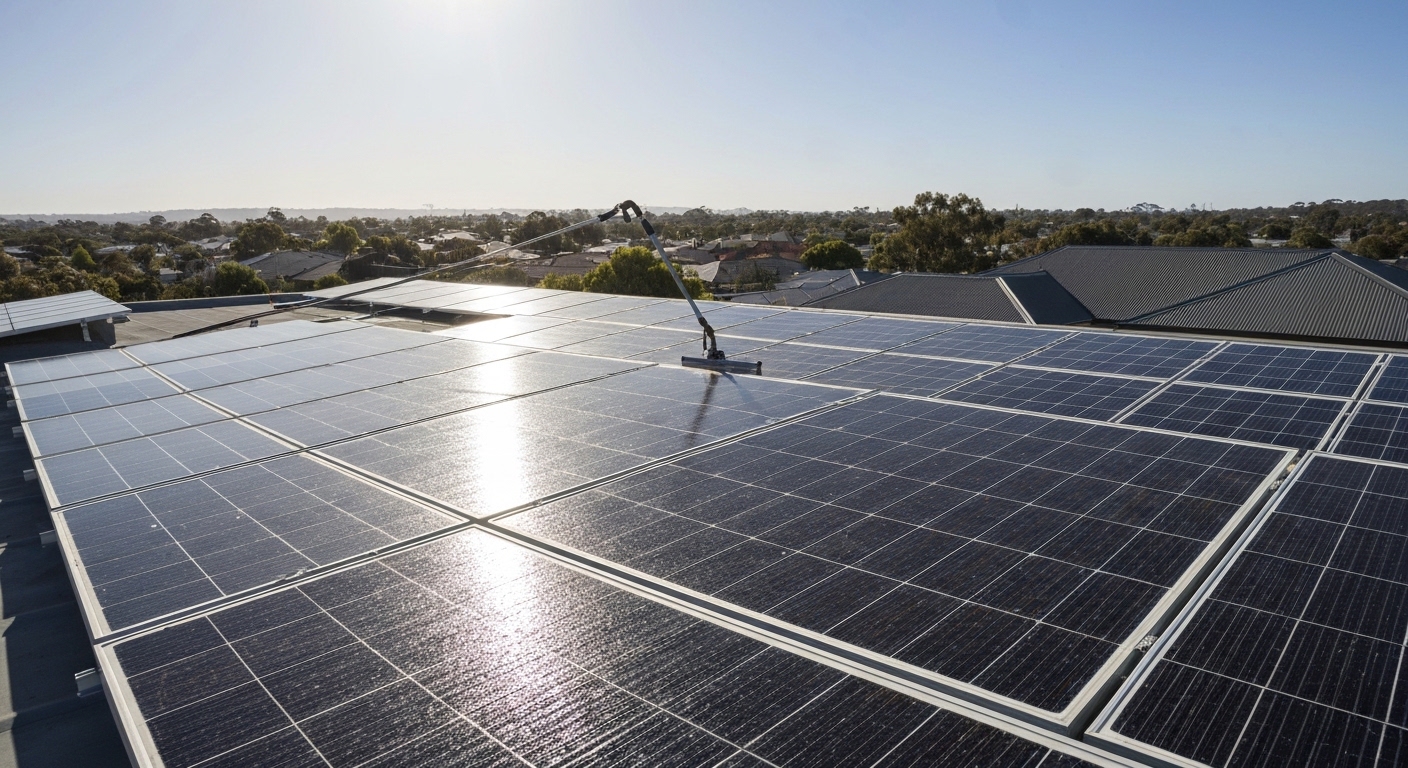
Adelaide occupies a unique position in Australia’s solar landscape. South Australia has one of the highest rates of household solar adoption in the world — with approximately 43% of homes with rooftop solar as of 2025 — and the state runs on solar power during many midday periods. But Adelaide’s geography creates soiling challenges that most solar owners seriously underestimate.
Adelaide’s Solar Soiling Environment
Adelaide is surrounded by agricultural and semi-arid land on three sides. The Fleurieu Peninsula and southern suburbs are exposed to sea breezes from the Gulf St Vincent. The Hills suburbs sit in a different micro-climate. Each zone has distinct soiling characteristics.
Agricultural Dust and Pollen
The Barossa Valley, McLaren Vale, Murray Mallee, and Riverland agricultural regions lie directly upwind of metro Adelaide during the prevailing north and northeast winds. During dry periods these winds carry:
- Grain dust (February–April) from the harvest season
- Pollen from canola, cereal crops, and native species (August–November)
- Red clay dust from the Murray-Darling basin during drought periods
- Smoke residue from autumn burn-off in the Hills and the Southeast
This agricultural air mass means Adelaide solar panels accumulate a complex, multi-component soiling layer quite different from the urban-pollution-dominated soiling in Sydney or Melbourne.
Hot, Dry Summers
Adelaide’s climate is classified as Mediterranean — hot, dry summers and mild, wet winters. The summer soiling problem is significant:
- Summer temperatures regularly exceed 40°C in metro suburbs (Adelaide holds the record for most days above 40°C of any Australian capital)
- Panels reach surface temperatures of 70–75°C on extreme heat days
- Without regular rainfall through summer, dust accumulates unchecked for months
- When hot northerly winds carry fine agricultural dust, it lands on hot panel glass and essentially bakes on within hours
Dust Storm Events
Adelaide periodically receives major dust storm fronts from the Murray-Darling basin, particularly during El Niño drought periods. These events:
- Can deposit millimetres of dust on panel surfaces in a single event
- The dust composition (iron-rich red clay) makes it particularly adhesive
- Rainfall immediately following a dust storm wets the dust and creates a cement-like bond as it dries in Adelaide’s sun
- Post-dust-storm cleaning within 1–2 weeks (before it bakes fully) is important
Gulf St Vincent Coast
Coastal Adelaide suburbs from Port Willunga to Port Adelaide experience salt aerosol deposition from the Gulf. While the Gulf’s enclosed geography means less severe salt loading than open ocean coastlines, properties within 3 km of the coast still see measurable salt accumulation on panels — particularly during summer sea breezes.
Recommended Cleaning Frequencies for Adelaide
| Location | Recommended Frequency |
|---|---|
| Inner metro Adelaide | Twice yearly (March + September) |
| Coastal suburbs (within 3km of Gulf) | Every 3–4 months |
| Northern suburbs (Gawler, Two Wells) | Twice yearly + post-harvest check |
| Hills suburbs (Stirling, Crafers) | Twice yearly (higher pollen) |
| Barossa / McLaren Vale | 3 times yearly |
| Riverland (Renmark, Loxton) | Quarterly (extreme dust and heat) |
| Eyre Peninsula (Port Lincoln, Whyalla) | Quarterly |
Adelaide Solar Panel Cleaning Costs (2026)
Adelaide benefits from strong market competition among cleaning operators, making it one of the more affordable Australian capitals for solar maintenance.
| System Size | Average Adelaide Price | Notes |
|---|---|---|
| Small (up to 5 kW, ≤16 panels) | $130–$180 | Standard clean |
| Standard (6–8 kW, 16–24 panels) | $150–$240 | Most common residential |
| Large (9–13 kW) | $230–$340 | Full service |
| Hills suburbs | Add $20–$40 | Travel/access premium |
| Post-dust-storm emergency | +20–30% | Same-week booking |
| Bird proofing add-on | $280–$550 | Mesh installation |
What to Ask Adelaide Solar Cleaners
-
What water do they use? Ask for a TDS reading — Adelaide’s mains water (especially outer metro and Hills) can be 200–400 ppm TDS. Deionised water under 15 ppm is essential.
-
Do they brush-clean, not just rinse? Adelaide’s agricultural dust requires soft brush agitation to fully remove compacted layers.
-
Can they handle Hills access? Steep Hills properties require appropriate safety equipment and experience.
-
Do they treat for biological growth? Hills and southern suburbs with more shade and moisture can develop algae and lichen faster than flat northern metro areas.
-
Post-clean documentation — a written report noting panel condition, bird nesting check results, and recommended next clean date is a mark of a quality operator.
The Financial Case for Adelaide Panel Cleaning
South Australia has some of the highest electricity prices in Australia, making the electricity value recovered from a clean particularly significant.
Example — 6.6 kW system in Morphett Vale:
- Annual clean system generation: ~10,000 kWh
- SA Power Networks pricing (2026): ~$0.40/kWh consumption
- Self-consumption (35%): 3,500 kWh × $0.40 = $1,400
- SA feed-in tariff (65%): 6,500 kWh × $0.08 = $520
- Total annual electricity value: ~$1,920
After 12 months without cleaning (agricultural dust + summer baking): estimated 18% soiling loss
- Lost electricity value: ~$346
- Cost of a professional clean: $200
- Net annual benefit: $146 (first year), growing in subsequent years as soiling loss compounds
SA Government Solar Incentives and Maintenance
South Australia’s Virtual Power Plant (VPP) programs — operated by SA Power Networks and commercial providers like Tesla Energy — require participating solar + battery systems to maintain clean, well-performing panels to contribute maximum export capacity. VPP participants who neglect panel maintenance may underperform their VPP obligations, reducing their program payments.
If you’re in a VPP program, treat solar cleaning as part of your VPP participation obligations — not just general maintenance.
Adelaide-Specific Seasonal Guide
December–February: Peak summer heat and dust. Avoid cleaning during the hottest days (panels too hot by 8am). If dust events occur, plan a clean for the first cool morning after the storm.
March–April: Primary clean of the year. Removes full summer accumulation before the productive autumn period. Best value clean timing for Adelaide homeowners.
May–July: Adelaide’s rainy season. Rainfall provides partial natural cleaning. Monitor output — if it remains low despite rain, biological growth may be the cause (common in Hills properties).
August–September: Pre-peak-summer clean. Pollen season begins; remove early pollen accumulation before Adelaide’s high-output October–December period.
October–November: Monitor for harvest dust starting. Consider an additional clean if dust events have been significant.
Conclusion
Adelaide’s combination of agricultural surroundings, extreme summer heat, periodic dust storm events, and high electricity prices creates one of Australia’s strongest ROI cases for regular solar panel cleaning. Twice-yearly professional cleaning is the baseline — and the financial return, even at Adelaide’s relatively affordable cleaning prices, makes it one of the smartest maintenance decisions SA homeowners can make.
Adelaide Seasonal Soiling Guide: Best Times to Clean
October–November (Pre-Summer): Spring pollen from SA’s agricultural hinterland, including canola and cereal crops, creates a sticky yellow-green film on panels across the Adelaide Plains. Clean in late October/early November before the summer heat locks in — you’ll get maximum output through SA’s peak electricity price months (December–February).
January–March (Post-dust-storm season): SA’s summer dust events peak in January and February. Soiling from a single major dust event can reduce output by 15–25% — book a clean within 2 weeks of any event that visibly darkens the sky or deposits red dust across surfaces.
May–June (Post-Autumn): Adelaide’s cool wet winter begins in June. A clean in May, after the autumn dust but before winter condensation, sets systems up well for the reduced-sunlight winter months. Less output to recover but maintaining panel condition before the wet season prevents biological growth from establishing.
Adelaide Water Quality for DIY Cleaning
Adelaide’s water supply is among the hardest in Australia — mains water TDS typically ranges from 200–400 ppm depending on the source (Murray River vs. Mount Lofty Ranges). For solar panel cleaning:
- Never use Adelaide tap water directly for a final rinse — the mineral content will leave visible white deposits
- Rainwater tanks are common in Adelaide and provide significantly better water quality (typically 30–100 ppm if well-maintained) — test with a TDS meter before use
- Inline DI filters ($50–$100 at solar cleaning suppliers) connected to your tap reduce TDS to near-zero for panel-safe rinsing
- Professional cleaners in Adelaide should be using DI water systems as standard — verify this when booking
Related: Solar Panel Cleaning Cost Australia 2025 · Does Rain Clean Solar Panels? · How Often to Clean Solar Panels
Frequently Asked Questions
How often should solar panels be cleaned in Adelaide?
Most Adelaide homeowners should clean twice a year — in March (post-summer) and September (pre-peak-summer). Properties in the Hills, Barossa, or McLaren Vale wine regions experience higher pollen and dust loads and may benefit from three cleans annually.
What makes Adelaide solar panel soiling unique?
Adelaide is surrounded by agricultural land on three sides, meaning pollen, crop dust, and dry red soil from the Riverland and Murray Mallee are constantly blown into metro suburbs. Combined with Adelaide’s hot, dry summers (often exceeding 40°C) and long dry spells with minimal rain, soiling layers bake onto panels more aggressively than in coastal cities.
How much does solar panel cleaning cost in Adelaide?
Professional solar panel cleaning in Adelaide costs $150–$240 for a standard 6.6 kW system — among the more affordable rates in Australia due to strong market competition. Hills suburbs and outer metro areas attract a small travel premium.
Do Adelaide solar panels need cleaning after dust storms?
Yes, immediately. Adelaide periodically receives dust storm fronts from the Murray-Darling basin — the same events that occasionally turn the sky orange. These deposit thick red-clay dust that compacts rapidly in Adelaide’s heat and must be cleaned within a week or two before it becomes difficult to remove.
Is bird proofing necessary in Adelaide?
Yes — Adelaide has significant pigeon, myna, and sparrow populations in metro suburbs, and galah populations in outer areas. Bird activity is a year-round concern, and the sheltered gap under solar panels is prime nesting real estate in Adelaide’s hot summers.
Frequently Asked Questions
Most Adelaide homeowners should clean twice a year — in March (post-summer) and September (pre-peak-summer). Properties in the Hills, Barossa, or McLaren Vale wine regions experience higher pollen and dust loads and may benefit from three cleans annually.
Adelaide is surrounded by agricultural land on three sides, meaning pollen, crop dust, and dry red soil from the Riverland and Murray Mallee are constantly blown into metro suburbs. Combined with Adelaide's hot, dry summers (often exceeding 40°C) and long dry spells with minimal rain, soiling layers bake onto panels more aggressively than in coastal cities.
Professional solar panel cleaning in Adelaide costs $150–$240 for a standard 6.6 kW system — among the more affordable rates in Australia due to strong market competition. Hills suburbs and outer metro areas attract a small travel premium.
Yes, immediately. Adelaide periodically receives dust storm fronts from the Murray-Darling basin — the same events that occasionally turn the sky orange. These deposit thick red-clay dust that compacts rapidly in Adelaide's heat and must be cleaned within a week or two before it becomes difficult to remove.
Yes — Adelaide has significant pigeon, myna, and sparrow populations in metro suburbs, and galah populations in outer areas. Bird activity is a year-round concern, and the sheltered gap under solar panels is prime nesting real estate in Adelaide's hot summers.