How Often to Clean Solar Panels: A Climate-by-Climate Guide for Australia
Cleaning frequency for Australian solar panels varies enormously by climate zone. Here's the data-backed schedule for every region — desert, coastal, subtropical, and temperate.
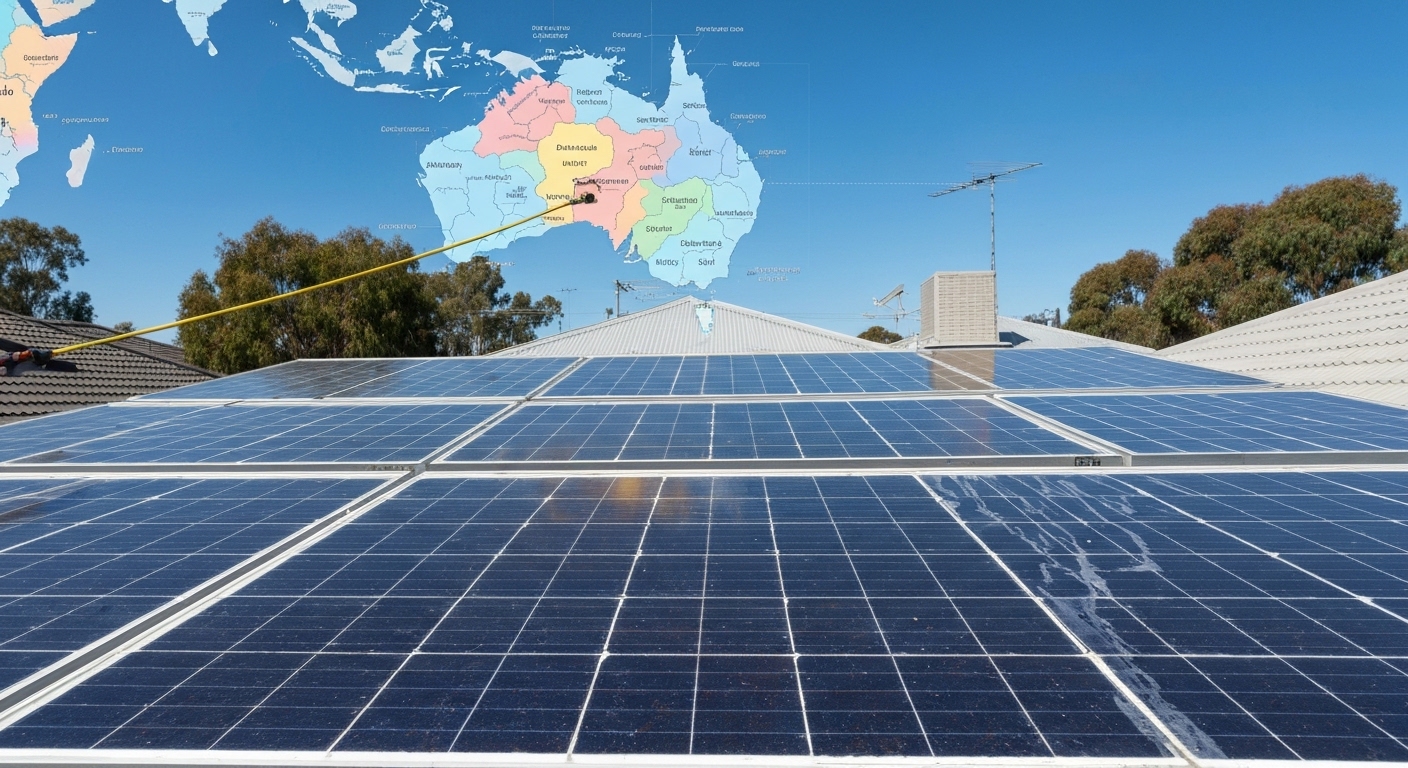
Australia’s solar panel cleaning needs vary more by location than almost any other country. A rooftop system in Darwin accumulates soiling at a fundamentally different rate than the same system in Hobart. Yet most generic advice defaults to “once or twice a year” — which is too infrequent for some climates and unnecessary for others.
This guide maps recommended cleaning frequency to Australia’s major climate zones, with specific city guidance and the conditions that should trigger an off-schedule clean regardless of where you live.
Why Climate Drives Cleaning Frequency
The key soiling variables that climate controls are:
- Dust load — how much particulate matter is airborne in your region
- Rainfall — frequency, intensity, and whether it’s sufficient to flush horizontal surfaces
- Humidity — high humidity promotes biological growth (algae, lichen, moss) and causes pollen to bond more tightly to glass
- Pollen seasons — Mediterranean and subtropical climates have intense seasonal pollen loads
- Salt spray — coastal proximity determines salt deposition rate
- Temperature swing — large day/night temperature variation causes panels to act like dust magnets through electrostatic cycling
No single schedule addresses all of these variables. Your optimal frequency is determined by the combination that applies to your location.
Australia’s Climate Zones: Recommended Cleaning Frequency
Zone 1 — Hot Arid / Semi-Arid (Outback + Far West)
Locations: Alice Springs, Broken Hill, Kalgoorlie, Coober Pedy, Longreach, Bourke, Port Hedland (inland areas), much of the Northern Territory
Soiling profile: Extreme fine mineral dust, prolonged dry periods, major dust storms multiple times per year. Very low rainfall with almost no self-cleaning capacity.
Recommended frequency: Every 2–4 months
A 6.6 kW system in Alice Springs can lose 25–35% of output within 6–8 weeks of a professional clean during peak dust season (June–September). The economics are unambiguous: in high-solar-radiation zones, cleaning every 3 months at $250 per service pays for itself several times over.
Output trigger: If daily production drops more than 15% from your rolling average, clean immediately regardless of schedule.
Zone 2 — Hot Dry Mediterranean (Perth, Adelaide)
Locations: Perth, Fremantle, Mandurah, Adelaide, Mount Barker, Yorke Peninsula
Soiling profile: Long hot dry summers (December–March) with significant dust and mineral particulate. Low annual rainfall (Perth 730 mm/year, Adelaide 540 mm/year) concentrated in winter months. Perth has the additional burden of Indian Ocean mineral dust, and Adelaide is downwind of the Murray Darling agricultural basin.
Recommended frequency: Twice per year — once in late autumn (May), once in early spring (September)
Perth and Adelaide systems that go 12 months without cleaning typically show 18–22% efficiency losses by the end of summer. The bi-annual schedule captures maximum efficiency through both the high-output summer months and the moderate spring/autumn shoulder periods.
Perth-specific note: Coastal suburbs within 10 km of the ocean (Cottesloe, Scarborough, City Beach, Fremantle) should consider three cleans per year — autumn, winter, and spring — due to salt deposition compounding mineral soiling.
Zone 3 — Subtropical / Humid Subtropical (Queensland + Northern NSW)
Locations: Brisbane, Gold Coast, Sunshine Coast, Toowoomba, Cairns, Townsville, Byron Bay, Lismore, Coffs Harbour
Soiling profile: High humidity promotes biological growth between rainfall events. Intense tropical and subtropical pollen seasons. Seasonal dust events from western Queensland. Coastal areas add salt spray. Rain is frequent but often too light to flush horizontal surfaces.
Recommended frequency: Twice per year — late autumn (May) and late spring (November)
Brisbane’s subtropical humidity means pollen and organic matter stick more persistently than in dry climates. Even with above-average rainfall (~1,000 mm/year), frequent light showers leave mineral deposits rather than cleaning panels.
Cairns / Far North Queensland note: Wet season (November–April) brings heavy rainfall but often contains fine sediment. Dry season cleaning in July–August and again in November captures peak solar production months. Tropical coast systems may need a third clean if biological growth (algae, moss) is visible.
Zone 4 — Temperate / Oceanic (Melbourne, ACT, Tasmania, Southern NSW)
Locations: Melbourne, Canberra, Hobart, Bendigo, Ballarat, Albury-Wodonga, Southern Tablelands
Soiling profile: Highest rainfall relative to solar potential. Melbourne’s pollen season (October–November) is the main soiling driver. Canberra is drier and receives Monaro dust. Hobart has the cleanest conditions in mainland Australia. Temperate zones have the best natural self-cleaning capacity.
Recommended frequency: Once per year — autumn (April–May)
Melbourne: wait until after the pollen season peak (late November) before your annual clean OR clean in late April for optimal pre-winter efficiency. Cleaning in September will be undone by October–November pollen within weeks.
Canberra exception: Canberra’s lower rainfall (635 mm/year) and occasional dust events from the Monaro Plains mean some systems benefit from twice-yearly cleaning, particularly if near the lake foreshore or in exposed rural-residential zones.
Hobart: One clean per year is typically sufficient. Hobart receives 619 mm of rain, but more importantly the rain is distributed relatively evenly across the year, providing regular self-cleaning. Biological growth (moss) is the more common issue than mineral soiling.
Zone 5 — Tropical Monsoon (Darwin, Kimberley, Gulf Country)
Locations: Darwin, Katherine, Broome, Wyndham, Nhulunbuy, Weipa
Soiling profile: Extreme seasonality. Wet season (October–April) brings 1,500–1,900 mm of rain in Darwin — heavy enough to self-clean effectively. Dry season (May–September) is almost completely rainless with growing mineral dust and bird activity.
Recommended frequency: Once per year — immediately after the wet season (April–May)
The Darwin wet season does a credible job of flushing most accumulated soiling. Cleaning at the start of the dry season captures 5–6 months of peak solar production (Darwin averages 10–11 peak sun hours in the dry season) with clean panels. Avoid cleaning in the middle of the wet season — you’re simply creating the conditions for rapid resoiling from muddy splash-back.
Zone 6 — Alpine / Southern Highlands
Locations: Thredbo, Perisher, Mount Hotham, Bright, Falls Creek areas, Southern Highlands NSW
Soiling profile: Snow, debris, and leaf litter are primary challenges. Very low dust load, but winter snow accumulation can shade panels for days. Biological growth (lichen, moss) is the most significant long-term threat.
Recommended frequency: Once per year — spring (October), plus post-snowfall inspections
After heavy snowfall, safely clear panels from ground level if possible — even partial shading from snow significantly cuts output. Check for cracked glass after the snow season, as freeze-thaw cycles stress glass.
Summary Table: Cleaning Frequency by Climate Zone
| Zone | Example Cities | Recommended Annual Cleans | Best Timing |
|---|---|---|---|
| Hot Arid/Outback | Alice Springs, Broken Hill | 3–4+ | Year-round, every 2–3 months |
| Hot Mediterranean | Perth, Adelaide | 2 | May + September |
| Subtropical | Brisbane, Gold Coast | 2 | May + November |
| Temperate | Melbourne, Canberra | 1–2 | April–May (post-pollen) |
| Tropical Monsoon | Darwin, Broome | 1 | April–May (post-wet season) |
| Alpine/Highlands | Thredbo, Bright | 1 | October (spring) |
Conditions That Trigger an Off-Schedule Clean — Any Climate
Regardless of your scheduled frequency, clean promptly if:
- Visible soiling — if you can see dust, bird droppings, or dark patches from ground level, production is already affected
- Inverter output drop ≥10% — compare today’s specific yield (kWh/kW) to the same week last year using your inverter app
- Major dust storm — central Australia dust events regularly reach coastal cities; check your panels within 48 hours
- Bird infestation discovered — a roosting flock deposits more fouling in a week than months of normal weathering
- Post-bushfire smoke — smoke residue forms a persistent oily film; ordinary rain won’t remove it
- Hailstorm — check for micro-cracks even if glass appears intact; hail damage accelerates soiling adhesion
Making a Climate-Adjusted Maintenance Plan
The most effective approach for any Australian homeowner is a two-part system:
- Set a scheduled baseline frequency using the climate zone table above as your starting point
- Monitor monthly specific yield via your inverter app (Fronius Solar.web, SolarEdge monitoring, GoodWe SEMS Portal, etc.) and respond to drops of ≥8% below your rolling monthly average
This combination ensures you’re never waiting on a calendar date while your output silently falls, and that you’re not over-cleaning systems that happen to be performing well.
For professional cleaning bookings, request a service that includes pre-clean and post-clean output comparisons — this gives you real data on soiling impact in your specific location and helps calibrate future scheduling.
Last updated: April 2026. Soiling data sourced from ARENA-funded research and peer-reviewed Australian solar performance studies.
See also How Often to Clean Solar Panels, Solar Panel Cleaning Frequency Queensland, and Solar Panel Soiling Cost Australia.
Frequently Asked Questions
How often should I clean solar panels in a dusty inland area?
In high-dust inland areas like western Queensland, central NSW, or the Northern Territory, professional cleaning every 3–4 months is recommended. After major dust storms, inspect output immediately and clean if you see a drop of more than 10% versus the prior-period baseline.
Does heavy rainfall replace professional cleaning?
No. Rain removes loose dust but leaves behind bird droppings, pollen films, salt deposits, and hard mineral spots from the water itself. Even the wettest Australian climates still benefit from one professional clean per year.
Which Australian cities have the worst solar panel soiling?
Perth (mineral dust, salt, low annual rainfall), Adelaide (dust and low rain), and Alice Springs (extreme dust with very low rainfall) are the highest-soiling environments. Brisbane and coastal Queensland follow closely due to subtropical pollen and humidity. Melbourne and Hobart have the best self-cleaning conditions but still require annual maintenance.
Can I use my inverter data to determine cleaning frequency?
Yes — this is the most accurate method. Log your specific performance ratio (kWh generated ÷ peak sun hours ÷ system kW) monthly. A sustained drop of 8% or more compared to the same month in the prior year is a reliable trigger for professional cleaning, regardless of your climate zone.
Do rooftop angle and orientation affect how often I need to clean?
Yes. Low-pitch panels (under 10°) accumulate soiling faster because rain doesn’t flush them effectively. North-facing panels in dusty inland areas collect more debris than east or west-facing panels. High-pitch panels (over 30°) in moderate-rainfall areas often need cleaning less frequently.
Frequently Asked Questions
In high-dust inland areas like western Queensland, central NSW, or the Northern Territory, professional cleaning every 3–4 months is recommended. After major dust storms, inspect output immediately and clean if you see a drop of more than 10% versus the prior-period baseline.
No. Rain removes loose dust but leaves behind bird droppings, pollen films, salt deposits, and hard mineral spots from the water itself. Even the wettest Australian climates still benefit from one professional clean per year.
Perth (mineral dust, salt, low annual rainfall), Adelaide (dust and low rain), and Alice Springs (extreme dust with very low rainfall) are the highest-soiling environments. Brisbane and coastal Queensland follow closely due to subtropical pollen and humidity. Melbourne and Hobart have the best self-cleaning conditions but still require annual maintenance.
Yes — this is the most accurate method. Log your specific performance ratio (kWh generated ÷ peak sun hours ÷ system kW) monthly. A sustained drop of 8% or more compared to the same month in the prior year is a reliable trigger for professional cleaning, regardless of your climate zone.
Yes. Low-pitch panels (under 10°) accumulate soiling faster because rain doesn't flush them effectively. North-facing panels in dusty inland areas collect more debris than east or west-facing panels. High-pitch panels (over 30°) in moderate-rainfall areas often need cleaning less frequently.