Solar Panel Cleaning Checklist: 9 Things to Verify Before You Hire Anyone in Australia
Before you let anyone on your roof to clean solar panels, run this checklist. Covers insurance, water type, WorkSafe compliance, and pricing red flags.
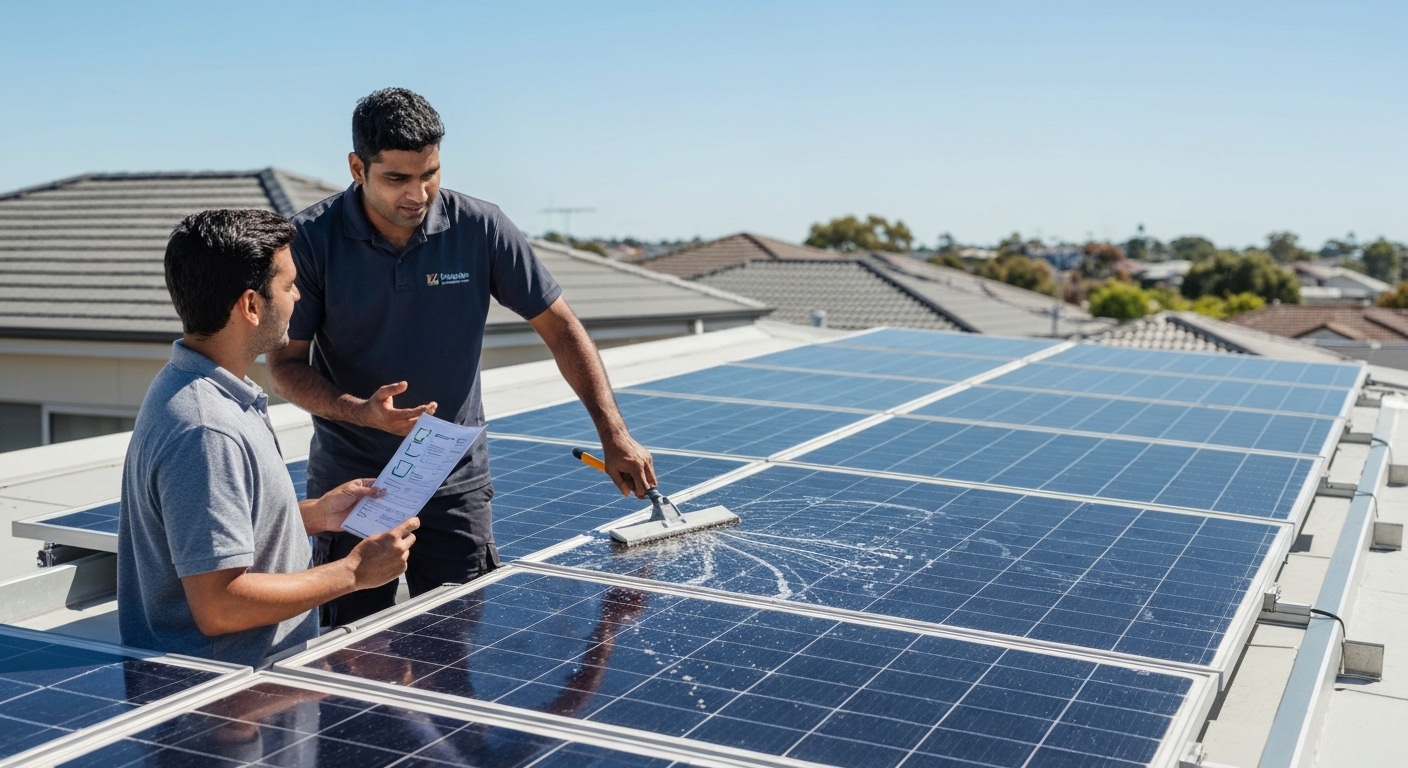
Choosing a solar panel cleaner isn’t as simple as accepting the cheapest quote. The wrong operator can scratch your panels, use water that leaves mineral deposits reducing output, access your roof without proper safety equipment, or leave you legally liable if an uninsured worker is injured on your property.
This checklist covers the 9 things every Australian homeowner should verify before handing over their solar panels — and their roof — to anyone.
✅ Item 1: Public Liability Insurance (Minimum $5 Million)
Why it matters: If the cleaner damages your panels, roof, gutters, or any other property, you need their insurance to cover the cost. More critically, if an uninsured worker is injured on your property, you may face liability claims that go well beyond the cost of a cleaning job.
What to ask: “Can you email me your Certificate of Currency before the job?”
A Certificate of Currency is the formal insurance document that shows:
- The policy is current (not expired)
- The coverage amount ($5M minimum, $10M preferred)
- The specific activities covered (roof work, solar cleaning)
Red flag: Any operator who refuses to provide a Certificate of Currency, provides one verbally only, or shows you a document that doesn’t clearly list roof work as a covered activity.
Note: Workers’ compensation insurance is also required for operators with employees. Ask whether the cleaner will be working alone or with a team — if with a team, workers’ comp should be in place.
✅ Item 2: Working at Heights Certification
Why it matters: Falls from roofs are the leading cause of non-workplace fatalities in Australia. Any operator accessing your roof professionally should hold formal Working at Heights certification under the relevant state Work Health and Safety framework.
What to ask: “Are your workers Working at Heights certified? Do they use fall arrest equipment for multi-storey or steep-pitch roofs?”
The relevant standard: Safe Work Australia’s Code of Practice — Construction Work requires appropriate fall protection for any work above 2 metres. For two-storey homes or steep pitch roofs, this means either scaffolding, an elevated work platform, or a harness and anchor system.
What to look for:
- For single-storey low-pitch roofs: certification is desirable but less critical
- For two-storey homes: fall arrest equipment is non-negotiable
- For any commercial or strata installation: full site safety plan required
Red flag: Operators who dismiss safety concerns with “we’re quick, we don’t need harnesses” are both legally non-compliant and a risk to you and your property.
✅ Item 3: Water Type — Deionised or Purified Only
Why it matters: Tap water across most Australian cities and regional areas contains 50–300 ppm of dissolved minerals (calcium, magnesium, sodium, silica). When tap water evaporates on a hot solar panel, those minerals are deposited on the glass surface as a white or hazy residue. This residue is often harder to remove than the original soiling — and reduces panel output.
What to ask: “What TDS level is your cleaning water? Can you show me a reading?”
What the answer should be: Under 50 ppm for adequate cleaning; under 15 ppm for professional-grade results. Properly deionised (DI) water reads 0–5 ppm. Reverse osmosis (RO) water typically reads 5–15 ppm.
How to test it yourself: A TDS meter costs $20–$40 from hardware stores or Amazon. You can test their water supply when they arrive. A legitimate professional will welcome the check.
Red flag: Operators using a garden hose connected to your tap, or operators who don’t know what a TDS meter is.
✅ Item 4: Written Quote with Itemised Scope
Why it matters: Verbal quotes are unenforceable and leave you with no recourse if the actual charge differs from what was discussed, or if they skip steps you expected to be included.
What the written quote should specify:
- Total price (GST inclusive)
- Number of panels to be cleaned
- Roof height/access notes
- What’s included: pre-inspection, cleaning method, post-clean check, any extras
- Payment terms
- Operator’s ABN and business name
Checking the ABN: Go to ABN Lookup (abr.business.gov.au) and enter the ABN from the quote. If it doesn’t match the business name on the quote, ask for clarification.
Red flag: Any operator who pressures you to commit before providing a written quote, or who provides a quote with no itemised scope.
✅ Item 5: Equipment — Water-Fed Pole System, Not a Garden Hose
Why it matters: Professional solar cleaning uses a water-fed pole — a telescoping pole with a brush head and water supply that allows the operator to clean from ground level or with minimal roof access. This reduces fall risk and avoids the walking-on-panels risk of manual roof access.
What to look for: When the operator arrives, they should have:
- A water-fed extension pole (3–6 metres)
- A soft-bristle or microfibre brush head specifically designed for solar panels
- An onboard water supply or connection to deionised water
- A TDS meter for checking water quality
What to avoid: Operators who use a standard garden hose and sponge or mop, who use abrasive brush heads, or who propose to walk across panels to clean them.
Red flag: Operators using domestic cleaning equipment — this signals they’re not solar cleaning specialists.
✅ Item 6: Before/After Inverter Output Comparison
Why it matters: Without a quantified outcome, you have no way to verify the clean made a difference — or to document the improvement for your own records or warranty purposes.
What to ask: “Will you check the inverter output before and after, and note the comparison?”
Better operators will:
- Ask you to pull up your inverter app before they start
- Note the current output (or recent daily generation figure)
- After cleaning, compare current output to the pre-clean reading
- Include the before/after output figures in their written service report
Why this matters practically: A 10–20% output improvement after cleaning confirms both that the panels were soiled and that the clean was effective. Some operators offer a guarantee — if output doesn’t improve, they revisit.
✅ Item 7: Panel Inspection Scope
Why it matters: A professional cleaning visit is the ideal time to identify panel defects that affect output or safety — cracked cells, delamination, snail trail discolouration, hot spots visible as discolouration, or loose framing. Spotting these during a cleaning visit is far cheaper than discovering them after a system failure.
What to ask: “As part of the clean, will you check for cracked cells, loose connections, or bird nesting? Do you provide a written report if you find anything?”
What should be included in a thorough clean:
- Visual inspection of each panel surface for cracks, delamination, snail trails
- Frame inspection for corrosion or loose mounting hardware
- Bird nesting check in panel underside cavity
- Cable visual inspection (looking for chew damage, UV degradation)
- Written report noting any concerns
Red flag: Operators who position themselves purely as “cleaners” with no inspection capability or reporting.
✅ Item 8: Cleaning Products — What Will They Use?
Why it matters: Some cleaning agents — even household soap — can leave residue on panel glass that reduces output or degrades anti-reflective coatings. Acidic cleaners can damage aluminium frames. Bleach or chlorine-based products damage rubber seals.
What to ask: “What cleaning products do you use, if any, beyond water?”
Acceptable answers:
- Deionised water only (most common, best practice)
- Manufacturer-approved solar cleaning solution (pH neutral, rinse-free)
- Small amount of dish soap heavily diluted in DI water (for heavy bird droppings only)
Unacceptable answers:
- Standard household cleaning products (e.g., Spray n’ Wipe, Exit Mould)
- Bleach or chlorine-based products
- Products containing solvents or alcohol
- Any product not explicitly approved for solar panel use by the manufacturer
✅ Item 9: Google Reviews and Verifiable References
Why it matters: Solar cleaning is an unregulated industry in Australia — anyone can buy a brush and start operating. Reviews and references are your primary filter for quality and legitimacy.
What to check:
- Google Business Profile: Minimum 10 reviews, average 4.3+. Read 1-star reviews for recurring themes.
- Response to reviews: Operators who respond professionally to negative reviews demonstrate accountability.
- Review recency: At least some reviews in the past 6 months (businesses change).
- Specific mentions of solar cleaning (not just general cleaning services).
Red flags in reviews:
- Multiple reviews mentioning water spots, scratched panels, or damage
- Reviews from outside your state (may be a different branch with different standards)
- Suspiciously clustered 5-star reviews with no review history (potential fake reviews)
Quick Reference Checklist
Print or screenshot this before every hire:
- Certificate of Currency (public liability ≥$5M) received and checked
- Working at Heights certification confirmed for multi-storey or steep roofs
- Water TDS confirmed under 50 ppm (ask to see meter reading)
- Written, itemised quote with ABN received
- Professional water-fed pole equipment confirmed
- Before/after inverter comparison agreed
- Panel inspection scope agreed and written report to be provided
- Cleaning products confirmed as approved/appropriate
- Google reviews checked (minimum 10 reviews, 4.3+ average)
Following this checklist takes 15 minutes and is genuine protection for a $6,000–$15,000 investment. Most reputable solar cleaners will have no issues answering every one of these questions — it’s actually a good filtering tool, because operators who baulk at the questions are the ones you want to filter out.
Sources
- Safe Work Australia: Working at Heights Code of Practice (2022)
- Australian Tax Office: ABN Lookup Service (abr.business.gov.au)
- Clean Energy Council: Choosing a Solar Cleaning Provider (2024)
- Consumer Affairs Victoria: Hiring Tradespeople — Your Rights (2024)
- Fair Trading NSW: Home Service Contracts (2024)
Related resources: Solar Panel Cleaning Cost Australia 2025, Professional vs DIY Solar Cleaning Australia, and Solar Panel Cleaning Insurance Australia.
Frequently Asked Questions
What should I ask a solar panel cleaner before hiring them?
The five most important questions: (1) Do you carry public liability insurance of at least $5 million? (2) What type of water do you use — deionised or purified? (3) Are your workers trained and certified for working at heights? (4) Can you provide a written quote before starting? (5) Do you provide a before/after inverter output comparison? Any provider who hesitates on any of these deserves a follow-up or replacement quote.
What is the minimum insurance a solar panel cleaner should carry in Australia?
Public liability insurance with a minimum cover of $5 million is the industry standard. Better operators carry $10–$20 million. Workers’ compensation insurance is also required if the cleaner has employees. Always ask for a Certificate of Currency — not just a verbal assurance — before they access your property.
Why does water type matter for solar panel cleaning?
Tap water in most Australian cities contains dissolved minerals (TDS 50–300 ppm depending on location). When this water evaporates on panel glass, it leaves a mineral residue that reduces light transmission and is difficult to remove. Professional cleaners use deionised (DI) water or reverse osmosis water with TDS under 10 ppm, which leaves no residue. Ask to see their TDS meter reading before they start.
How do I know if a solar panel cleaner is legitimate?
Check: (1) ABN on the quote (searchable at ABN Lookup), (2) Certificate of Currency for public liability insurance, (3) professional equipment (water-fed pole system, not a garden hose), (4) written quote itemising what’s included, (5) reviews on Google or Trustpilot. Be cautious of door-to-door or cold-call solar cleaners — legitimate operators rarely use this sales approach.
What red flags should I watch for when getting solar cleaning quotes?
Major red flags: prices under $100 for a full system (quality shortcuts guaranteed), refusal to provide written quotes, use of tap water or garden hoses, no proof of insurance, high-pressure sales tactics or urgency pressure, door-to-door solicitation, and operators who cannot explain what products they use or why. Also be wary of anyone who quotes without inspecting your specific roof access situation.
Frequently Asked Questions
The five most important questions: (1) Do you carry public liability insurance of at least $5 million? (2) What type of water do you use — deionised or purified? (3) Are your workers trained and certified for working at heights? (4) Can you provide a written quote before starting? (5) Do you provide a before/after inverter output comparison? Any provider who hesitates on any of these deserves a follow-up or replacement quote.
Public liability insurance with a minimum cover of $5 million is the industry standard. Better operators carry $10–$20 million. Workers' compensation insurance is also required if the cleaner has employees. Always ask for a Certificate of Currency — not just a verbal assurance — before they access your property.
Tap water in most Australian cities contains dissolved minerals (TDS 50–300 ppm depending on location). When this water evaporates on panel glass, it leaves a mineral residue that reduces light transmission and is difficult to remove. Professional cleaners use deionised (DI) water or reverse osmosis water with TDS under 10 ppm, which leaves no residue. Ask to see their TDS meter reading before they start.
Check: (1) ABN on the quote (searchable at ABN Lookup), (2) Certificate of Currency for public liability insurance, (3) professional equipment (water-fed pole system, not a garden hose), (4) written quote itemising what's included, (5) reviews on Google or Trustpilot. Be cautious of door-to-door or cold-call solar cleaners — legitimate operators rarely use this sales approach.
Major red flags: prices under $100 for a full system (quality shortcuts guaranteed), refusal to provide written quotes, use of tap water or garden hoses, no proof of insurance, high-pressure sales tactics or urgency pressure, door-to-door solicitation, and operators who cannot explain what products they use or why. Also be wary of anyone who quotes without inspecting your specific roof access situation.