Solar Panel Cleaning for Strata and Apartment Buildings in Australia
Strata-titled buildings have unique rules, responsibilities, and access challenges for solar panel cleaning. Here's how owners corporations, lot owners, and strata managers should approach it.
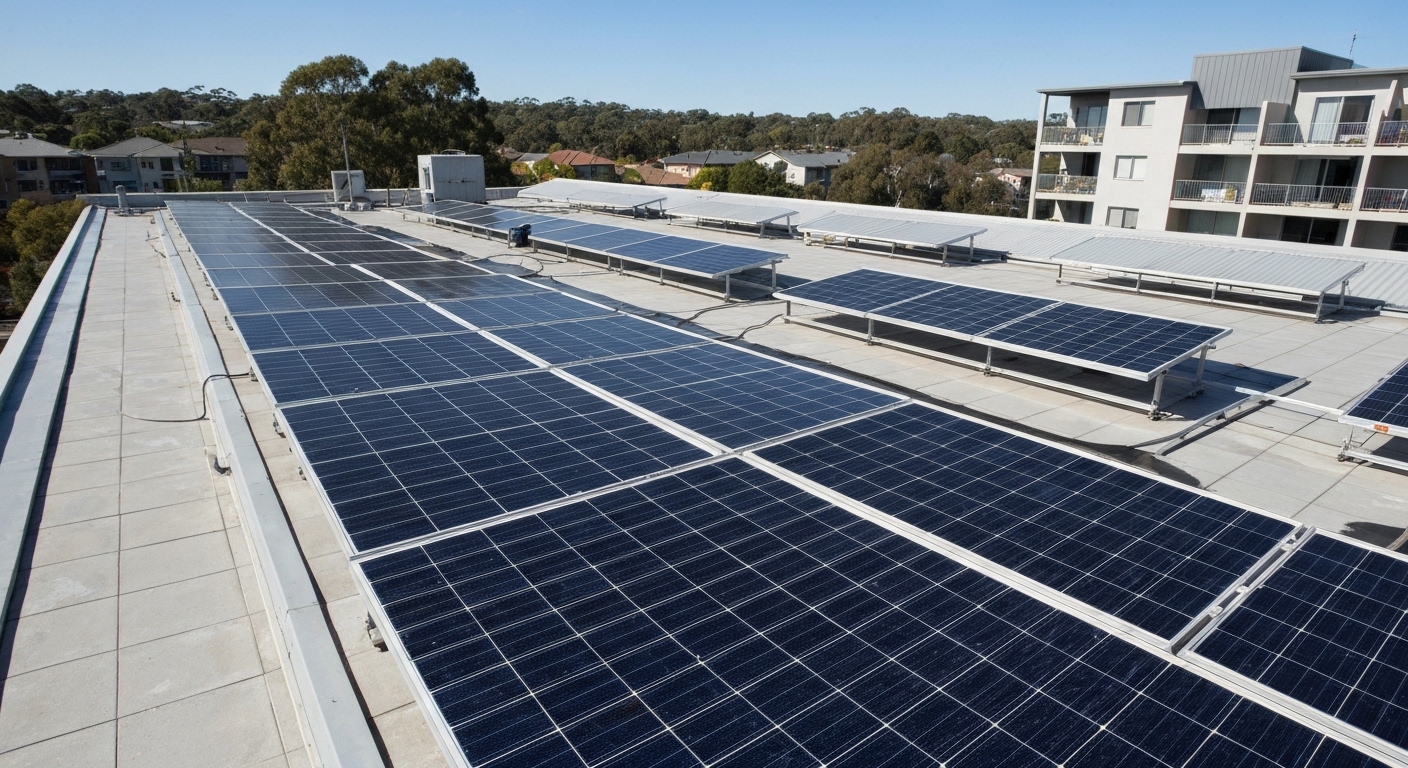
Australia’s apartment and strata market is one of the fastest-growing residential solar segments. Building-level solar installations are now found in strata schemes across every major city. They typically sit on rooftops, carparks, and common areas.
But solar panel cleaning for strata and apartment buildings is more complex than for single-family homes. The rules, responsibilities, and practical steps differ significantly.
This guide covers the key issues for owners corporations, strata managers, building managers, and individual lot owners navigating solar panel cleaning in a strata context.
Key Takeaways
- Strata buildings often have shared solar systems on the roof
- The owners corporation is usually responsible for solar panel cleaning
- Cleaning costs come from the building maintenance fund
- All owners benefit from a well-maintained solar system
- Strata managers can arrange regular cleaning contracts
- Ask your strata manager how often the panels are cleaned
- Dirty panels can reduce power output by 15–25%
How Strata Property Ownership Affects Solar Panel Cleaning Responsibility
In Australian strata law, every part of a building falls into one of three categories:
Common property — owned collectively by all lot owners through the owners corporation or body corporate. In almost every Australian strata scheme, the roof is common property.
Lot property — the individually owned area of each apartment, unit, or townhouse.
Exclusive use areas — common property that has been allocated for exclusive use by a specific lot owner. Examples include a balcony, car space, or roof terrace allocated by by-law.
This classification determines who is responsible for solar panel cleaning:
| Solar Panel Location | Owner | Responsible for Cleaning |
|---|---|---|
| Roof of common building | Owners Corporation (OC) | OC / Body Corporate |
| Balcony exclusive-use area | Lot owner (by by-law) | Lot owner (usually) |
| Individual lot airspace (rare) | Lot owner | Lot owner |
| Carpark canopy (common) | Owners Corporation | OC |
The practical implication: most building-wide solar systems in strata are on the roof. That makes them common property. The owners corporation must maintain them.
State-by-State Strata Solar Legislation Overview
Strata law is state-based in Australia. Here are the key references for solar panel cleaning and maintenance:
New South Wales
The Strata Schemes Management Act 2015 governs strata in NSW. The 2021 sustainability by-law amendments created a streamlined path for lot owners to install solar panels.
Key points:
- An owners corporation cannot unreasonably refuse a sustainability infrastructure request (which includes solar panels)
- Lot owner installations on common property require a registered by-law and usually a maintenance agreement
- The owners corporation retains the right to impose conditions, including insurance, maintenance obligations, and approved installer requirements
Victoria
The Owners Corporations Act 2006 and Owners Corporations Regulations 2018 apply. Victoria does not have a specific sustainability by-law framework equivalent to NSW’s 2021 reforms. That means lot owner solar installations require a full owners corporation resolution. The government has signalled reform is pending.
Queensland
The Body Corporate and Community Management Act 1997 (BCCM Act) applies. Module-specific regulations depend on scheme type (Accommodation Module, Standard Module, etc.). Body corporates can pass solar installation motions by ordinary resolution.
Western Australia
The Strata Titles Act 1985 (as amended 2021) applies. The 2021 reforms significantly modernised WA strata law, including provisions for sustainability improvements. Scheme by-laws govern lot owner installations.
South Australia
The Community Titles Act 1996 applies. A significant rewrite is underway as of 2025. Maintenance responsibilities for common property solar remain with the community corporation.
Who Arranges Solar Panel Cleaning in a Strata Building?
The strata manager or building manager typically coordinates solar panel cleaning on behalf of the owners corporation. This includes:
- Obtaining quotes from licensed contractors
- Checking insurance certificates and qualifications
- Scheduling the work around building access requirements
- Arranging payment from the administrative fund
- Keeping records of cleaning dates and contractor details
Individual lot owners cannot typically arrange solar panel cleaning for common property systems. That must be approved and arranged by the owners corporation.
If you’re a lot owner concerned about dirty panels, raise the issue with your strata committee or at the next AGM.
Practical Steps for Solar Panel Cleaning in Strata Buildings
Step 1: Identify the Solar System Owner and Records
Before booking any cleaning, the strata manager should confirm:
- Who installed the system (original installer contact and CEC accreditation number)
- Where the system’s warranty documentation is held
- Whether a maintenance agreement with the installer exists
- What the current output is (monthly kWh — check the inverter portal)
Many strata-managed buildings do not have this information readily accessible. Locating it is the first step.
Step 2: Assess the Solar Panel Cleaning Requirement
For common property systems, the owners corporation committee should commission an annual inspection. This determines:
- Current soiling level and estimated output impact
- Any maintenance issues (damaged panels, wiring concerns, inverter faults)
- Recommended cleaning frequency for the specific building location and environment
This can usually be bundled with the solar panel cleaning service itself. A reputable provider will assess and report before and after cleaning.
Step 3: Secure the Right Contractor for Strata Solar Panel Cleaning
Strata buildings have higher compliance requirements for contractors than residential homes. Any contractor must provide:
Public liability insurance certificate — minimum $10 million (most strata managers require $20 million)
Workers compensation insurance — mandatory for contractors with employees
Working at Heights certification — required for any work above 2 metres under WHS regulations
Rope access licence (IRATA or ROPEWALK) — for buildings above 3 storeys requiring abseiling access
Relevant electrician licence — if any electrical inspection or connection work is included
CEC accreditation — if solar-specific electrical work is performed
Request all certificates before commencement. The strata manager should retain copies for the building records.
Step 4: Budget for Solar Panel Cleaning
Solar panel cleaning should be included in the owners corporation’s annual maintenance budget. It’s an administrative fund expense, not a capital works expense. It’s routine maintenance, not a capital improvement.
Budget estimates for common property system cleaning:
| Building Type | System Size | Annual Cleaning Budget |
|---|---|---|
| 2–3 storey, 12 units | 20–30 kW (50–75 panels) | $600–$1,200/year |
| 4–6 storey, 30 units | 40–80 kW (100–200 panels) | $1,400–$3,000/year |
| 7–12 storey, 60 units | 100–200 kW (250–500 panels) | $3,000–$8,000/year |
| High-rise 20+ storeys | 200+ kW | $6,000–$20,000+/year |
These estimates assume one clean per year. Buildings in high-soiling environments need more frequent cleaning. Central-city, coastal, or subtropical locations should budget for twice-yearly service.
Why Regular Solar Panel Cleaning Matters for Strata Buildings
Dirty solar panels produce less electricity. Studies show that accumulated dirt, dust, bird droppings, and pollution can reduce output by 15–25% in Australian cities.
For a strata building with a 100 kW system, that could mean:
- Lost generation: 15,000–30,000 kWh per year
- Lost savings: $3,000–$6,000 per year (at average electricity rates)
- Extended payback period: an extra 1–2 years to recover the installation cost
Regular solar panel cleaning ensures the building gets the full financial benefit of the solar investment. It also maintains warranty compliance. Most manufacturers require evidence of regular cleaning.
Access Challenges for Multi-Storey Strata Solar Panel Cleaning
Low-Rise (2–3 Storeys)
Roof access via a fixed roof hatch or external ladder is standard. A standard solar panel cleaning service with scaffolding or an aluminium platform ladder is sufficient. Most residential solar cleaning companies can service low-rise strata with their standard equipment.
Mid-Rise (4–8 Storeys)
Requires Working at Heights equipment and methods. Options include:
Elevated Work Platform (EWP/cherry picker) — practical if there is adequate ground-level access around the building. Not always available in built-up urban areas.
Rope access — most cost-effective method for buildings with complex roofline or no EWP access.
Building Maintenance Unit (BMU) — permanent suspended platform used in some buildings. Requires specialist operator.
High-Rise (9+ Storeys)
Rope access (IRATA Level 2+ certified technicians) or BMU access is standard. For very large arrays, drone-mounted cleaning systems are beginning to be used on a commercial basis in Australia. This remains a specialist service.
Individual Lot Owner Solar Panel Cleaning Responsibilities
If a lot owner has installed solar panels under an approved strata by-law, the by-law itself will typically specify maintenance obligations. Common provisions:
- The lot owner is responsible for all cleaning, maintenance, and repair of the installation
- The lot owner must use licensed contractors for any electrical work
- The lot owner must maintain public liability insurance for the installation
- The installation must be removed or updated at the lot owner’s cost if common property work requires it
Lot owners in this situation should treat their system with the same diligence as a detached home. That means annual solar panel cleaning, inverter monitoring, and a 3-yearly thermal inspection.
How to Raise Solar Panel Cleaning Issues at an AGM
If the owners corporation is not maintaining a common property solar system, a lot owner can:
- Write formally to the committee requesting the matter be placed on the agenda
- Raise it at the AGM or EGM — solar panel cleaning and maintenance of common property solar is an operational decision that can be made by ordinary resolution of the committee
- Request a quote be obtained and presented to owners for approval
- Escalate to the state tribunal (NCAT, VCAT, QCAT, SAT, etc.) if the OC is in breach of its maintenance duty
Most strata disputes about solar maintenance resolve at step 2. This happens once the financial cost of neglect is clearly presented. Lost output equals lost common electricity savings.
Summary
Solar panel cleaning for strata and apartment buildings is a legitimate, recurring maintenance obligation for owners corporations. It’s not optional.
Buildings with common property solar systems should:
- Budget for annual professional solar panel cleaning
- Secure contractors with appropriate insurance and certifications
- Track system performance to quantify the return on maintenance investment
For lot owners with approved individual installations, the responsibility sits squarely with you. Treat it with the same professionalism you’d expect from the owners corporation for the rest of the building.
Sources
- Strata Schemes Management Act 2015 (NSW) — Part 7A Sustainability Infrastructure, NSW Legislation, legislation.nsw.gov.au
- Australian Building Codes Board (ABCC), Work Health and Safety Requirements for Solar Panel Access, 2024, abcb.gov.au
- Clean Energy Council, Solar Panel Maintenance Best Practice Guide for Commercial and Strata Buildings, 2025, cleanenergycouncil.org.au
Last updated: April 2026. Strata legislation references are correct as of writing. Legislation varies by state — always consult the current Act and regulations for your state and seek legal advice for complex strata matters.
See also Solar Panel Cleaning Rental Properties Australia, Solar Panel Cleaning Cost Australia 2025, and Solar Panel Cleaning Insurance Australia.
Frequently Asked Questions
Who is responsible for cleaning solar panels on a strata building?
In most cases, if the solar panels are on common property (the roof, which is typically common property in strata), the owners corporation (body corporate) is responsible for cleaning and maintaining them. If a lot owner has installed solar panels exclusively for their own use on common property under a special resolution, the by-law granting that approval usually requires the lot owner to maintain them. Always check your strata by-laws and scheme records.
Can a strata scheme refuse to clean its common property solar panels?
Owners corporations have a legal duty to maintain common property in good repair under strata legislation in every Australian state. If solar panels are installed on common property, failure to maintain them (including cleaning) may constitute a breach of this duty. Lot owners can raise the issue at an AGM or extraordinary general meeting, and if the committee refuses to act, the matter can be escalated to the relevant state tribunal (e.g., NCAT in NSW, VCAT in Victoria, QCAT in Queensland).
How do strata buildings access the roof for solar panel cleaning?
Most strata buildings use either a licensed building maintenance company (abseiling or BMU access for high-rise) or a solar cleaning specialist with appropriate Working at Heights certification and public liability insurance. All roof access must comply with WHS regulations in the relevant state. The strata manager or owners corporation must ensure any contractor engaged holds a minimum of $10 million public liability insurance and relevant certifications.
How much does solar panel cleaning cost for a strata or commercial building?
Pricing depends on the number of panels, building height, and access method. Low-rise strata (2–3 storeys): $400–$900 for a typical 30–50 panel common property array. Mid-rise (4–8 storeys with rope access): $900–$2,500. High-rise (9+ storeys with BMU or abseiling): $2,000–$6,000+. Annual service agreements for strata buildings are common and usually reduce the per-service cost by 15–25%.
Can individual apartment owners install their own solar panels in a strata scheme?
Yes, in most Australian states, with owners corporation approval (typically by ordinary or special resolution). The process, conditions, and by-law requirements vary by state. NSW has the most developed framework (following the 2021 strata law reforms) which provides a path for lot owners to install solar on their balcony or exclusive-use area. Common property roof installations require explicit owners corporation approval and a registered by-law.
How often should strata buildings clean their solar panels?
Clean panels every 6–12 months depending on your location. Coastal buildings and city apartments need more frequent cleaning due to salt spray and pollution. Brisbane and Sydney strata buildings typically clean twice yearly, while regional areas may only need annual cleaning. Check your inverter readings monthly to spot performance drops that indicate dirty panels.
Frequently Asked Questions
In most cases, if the solar panels are on common property (the roof, which is typically common property in strata), the owners corporation (body corporate) is responsible for cleaning and maintaining them. If a lot owner has installed solar panels exclusively for their own use on common property under a special resolution, the by-law granting that approval usually requires the lot owner to maintain them. Always check your strata by-laws and scheme records.
Owners corporations have a legal duty to maintain common property in good repair under strata legislation in every Australian state. If solar panels are installed on common property, failure to maintain them (including cleaning) may constitute a breach of this duty. Lot owners can raise the issue at an AGM or extraordinary general meeting, and if the committee refuses to act, the matter can be escalated to the relevant state tribunal (e.g., NCAT in NSW, VCAT in Victoria, QCAT in Queensland).
Most strata buildings use either a licensed building maintenance company (abseiling or BMU access for high-rise) or a solar cleaning specialist with appropriate Working at Heights certification and public liability insurance. All roof access must comply with WHS regulations in the relevant state. The strata manager or owners corporation must ensure any contractor engaged holds a minimum of $10 million public liability insurance and relevant certifications.
Pricing depends on the number of panels, building height, and access method. Low-rise strata (2–3 storeys): $400–$900 for a typical 30–50 panel common property array. Mid-rise (4–8 storeys with rope access): $900–$2,500. High-rise (9+ storeys with BMU or abseiling): $2,000–$6,000+. Annual service agreements for strata buildings are common and usually reduce the per-service cost by 15–25%.
Yes, in most Australian states, with owners corporation approval (typically by ordinary or special resolution). The process, conditions, and by-law requirements vary by state. NSW has the most developed framework (following the 2021 strata law reforms) which provides a path for lot owners to install solar on their balcony or exclusive-use area. Common property roof installations require explicit owners corporation approval and a registered by-law.
Clean panels every 6–12 months depending on your location. Coastal buildings and city apartments need more frequent cleaning due to salt spray and pollution. Brisbane and Sydney strata buildings typically clean twice yearly, while regional areas may only need annual cleaning. Check your inverter readings monthly to spot performance drops that indicate dirty panels.