Commercial Solar Panel Cleaning in Australia: What Business Owners Need to Know
Everything Australian business owners need to know about commercial solar panel cleaning — frequency, cost per panel at scale, insurance obligations, and strata requirements.
Key Takeaways
- Large solar systems need regular cleaning. Dirty panels cost money.
- Most businesses should clean twice a year.
- Sites near dust or birds may need to clean four times a year.
- The cost per panel drops when you clean more panels at once.
- You must keep cleaning records. Insurance may need them.
- Only use cleaners with the right safety tickets and insurance.
Why Commercial Solar Panel Cleaning Is Different to Residential
Australia’s commercial solar sector has grown dramatically. By 2025, over 40,000 Australian businesses operated rooftop solar systems, with combined installed capacity exceeding 6 GW according to the Clean Energy Regulator. A 100 kW commercial array on a warehouse or shopping centre roof represents a capital investment of $80,000–$150,000. Like any asset of that scale, it demands a structured maintenance programme.
Commercial solar panel cleaning differs from residential maintenance in several key ways:
Lost output compounds quickly — A 200-panel system losing 15% efficiency to soiling loses roughly 2,250 kWh per month. That potentially costs $600–$900 in lost bill savings or feed-in revenue.
Insurance and warranty obligations — Commercial insurers and panel manufacturers often require documented maintenance schedules.
WHS requirements — Roof access for large systems requires height safety compliance under the Work Health and Safety Act 2011 (Cth) and relevant state legislation.
Strata and tenancy complexity — Multi-tenanted properties have additional legal obligations around who pays and who approves.
Understanding these differences is the starting point for building a commercially sound cleaning programme.
Cost Per Panel for Commercial Solar Panel Cleaning at Scale
The per-panel cost drops significantly with volume. However, total outlay is still material. Here’s what to expect across system sizes:
| System Size | Panels (approx.) | Estimated Cost Range | Per-Panel Rate |
|---|---|---|---|
| 30 kW | 75 | $180–$280 | $2.40–$3.70 |
| 100 kW | 250 | $350–$600 | $1.40–$2.40 |
| 250 kW | 625 | $750–$1,250 | $1.20–$2.00 |
| 500 kW | 1,250 | $1,200–$2,100 | $0.96–$1.68 |
Figures are indicative national averages for ground-level or low-slope commercial rooftop systems. Elevated structures, steep pitches, and regional locations attract surcharges.
Factors That Drive Commercial Solar Panel Cleaning Costs
Roof access complexity — Multi-storey buildings require EWP (elevated work platforms) or rope access technicians. This adds $200–$800 to a standard job. Single-storey warehouses with parapet access are the most cost-efficient.
Soiling level — Heavy bird fouling, lichen, or industrial residue takes longer to remove. Cleaners may charge $0.50–$1.00 extra per panel for severely soiled systems. A regular schedule prevents heavy accumulation. This reduces long-run cost.
Location — Remote and regional properties carry travel surcharges. Contractors servicing Darwin, Kalgoorlie, or remote Queensland routinely add $150–$400 for travel time.
Contract vs one-off — Annual maintenance contracts typically run 15–25% cheaper per visit than ad hoc bookings. For large systems this saving is material over a 5-year period.
For a full national pricing breakdown, see Solar Panel Cleaning Cost in Australia — 2025 Guide.
Recommended Cleaning Frequency for Commercial Solar Panel Cleaning
There is no universal answer. The right frequency depends on your site’s soiling profile:
High Priority: Every 3–4 Months
- Industrial estates near manufacturing, quarrying, or heavy road freight
- Sites downwind of agricultural land (seasonal dust and crop spray)
- Properties with heavy bird activity — seagulls near ports, pigeons in CBDs, cockatoos in bush-adjacent suburbs
Standard: Every 6 Months
- Urban commercial rooftops in Sydney, Melbourne, Brisbane, and Adelaide
- Shopping centres and retail parks
- Office buildings with minimal nearby industrial activity
Lower Priority: Annual Clean
- Well-sealed low-slope rooftops in wetter climates (Cairns, Darwin wet season)
- Sites with automated water-rinsing systems
- Properties where inverter monitoring consistently shows output above 95% of baseline
The most reliable approach is inverter-level monitoring. A performance ratio (actual output ÷ expected output based on irradiance) drop below 90% is a clear trigger for cleaning. This data-driven approach is more reliable than any calendar schedule. See How to Read Your Solar Inverter Output in Australia for a step-by-step monitoring guide.
Insurance Obligations for Commercial Solar Panel Cleaning
Commercial property insurance in Australia increasingly includes specific provisions for solar systems.
Maintenance Documentation
Several major commercial property insurers include clauses requiring “reasonable maintenance” of plant and equipment. If a solar system causes a fire or sustains damage, and there is no maintenance record, insurers may use this to reduce or deny a claim.
Best practice: Keep receipts, service reports, and photos from every clean. Store them digitally alongside your system’s commissioning certificate. A simple spreadsheet log of dates, contractor names, and costs is sufficient.
Public Liability During Cleaning
When contractors work on your roof, their work falls under your occupier’s liability. Ensure every cleaning contractor carries:
- Public liability insurance (minimum $5 million recommended for commercial sites)
- WorkCover / workers’ compensation for all employees
- Proof of working at heights certification
Ask for a certificate of currency before work begins — not after.
Panel Damage Claims
If a cleaning contractor damages your panels (wrong chemicals, pressure washing, dropped tools), their public liability policy must respond. Confirm their policy specifically covers solar panel damage. Some policies exclude it.
For a detailed breakdown of solar insurance obligations, see Solar Panel Cleaning Insurance in Australia.
Strata and Commercial Lease Obligations
Strata-Titled Commercial Properties
Solar systems installed on common property (rooftops) are the owners corporation’s responsibility under most state strata legislation:
- NSW: Strata Schemes Management Act 2015
- VIC: Owners Corporations Act 2006
- QLD: Body Corporate and Community Management Act 1997
In practice, the owners corporation — managed by the strata manager — approves contractors. They fund cleaning from the administrative or sinking fund. They are also responsible for WHS compliance.
Tip for tenants: If your lease includes a provision for enjoying common property solar benefits (e.g. embedded network or solar credit arrangement), confirm the lease specifies cleaning obligations explicitly. Ambiguity generally favours the landlord.
Full Net Commercial Leases
Under a standard full net commercial lease, the tenant bears outgoings. These may include solar maintenance. Review your lease carefully. If your tenancy began before the solar system was installed, this may be negotiable.
Some landlords now include “green lease” clauses. These require the tenant to operate and maintain solar assets as part of a sustainability commitment. These obligations are enforceable.
For the residential equivalent, see Solar Panel Cleaning for Rental Properties for principles that apply across tenancy types.
WHS Requirements for Commercial Roof Cleaning
Cleaning a large commercial solar array is a notifiable work activity in many circumstances.
Working at Heights
Under the WHS Regulations, any work above 2 metres where there is a risk of falling requires a documented Safe Work Method Statement (SWMS). For rooftop solar cleaning this typically means:
- Edge protection or travel restraint systems
- Anchor points meeting AS/NZS 1891.4
- Competency evidence for all workers performing height work
Electrical Safety
Solar arrays are live whenever there is sunlight. Even with the inverter switched off, DC voltage is present at the panels. Commercial cleaners must:
- Never cut or access DC wiring during cleaning
- Keep water away from junction boxes and combiner boxes
- Follow AS/NZS 4836 (safe working on or near low-voltage electrical installations)
Engage only contractors who can demonstrate these competencies in writing. Low-cost quotes from unqualified operators create significant legal and financial liability for the site owner.
Choosing a Commercial Solar Panel Cleaning Contractor
What to Look For
A reputable commercial contractor should provide:
- Experience with your system size — ask for references from comparable jobs
- Appropriate insurance — minimum $5M public liability; $10M preferred for large systems
- De-ionised water systems — prevents mineral spotting on panels post-clean
- Written SWMS — for any work at height, before work commences
- Post-clean report — condition notes, photos, and any defects identified (e.g. microcracks, delamination, loose mounting)
Red Flags to Avoid
- Quote given without site inspection or panel count
- No insurance documentation available on request
- Proposes pressure washing as standard method (damages anti-reflective coatings)
- Cannot provide a SWMS for height work
See Professional vs DIY Solar Cleaning in Australia for a full contractor vetting checklist.
Tax Treatment of Commercial Solar Panel Cleaning
Commercial solar panel cleaning is a deductible operating expense for commercial property owners and businesses (ITAA 1997, s8-1). Key points:
Full immediate deduction: Cleaning is a repair/maintenance expense — not a capital improvement. It is deductible in the year incurred.
GST: GST-registered businesses claim the input tax credit on cleaning invoices.
Depreciation unaffected: Cleaning does not alter the panels’ depreciation schedule under the tax consolidation framework.
Document invoices properly. The ATO may treat a solar system producing significantly below its rated output as evidence of poor maintenance. This can affect asset depreciation claims under audit.
Building a Commercial Solar Maintenance Schedule
A structured annual programme that satisfies insurers, warranty requirements, and WHS obligations:
| Quarter | Activity |
|---|---|
| Q1 (Jan–Mar) | Full professional clean after summer storm season; output baseline review |
| Q2 (Apr–Jun) | Visual inspection; check for bird nesting before winter migration |
| Q3 (Jul–Sep) | Mid-year clean — skip only if monitoring shows output >95% of baseline |
| Q4 (Oct–Dec) | Pre-summer clean; inspect seals, mounting hardware, and bird mesh |
Add an unscheduled clean after any major dust storm, bushfire smoke event, or significant bird fouling episode.
For the full residential and commercial maintenance framework, see the Complete Solar Panel Maintenance Guide for Australia.
Summary
Commercial solar panel cleaning in Australia is a maintenance obligation, not an optional extra. For business owners, the combination of warranty requirements, insurer expectations, WHS obligations, and the financial impact of soiling makes a documented, scheduled maintenance programme essential.
Key takeaways:
- Cost runs $0.96–$3.70 per panel depending on system size and site
- Clean every 6 months as a baseline; adjust based on real monitoring data
- All contractors must hold appropriate insurance and height safety certification
- Keep records — they matter for insurance claims, warranty assertions, and tax
- Strata and commercial lease holders need to confirm who bears the cleaning obligation in writing
A well-maintained commercial solar system should deliver its rated output for 20–25 years. Soiling is the single largest controllable variable affecting real-world performance. It is entirely preventable through regular commercial solar panel cleaning.
Sources
-
Clean Energy Regulator (2025). Commercial Solar PV Installation Data 2024–2025. Australian Government. Retrieved from https://www.cleanenergyregulator.gov.au
-
Standards Australia (2021). AS/NZS 4836:2011 — Safe working on or near low-voltage electrical installations and equipment. Standards Australia Limited.
-
Safe Work Australia (2020). Managing the Risk of Falls at Workplaces: Code of Practice. Commonwealth of Australia. Retrieved from https://www.safeworkaustralia.gov.au
Frequently Asked Questions
How much does commercial solar panel cleaning cost in Australia?
Commercial solar panel cleaning typically costs $0.80–$2.50 per panel depending on system size, roof type, and accessibility. A 100 kW rooftop system (roughly 250 panels) averages $350–$600 per clean when done at scale. Larger systems benefit from lower per-panel rates.
How often should a commercial solar system be cleaned?
Most commercial systems in Australian cities benefit from professional cleaning every 6–12 months. Industrial sites near dust or pollution sources may require quarterly cleaning. Monitoring data should guide scheduling decisions to maintain optimal output.
Who is responsible for cleaning solar panels on a strata property?
Under most strata schemes, common property solar systems are the owners corporation’s responsibility. The strata manager typically organises commercial solar panel cleaning as part of routine building maintenance and allocates costs through levies.
Does commercial solar panel cleaning affect insurance?
Yes — some commercial property insurers require documented proof of regular maintenance to honour claims involving solar systems. Commercial solar panel cleaning records protect your claim. Always confirm your policy terms and keep cleaning receipts.
Can commercial solar systems be cleaned while operating?
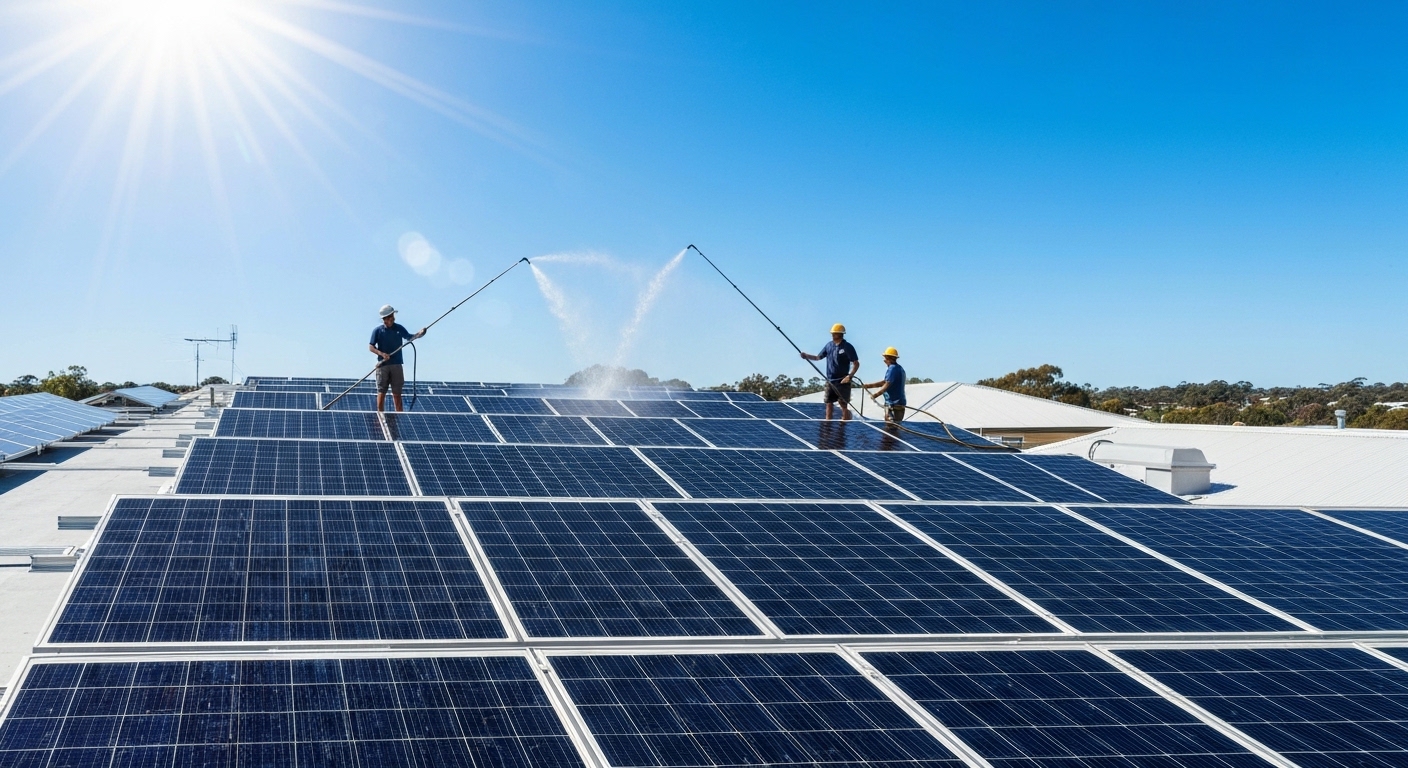
Yes, with appropriate safety protocols. Qualified commercial cleaners use de-ionised water fed-pole systems that require no system shutdown. However, any electrical work must follow AS/NZS 4836 lockout/tagout procedures for safe operation.
Frequently Asked Questions
Commercial solar panel cleaning typically costs $0.80–$2.50 per panel depending on system size, roof type, and accessibility. A 100 kW rooftop system (roughly 250 panels) averages $350–$600 per clean when done at scale. Larger systems benefit from lower per-panel rates.
Most commercial systems in Australian cities benefit from professional cleaning every 6–12 months. Industrial sites near dust or pollution sources may require quarterly cleaning. Monitoring data should guide scheduling decisions to maintain optimal output.
Under most strata schemes, common property solar systems are the owners corporation's responsibility. The strata manager typically organises commercial solar panel cleaning as part of routine building maintenance and allocates costs through levies.
Yes — some commercial property insurers require documented proof of regular maintenance to honour claims involving solar systems. Commercial solar panel cleaning records protect your claim. Always confirm your policy terms and keep cleaning receipts.
Yes, with appropriate safety protocols. Qualified commercial cleaners use de-ionised water fed-pole systems that require no system shutdown. However, any electrical work must follow AS/NZS 4836 lockout/tagout procedures for safe operation.