Solar Panel Cleaning vs Rain: Why Rainfall Isn't Enough in Australia
Waiting for rain to clean your solar panels? Australian data shows why rainfall fails against bird droppings, lichen, and dust — and when rain actually makes soiling worse.
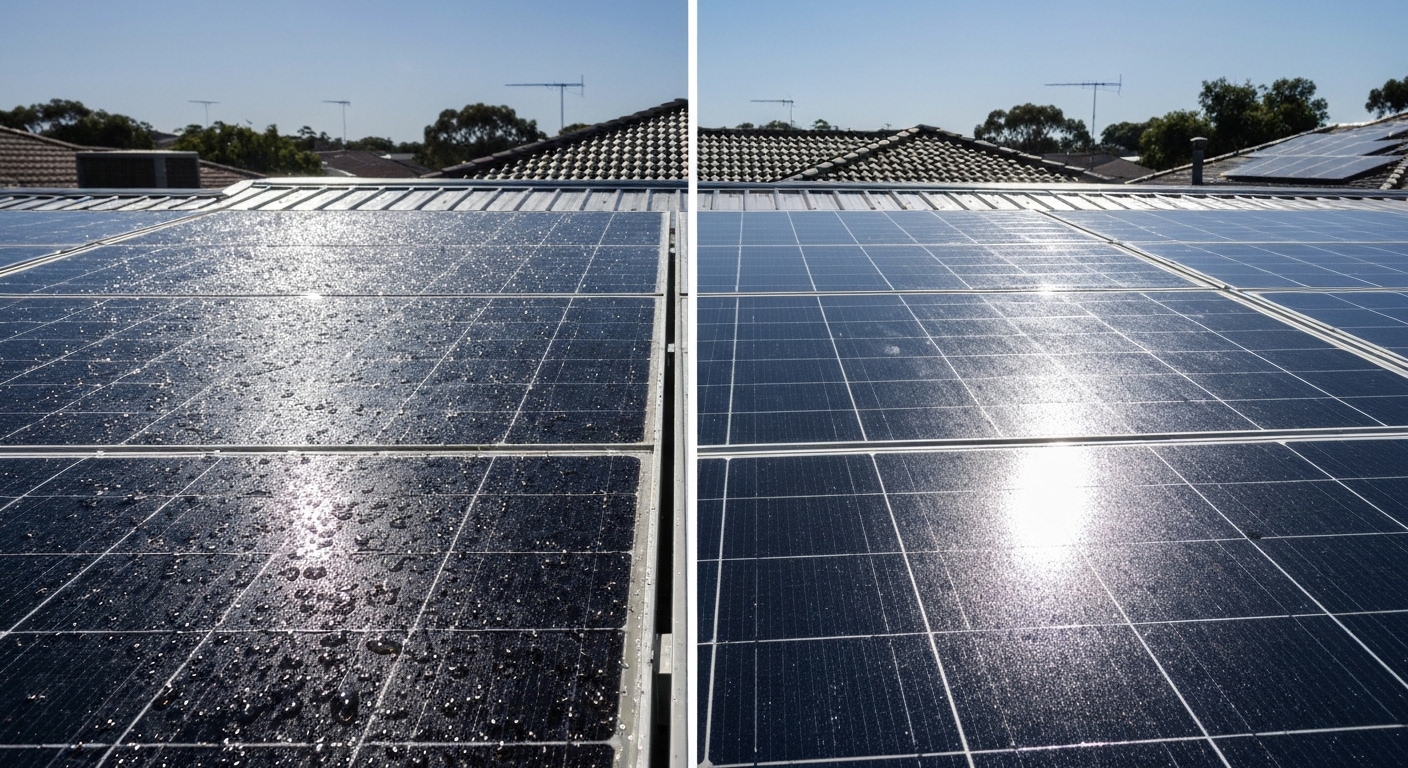
It’s a common assumption: “I don’t need to pay for cleaning — the rain takes care of it.” It sounds logical. Rain is free, it falls from the sky, and it washes everything else clean.
The reality for Australian solar panel owners is more complicated — and more costly.
What Rain Actually Does to Solar Panels
Rain does wash away loose, dry dust from panel surfaces. In ideal conditions — heavy, sustained rainfall on a lightly-soiled panel — you can recover 60–70% of soiling losses without any manual cleaning. That’s real value, and in some Australian climates, it genuinely delays the need for professional cleaning.
But here’s the problem: Australian solar panels rarely accumulate only loose, dry dust.
The 4 Things Rain Can’t Clean
1. Bird droppings
Bird droppings contain uric acid with a pH of 3–4. They dry hard, bond to glass chemically, and require physical agitation to remove. Rain simply doesn’t provide enough shear force to dislodge dried droppings. A dropping that’s been baking on a panel for a week in Queensland summer is essentially glued on.
Worse, rain can partially dissolve and spread the acidic material across a wider panel area, potentially etching a larger section of anti-reflective coating over time.
2. Lichen and biological growth
Lichen attaches to glass via root-like structures (rhizines) and is essentially immune to rainfall. Algae and moss trapped between panel frames and glass accumulate moisture from rainfall and actually thrive after wet periods. Rain accelerates biological colonisation, not cleaning.
3. Sticky pollen film
Spring brings eucalyptus, acacia, and grass pollen across Australia. This pollen is oily and sticky — it bonds to glass surfaces and forms a thin, transparent film that reduces light transmission by 3–8%. Rain on pollen-coated panels creates a paste that spreads across the surface rather than rinsing clean.
4. Mineral deposits from hard water areas
In areas where dust contains calcium carbonate, silica, or salt, rainfall can dissolve these minerals and redistribute them as the water evaporates — leaving behind white mineral deposits. This is particularly common in WA’s Wheatbelt, inland NSW and Victoria, and coastal areas where sea spray combines with dust.
The First-Flush Effect: When Rain Makes Things Worse
In extended dry periods, dust accumulates relatively evenly across panel surfaces. When light rain falls — the kind of 1–3mm showers that are common year-round across much of southern Australia — it doesn’t have the volume to sheet off the panel cleanly.
Instead, it creates rivulet channels: narrow paths where water flows, carrying concentrated dirt, surrounded by areas where particles are compressed into a thicker layer.
The result is a panel surface with diagonal dirt streaks that is, in some measurements, more efficient at blocking light than the pre-rain uniform dust layer.
This phenomenon — the first-flush effect — has been documented in solar monitoring research across arid and semi-arid Australian regions. It’s the reason output sometimes drops slightly in the week after light rainfall compared to the week before.
Rainfall by Australian Climate Zone: What It Means for Cleaning
Tropical North (Darwin, Cairns, Townsville)
Two distinct seasons: Wet season (Nov–April) delivers heavy, reliable rainfall that provides genuine partial cleaning. Dry season (May–Oct) sees zero meaningful rainfall for 5–6 months.
What this means: Annual professional cleaning at the start of the dry season removes accumulated wet-season biological growth (algae, moss thrive in the tropical wet). Mid-dry-season cleaning removes accumulated dust before the wet returns.
Recommendation: 2 cleans per year minimum. Rain helps but doesn’t replace cleaning.
South-East Queensland (Brisbane, Gold Coast, Sunshine Coast)
Sub-tropical: Good summer rainfall, drier winters. Significant bird activity year-round (ibis, mynas, lorikeets).
What this means: Summer rain partially cleans dust accumulation, but bird droppings require manual removal regardless. Winter dry periods allow significant dust and pollen accumulation.
Recommendation: 1–2 cleans per year. Post-winter clean is most impactful.
Southern States (Sydney, Melbourne, Adelaide)
Temperate: Irregular rainfall spread across the year, but frequently in small-event format (under 5mm). Significant pollen seasons in spring.
What this means: Small frequent rain events trigger the first-flush effect more than cleaning. Spring pollen creates sticky films that survive rain. Bird populations are high in urban areas.
Recommendation: 1–2 cleans per year. Post-spring clean to remove pollen film is particularly valuable.
Inland and Arid Regions (Outback NSW/QLD/WA/SA)
Dry continental: Rainfall is infrequent and unpredictable. Dust events (red dust, agricultural dust) can deposit millimetres of material in a single event. Low bird pressure but extreme dust.
What this means: Rain is too infrequent to be relied upon. After major dust events, output losses of 20–40% are common.
Recommendation: Quarterly or more frequent cleaning depending on proximity to agriculture or unpaved roads.
Western Australia (Perth, regional WA)
Mediterranean to arid: Perth has a hot, dry summer with almost no rainfall May–October. Dust from the Wheatbelt is a major soiling source.
What this means: Six months of zero rainfall means significant summer accumulation. Winter rains help, but the first-flush effect is common after dry Perth summers.
Recommendation: End-of-summer clean (April/May) is critical. Second clean in spring optional.
Comparing the Numbers: Rain vs Professional Cleaning
| Soiling Type | Rain Effectiveness | Professional Clean |
|---|---|---|
| Loose surface dust | 40–70% removal | 99%+ removal |
| Bird droppings | 0–5% (spreads, doesn’t remove) | 99%+ removal |
| Pollen film | 10–20% removal | 99%+ removal |
| Mineral deposits | 0% (worsens with evaporation) | 99%+ removal |
| Lichen/algae | 0% (may worsen) | 90–99% (multiple treatments) |
| Post-fire soot | 5–15% removal | 95%+ removal |
Sources: CSIRO Solar Soiling Study 2019; ARENA Rooftop Solar Performance Report 2022; CleanSolarAus field data 2024.
The Real Cost of Waiting for Rain
For a 6.6 kW system in Sydney losing 15% output to soiling over 6 months:
- Daily generation: ~24 kWh (summer average)
- 15% soiling loss: ~3.6 kWh/day lost
- Self-consumption rate: ~30 cents/kWh
- 6-month cost of waiting: ~$197 in lost electricity value
A professional clean costs $200–$260 for that same system. The math is almost exactly break-even — but this assumes 15% soiling, which is conservative for dusty areas. In agricultural regions or near construction, soiling losses of 25–35% make the payback calculation even more compelling.
When Rain Is “Good Enough”
To be fair to the rain-reliant approach, there are situations where rain provides adequate maintenance:
- Very new panels (first 6–12 months) in urban coastal areas with low bird pressure
- Ground-mounted systems angled at 10° or greater that naturally shed rain
- Systems near the coast where regular salt spray and rainfall provides some cleaning action (though watch for salt film buildup)
- Winter months in southern states when output is already reduced and soiling losses are relatively smaller in absolute kWh terms
In these contexts, annual professional cleaning combined with rain between cleans is often sufficient.
Practical Takeaway
Rain is a helpful maintenance partner, not a cleaning solution. For most Australian solar owners:
- After any heavy rainfall, check your inverter output. If it’s back within 5% of your seasonal baseline, the rain did its job on dust.
- If output remains low after rain, you have bird droppings, lichen, pollen, or mineral deposits that won’t shift without physical cleaning.
- Don’t schedule annual cleaning in winter on the logic that “it rains anyway” — the best time to clean is before peak generation season (late winter/early spring) so you capture maximum value from summer output.
- Regional and rural owners should abandon the rain-cleaning assumption entirely. Dust events in agricultural areas deposit more material in a single day than months of rainfall can remove.
Your panels are a significant investment — typically $5,000–$12,000 installed. Protecting their output with one or two professional cleans per year is straightforward insurance.
Sources
- CSIRO: Solar Panel Soiling in Australia — Impact Assessment (2019)
- ARENA: Rooftop PV Performance and Monitoring Report (2022)
- Clean Energy Council: Solar Panel Maintenance Guidelines (2024)
- Solar Analytics: Soiling Loss Data Across 10,000 Australian Rooftop Systems (2023)
- Solargis: Australian Solar Resource Atlas — Climate Zone Data (2024)
How to Use Rainfall Data to Optimise Your Cleaning Schedule
Rather than cleaning on a fixed calendar, the most cost-effective approach is rainfall-aware scheduling — using rain as a partial cleaning event and booking professional cleans to capture the remaining accumulated soiling.
The data-driven approach:
- Note your system’s output on a clear day after significant rainfall (baseline after natural cleaning)
- Track weekly output on clear days over the following 4–6 weeks
- When weekly output falls more than 8% below your rain-reset baseline, that’s your trigger to book a professional clean
This approach automatically adjusts to your actual soiling rate. In a wet year with frequent heavy rains, you may find you only need one professional clean annually. In a dry year, you might find the trigger hits at 10 weeks rather than 26 weeks.
Using Bureau of Meteorology rainfall data: If you want to calibrate further, the BoM daily rainfall records for your nearest weather station are publicly available at bom.gov.au. Cross-referencing your output data against rainfall events reveals exactly how much your local rain cleans — and over a year or two, patterns become predictable.
Rain and Biological Growth: The Counterintuitive Risk
While rain is generally helpful for dust removal, in certain conditions it can actually promote soiling in the medium term:
Algae and lichen spore establishment: Rain events deposit biological spores (from surrounding vegetation) onto panel surfaces. In humid post-rain conditions, these spores can establish within days. A panel that was rained clean of mineral dust may simultaneously receive a new algae or lichen spore load. Over 2–3 wet seasons without cleaning, biological growth can establish even on panels that “look clean” from the road.
This is why professional cleaning serves a dual function: removing visible surface soiling and preventing biological establishment before it becomes a multi-week removal project.
Soiling in high dust followed by rain: In agricultural and inland areas, the first significant rainfall after a dry dust period often makes panels worse — rain droplets pick up suspended dust particles and bond them to the glass as they evaporate. The visual result is a mottled, hard-to-remove deposit that requires scrubbing, not just rinsing.
Sources: CSIRO, ARENA, Clean Energy Council, Solar Analytics, Solargis.
Related: Does Rain Clean Solar Panels? · How Often to Clean Solar Panels · Solar Panel Soiling Cost Australia
Frequently Asked Questions
Does rain actually clean solar panels?
Rain removes loose surface dust — but only partially. Studies show self-cleaning from rainfall reduces soiling losses by 30–50% compared to zero rain, but never restores panels to clean baseline. Bird droppings, lichen, sticky pollen film, and mineral-rich dust are unaffected by rain.
Why does rain sometimes make solar panels dirtier?
In dry periods, dust and particles accumulate across the full panel surface. When light rain hits, it redistributes this material in rivulets rather than washing it off — creating a ‘mud map’ pattern of concentrated dirt lines. This is called the ‘first-flush effect’ and can temporarily increase soiling losses.
How much rain is needed to clean solar panels effectively?
Research from CSIRO and Australian solar monitoring studies suggests at least 5–10mm of sustained rainfall is needed to partially clean panels. Light showers under 2mm typically just move dust around. Even 20mm+ events leave behind bird droppings, sticky residue, and biological growth.
Which Australian cities can rely most on rain to clean panels?
Darwin and tropical Queensland (Cairns, Townsville) receive the most reliable heavy rainfall and benefit most from natural cleaning during the wet season. However, even these regions accumulate dry-season soiling that requires professional cleaning 1–2 times per year.
How do I know if rain cleaned my panels properly?
Check your inverter app output the day after a significant rainfall event and compare it to the same clear day the previous week. If output is within 2–3% of your historical baseline for that season, rain did a reasonable job. A larger gap indicates soiling that needs professional attention.
Frequently Asked Questions
Rain removes loose surface dust — but only partially. Studies show self-cleaning from rainfall reduces soiling losses by 30–50% compared to zero rain, but never restores panels to clean baseline. Bird droppings, lichen, sticky pollen film, and mineral-rich dust are unaffected by rain.
In dry periods, dust and particles accumulate across the full panel surface. When light rain hits, it redistributes this material in rivulets rather than washing it off — creating a 'mud map' pattern of concentrated dirt lines. This is called the 'first-flush effect' and can temporarily increase soiling losses.
Research from CSIRO and Australian solar monitoring studies suggests at least 5–10mm of sustained rainfall is needed to partially clean panels. Light showers under 2mm typically just move dust around. Even 20mm+ events leave behind bird droppings, sticky residue, and biological growth.
Darwin and tropical Queensland (Cairns, Townsville) receive the most reliable heavy rainfall and benefit most from natural cleaning during the wet season. However, even these regions accumulate dry-season soiling that requires professional cleaning 1–2 times per year.
Check your inverter app output the day after a significant rainfall event and compare it to the same clear day the previous week. If output is within 2–3% of your historical baseline for that season, rain did a reasonable job. A larger gap indicates soiling that needs professional attention.