Solar Panel Hot Spots: Causes, Damage, and How to Fix Them
Hot spots are one of the most destructive solar panel faults — and one of the most preventable. Here's what causes them, how to find them, and what repairs cost in Australia.
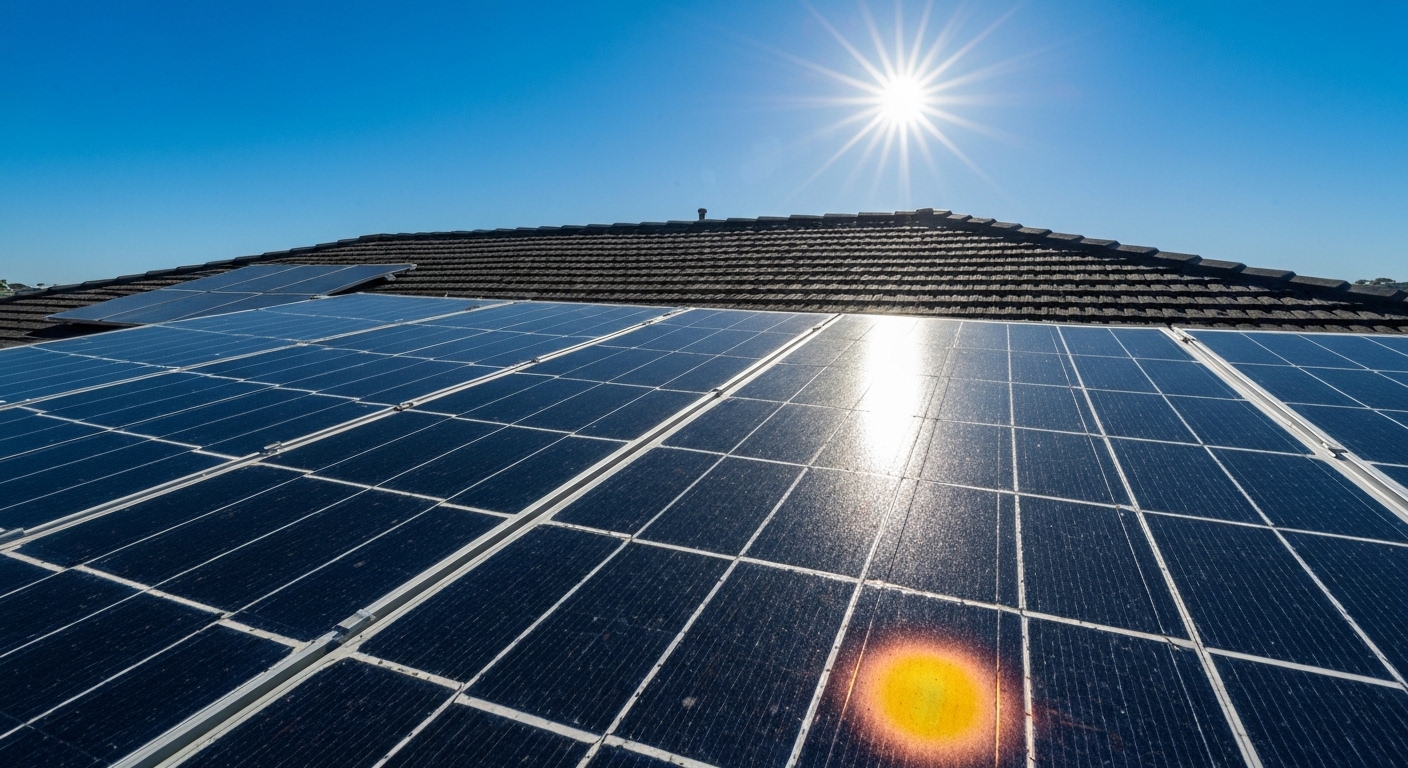
Hot spots are among the most destructive problems a solar panel system can develop. Most homeowners have no idea they’re happening. Unlike a blown fuse or a dead inverter, solar panel hot spots don’t trigger an alarm or error code in your monitoring app. They silently degrade individual cells, reducing your system’s performance permanently. In severe cases, they pose a genuine fire risk.
Understanding what causes solar panel hot spots, how to identify them, and how to prevent them is essential knowledge for any Australian solar panel owner.
What Is a Solar Panel Hot Spot and How Does It Form?
A solar panel is made up of many individual photovoltaic cells. A standard 60-cell or 72-cell panel connects these in series strings, with bypass diodes protecting small groups of cells. When all cells in a string work correctly, current flows uniformly. The panel operates at its rated temperature.
A solar panel hot spot forms when one or more cells produce less current than the others in their string. Because the cells are in series, the full current generated by the functioning cells must still flow through the underperforming cell. The underperforming cell cannot accept this current as electricity. It dissipates it as heat instead.
The result: a small area of the panel reaches temperatures that can exceed 100–150°C. Meanwhile, the surrounding panel surface sits at 40–60°C. At these temperatures:
- The ethylene vinyl acetate (EVA) encapsulant laminate begins to degrade and yellow
- Cell metallisation (the silver contact grid) can crack or come loose
- The backsheet (typically white TPT or similar material) discolours and can eventually burn
- In extreme cases, the glass can crack from thermal stress
Once hot spot damage has occurred to the laminate or cells, it is irreversible. This makes early detection and prevention critical for maintaining solar panel performance.
What Causes Solar Panel Hot Spots in Australian Conditions
1. Bird Droppings and Soiling
This is the number one cause of solar panel hot spots in Australian residential systems. A single bird dropping that covers even part of one cell creates a classic partial shade condition. Because the dropping is opaque, the shaded cell produces little or no current while the rest of the string generates full output.
The bypass diodes activate to protect the affected cells. But if the dropping is small enough to affect only part of a cell, the bypass diode may not trigger. This means the partial shade condition forces current through the partially shaded area continuously.
Australia-specific context: The Australian Bureau of Statistics reported 3.7 million rooftop solar systems operating by 2025. The Clean Energy Regulator has noted bird droppings as the leading cause of unscheduled warranty claims related to cell damage in systems under 5 years old.
Regular professional cleaning to remove bird droppings is your first line of defence against hot spots.
2. Lichen and Organic Growth
Unlike bird droppings, lichen grows slowly. Its shading effect increases gradually over months and years. The combination of persistent shade (lichen doesn’t wash off in rain) and the slightly acidic surface the organism creates means lichen-covered cells develop solar panel hot spots over time. There’s no visible triggering event.
Roof-pitch angles under 15° and shaded or south-facing panels in humid climates carry the highest risk for lichen-driven hot spots.
3. Micro-Cracks (Invisible to the Naked Eye)
Micro-cracks in silicon cells can develop from several sources:
- Installation damage — dropped panels, improper panel walking during installation
- Hail impact — even hail that doesn’t visibly crack the glass can crack underlying cells
- Thermal cycling stress — extreme temperature variation (common in inland Australia) causes expansion and contraction that stresses cell metallisation
A micro-cracked cell has reduced current-carrying capacity. The greater the crack, the more it mimics a shading condition. This forces bypass and generates heat.
4. Manufacturing Defects
Latent manufacturing defects can manifest as solar panel hot spots within the first 1–5 years of operation. Poor solder joints, misaligned cell busbars, and substandard EVA lamination are common culprits. Quality-certified panels from established manufacturers (Tier 1 as assessed by Bloomberg NEF) have significantly lower defect rates than lower-cost alternatives.
5. Dust and Non-Uniform Soiling
Non-uniform soiling creates partial shading similar to bird droppings. Dust accumulates more heavily on parts of the panel than others. This is particularly relevant in dusty inland Australian environments. Windborne dust deposits unevenly, often concentrating at the leading edges and lower portion of a tilted panel.
6. Shading from Trees, Structures, or Neighbouring Buildings
External shading is a design issue rather than a maintenance issue. But it’s worth noting: any regular partial shading condition creates ongoing hot spot risk in the shaded cells. This includes shading from growing trees, new structures, or neighbouring buildings.
How to Detect Solar Panel Hot Spots
Method 1: Thermal Imaging (Most Reliable)
An infrared camera or thermal imaging drone scan is the gold standard. A qualified inspector scans the array while it operates under full sunlight (typically between 10am and 2pm). The thermal image reveals cell temperature distribution across every panel.
What to look for in the report:
- “Point anomalies” — a single bright spot on a panel (single cell or small group) indicates bird dropping or micro-crack hot spots
- “Stripe anomalies” — a line of elevated temperature across a cell row indicates a cracked cell or series resistance issue
- “Panel-level anomalies” — where one full panel is hotter than surrounding panels, suggesting a bypass diode failure or delamination
Thermal imaging services cost $150–$350 for a standard residential array. They’re available from specialist solar inspection companies. Many are increasingly offered as a drone service in metro areas.
Method 2: String-Level and Module-Level Monitoring
Systems with SolarEdge optimisers or Enphase microinverters monitor output at the individual panel level. An underperforming panel — producing significantly less than its neighbours under the same conditions — may have an active solar panel hot spot.
Log into your monitoring portal and compare panel-by-panel output on a clear day. Any panel producing more than 10–15% below its array neighbours warrants investigation. This approach helps with diagnosing solar panel output drops.
Method 3: Visual Inspection
While micro-cracks and early-stage solar panel hot spots are invisible, advanced hot spot damage is often visible:
- Brownish or yellowish discolouration on the cell visible through the glass (EVA browning)
- Dark patches on the backsheet (backsheet degradation)
- Visible cell cracking in the pattern of a cracked windscreen
- Bubbling or delamination visible as raised areas on the panel surface
If you can see any of these signs from ground level with binoculars, the affected panel is likely permanently degraded.
How to Prevent Solar Panel Hot Spots
The strong link between hot spots and preventable soiling means that regular professional cleaning is also hot-spot prevention. Here’s what works:
| Preventable Cause | Prevention Method |
|---|---|
| Bird droppings | Professional cleaning every 6–12 months; bird mesh installation |
| Lichen/organic growth | Annual inspection; lichen treatment (professional application only) |
| Non-uniform dust soiling | Regular cleaning, particularly in dusty inland areas |
| Vegetation shading | Annual inspection; tree trimming |
Bird mesh installation specifically eliminates the most common hot spot cause in Australian conditions. A bird proofing system typically costs $400–$900 for a 6.6 kW array. That’s less than the cost of a single panel replacement. It prevents the problem from recurring.
Regular maintenance also helps you meet warranty cleaning requirements, protecting your investment long-term.
What to Do If You Suspect Solar Panel Hot Spots
Follow these steps if you think your system has developed hot spots:
- Check your inverter monitoring for any panels flagged as underperforming, or any unexplained output drops
- Inspect panels from ground level with binoculars for visible discolouration or cell damage
- Book a thermal imaging inspection — do this before or after cleaning, not during. A wet panel surface can mask thermal anomalies
- If damage is confirmed, check your warranty — most Tier 1 panel warranties cover hot spot damage caused by manufacturing defects. Some cover severe bird dropping damage if it occurred within a specific timeframe
- Get a quote for panel replacement from your original installer or a qualified solar technician
Do not continue operating a system with suspected DC wiring exposure or backsheet damage. These conditions can lead to arc faults and fire.
Solar Panel Hot Spot Repair and Replacement Costs
Here’s what you can expect to pay for hot spot-related repairs in Australia:
| Issue | Typical Cost (Installed) |
|---|---|
| Thermal imaging inspection | $150–$350 |
| Single panel replacement (standard 400W panel) | $300–$600 |
| Two-panel replacement | $500–$900 |
| String-level diagnosis and repair | $400–$800 |
| Bypass diode replacement (module-level, if accessible) | $200–$400 |
| Inverter repair related to ground fault | $500–$1,500 |
| Full array thermal imaging + report (drone) | $250–$500 |
Summary
Solar panel hot spots are a silent but serious threat to solar panel performance and longevity. They’re caused by partial shading — most commonly from bird droppings in the Australian context. Micro-cracks, lichen, and manufacturing defects also contribute. Left undetected, they permanently degrade cells and reduce your system’s output for its remaining lifespan.
The prevention strategy is simple. Keep panels clean, install bird mesh if your system experiences regular fouling, and book an annual inspection. This should include a panel-by-panel output check. Ideally, get a full thermal imaging scan every 2–3 years.
Catching a solar panel hot spot early means catching it before the damage is permanent.
Sources
- Australian Bureau of Statistics (2025). Household Energy Use and Renewable Systems Survey. Retrieved from abs.gov.au
- Clean Energy Regulator (2024). Solar Panel Warranty Claims Analysis: Common Failure Modes in Australian Installations. Retrieved from cleanenergyregulator.gov.au
- Bloomberg New Energy Finance (2024). Tier 1 Solar Panel Manufacturer Quality Rankings. Retrieved from about.bnef.com
- International Energy Agency Photovoltaic Power Systems Programme (IEA-PVPS) (2023). Review of Failures of Photovoltaic Modules: Task 13 Report. Retrieved from iea-pvps.org
Last updated: April 2026. Cost estimates are indicative and reflect Australian market conditions. Always obtain written quotes from licensed installers.
Frequently Asked Questions
What is a solar panel hot spot?
A hot spot is a localised area of a solar panel that overheats — typically 20–80°C above the temperature of the surrounding cells. It occurs when one or more cells in a panel are shaded or underperforming, causing the full current from unaffected cells to be forced through the damaged area as heat. Hot spots can permanently damage cells, degrade EVA laminate, and in severe cases cause fire.
Can bird droppings cause solar panel hot spots?
Yes — bird droppings are one of the most common causes of hot spots in Australian residential systems. A single dropping that covers part of one cell creates a partial shade condition. The bypassed current concentrates heat at the shaded point. This is why professional cleaning specifically addresses droppings rather than simply rinsing the panel surface.
How are hot spots detected?
The most reliable detection method is thermal imaging (thermography) — a licensed technician uses an infrared camera to scan panels while they are operating. Temperature differentials of 20°C or more above the panel average indicate a hot spot. Some monitoring systems (SolarEdge, Enphase) flag underperforming panels at the module level, which can also suggest hot spot conditions.
Can a hot spot panel be repaired?
Minor hot spots (early-stage cell discolouration, small delamination) can sometimes be caught before they cause permanent damage if detected by thermal imaging. However, if the EVA laminate has browned, the cell has visibly cracked, or the backsheet has discoloured, the panel is permanently degraded. Replacement is the only effective remedy in these cases. Most quality panel warranties cover hot spot damage as a manufacturing defect.
How much does hot spot damage repair cost in Australia?
Thermal imaging inspections cost $150–$350 for a standard residential array. Panel replacement for a hot-spot-damaged panel runs $300–$600 installed (panel + labour). If an entire string is affected, string-level diagnosis and repair can reach $800–$1,500. Inverter damage caused by hot-spot-related ground faults can cost $1,000–$3,000 to repair or replace.
Frequently Asked Questions
A hot spot is a localised area of a solar panel that overheats — typically 20–80°C above the temperature of the surrounding cells. It occurs when one or more cells in a panel are shaded or underperforming, causing the full current from unaffected cells to be forced through the damaged area as heat. Hot spots can permanently damage cells, degrade EVA laminate, and in severe cases cause fire.
Yes — bird droppings are one of the most common causes of hot spots in Australian residential systems. A single dropping that covers part of one cell creates a partial shade condition. The bypassed current concentrates heat at the shaded point. This is why professional cleaning specifically addresses droppings rather than simply rinsing the panel surface.
The most reliable detection method is thermal imaging (thermography) — a licensed technician uses an infrared camera to scan panels while they are operating. Temperature differentials of 20°C or more above the panel average indicate a hot spot. Some monitoring systems (SolarEdge, Enphase) flag underperforming panels at the module level, which can also suggest hot spot conditions.
Minor hot spots (early-stage cell discolouration, small delamination) can sometimes be caught before they cause permanent damage if detected by thermal imaging. However, if the EVA laminate has browned, the cell has visibly cracked, or the backsheet has discoloured, the panel is permanently degraded. Replacement is the only effective remedy in these cases. Most quality panel warranties cover hot spot damage as a manufacturing defect.
Thermal imaging inspections cost $150–$350 for a standard residential array. Panel replacement for a hot-spot-damaged panel runs $300–$600 installed (panel + labour). If an entire string is affected, string-level diagnosis and repair can reach $800–$1,500. Inverter damage caused by hot-spot-related ground faults can cost $1,000–$3,000 to repair or replace.