Solar Panel Inspection Checklist for Australian Homeowners (2026)
A complete annual inspection checklist for residential solar panels in Australia — covering panels, mounting, wiring, inverter, and what to record. Printable and professional-grade.
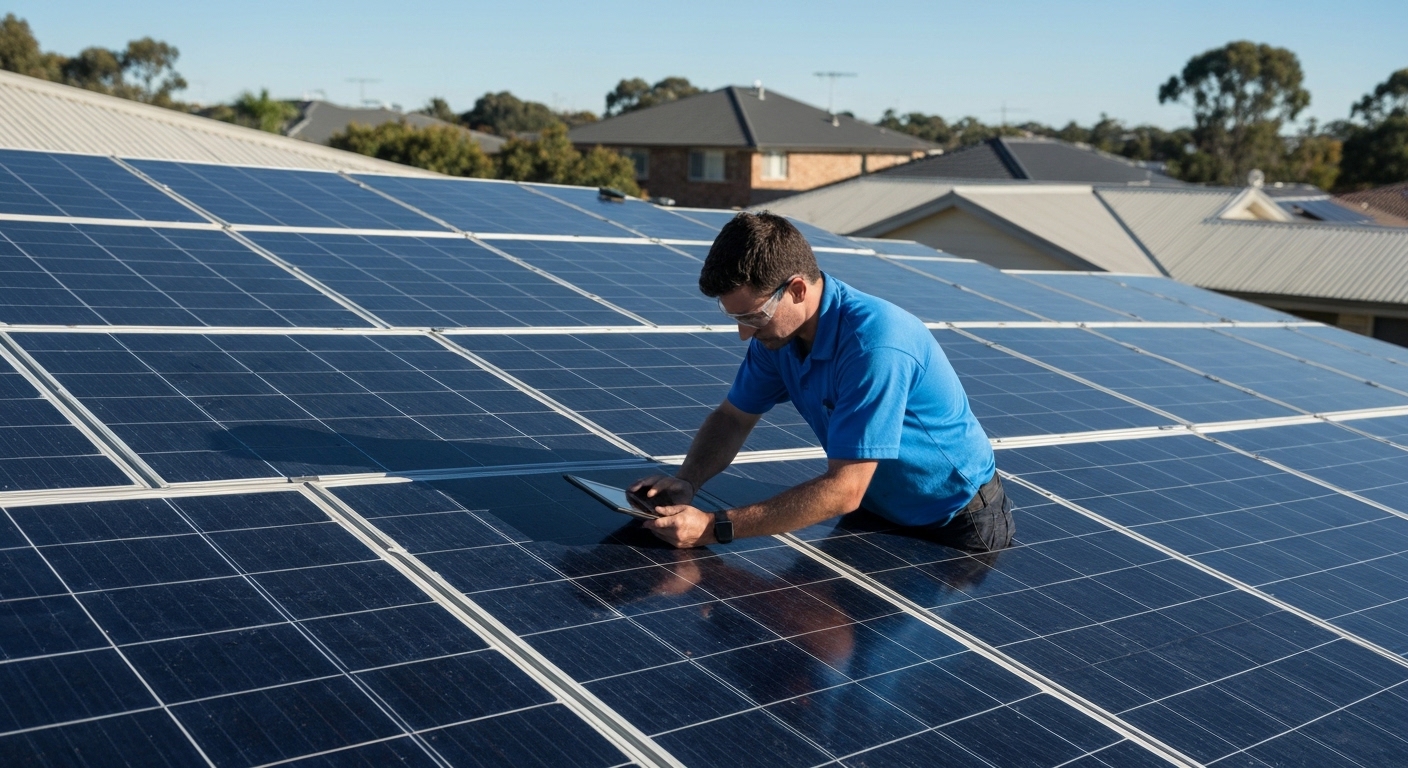
Australia has 3.7 million rooftop solar systems operating across every climate from tropical Darwin to alpine Thredbo. Yet the Australian Energy Regulator has consistently found that most residential solar owners do not perform any regular solar panel inspection. They rely instead on their energy bill to signal problems, often months after issues develop.
This solar panel inspection checklist provides a structured annual framework for Australian homeowners. You’ll learn what to check, how to check it safely, what findings need professional follow-up, and how to track system performance over time. Whether you’re inspecting solar panels yourself or preparing for a professional visit, this guide covers everything you need.
Key Takeaways
- Inspect your solar system once a year minimum.
- Look for cracks, discolouration, and loose wiring.
- Check your inverter display for error codes.
- Compare your output this month to the same month last year.
- A drop of more than 10% is worth investigating.
- Use a qualified inspector for a full check every two to three years.
Why Regular Solar Panel Inspections Matter
Regular inspections catch small problems before they become expensive repairs. A cracked panel that goes unnoticed can lead to water damage and complete panel failure. A loose mounting bracket can allow wind to lift your entire array during a storm.
More importantly, inspections protect your investment. Most solar panel warranties require proof of regular maintenance. Without inspection records, you may void your warranty coverage.
Australian conditions are harsh on solar systems. Coastal salt spray corrodes connections. Inland dust reduces output by up to 25%. Bird nesting can create fire hazards. A simple annual inspection addresses all these risks.
What You’ll Need for a Solar Panel Inspection
Before you start your solar panel inspection checklist, gather these items:
- Binoculars (for viewing panels from ground level)
- Camera or smartphone (to document any issues)
- Notebook or printout of this checklist
- Your solar monitoring app login details
- Previous year’s production data
- Ladder (only if you can safely access the roof edge — never climb onto the array itself)
Most inspections take 30-45 minutes once you’re familiar with the process.
Safety First: What You Must Not Do
Before using this solar panel inspection checklist, understand the clear boundary between safe homeowner inspection and work that requires a licensed electrician.
Safe for homeowners (no electrical contact):
- Visual inspection of panels from ground level or roof edge
- Reading inverter display and monitoring app data
- Checking inverter error codes
- Inspecting roof mounting brackets from a safe vantage point
- Trimming vegetation near panels from ground level
- Checking for visible pests and nesting material at panel edges
Requires a licensed electrician or CEC-accredited installer:
- Any measurement of DC or AC voltage
- Opening the inverter
- Touching wiring, conduit, or DC connectors
- Replacing isolators, fuses, or connections
- Any work within 300mm of a live solar array on a roof
The DC wiring in a solar array is live whenever there is daylight. It cannot be switched off. Even with the inverter turned off, your panels generate dangerous voltage in sunlight.
Solar Panel Inspection Checklist: Panel Condition
Start your inspection by examining the panels themselves. Use binoculars from ground level, or view from the roof edge if you can do so safely.
☐ A1. Panel Glass Surface
- No visible cracks, chips, or spider-web fracture patterns
- No visible delamination (bubbling or raised areas on glass)
- No obvious discolouration (yellow/brown patches indicate hot spots)
Cracked glass is the most urgent finding. It creates shock and moisture risks. Mark any cracked panels on your inspection record.
☐ A2. Panel Backsheet
- No discolouration (white backsheet should be uniformly white)
- No bubbling or blistering on the backsheet
- No cracks or holes in the backsheet
Backsheet damage allows moisture into the panel. This leads to cell corrosion and eventual failure.
☐ A3. Frame Condition
- Frame is free of significant corrosion
- No bent or buckled frame edges
- No visible water marks around the frame seal
Coastal homes often show aluminium corrosion (white powder). This is normal wear, but heavy corrosion can compromise the seal.
☐ A4. Soiling and Contamination
- Panels are free of visible dust accumulation
- No visible bird droppings on individual cells
- No visible lichen, moss, or algae growth
- No leaf matter accumulated at lower panel edges
- No nesting material visible at panel edges
Bird droppings on a single cell can reduce that panel’s output by 30-50%. Leaf matter blocks drainage and traps moisture.
☐ A5. Junction Box
- Junction box shows no cracks, scorching, or melting
- Junction box lid is sealed (not open or missing)
The junction box is the black plastic box on the back of each panel. Scorching here indicates bypass diode failure.
Mounting and Racking Inspection
Your mounting system keeps your panels secure in high winds. Check these components as part of your annual solar panel inspection.
☐ B1. Rail and Clamp Integrity
- No visible movement when panels are in wind
- No rail sections visibly pulling away from the roof
- Clamps appear seated correctly
Check on a breezy day if possible. Panels should not move or rattle.
☐ B2. Roof Penetrations
- All roof penetrations show no rust staining on surrounding tiles
- No visible lifting, cracked, or broken tiles near mounting points
- Flashings appear sealed with no visible gaps
Roof leaks from solar installations are rare but serious. Rust staining is an early warning sign.
☐ B3. Bird Mesh (If Installed)
- Mesh perimeter is intact with no gaps or damage
- No nesting material visible inside the mesh boundary
- Mesh fixings appear intact
Bird mesh protects against nesting under panels. Gaps allow birds to enter and create fire hazards.
DC Wiring and Connections
This section of the solar panel inspection checklist focuses on wiring. Remember: observe only. Never touch DC wiring or connectors.
☐ C1. Cable Management
- DC cables at roof edge or wall are secured
- Cable conduit shows no cracks, splits, or UV damage
- Cable ties appear intact
Loose cables can chaff and create short circuits. UV-damaged conduit allows moisture into connections.
☐ C2. Visible Connector Condition
- No MC4 connectors are unplugged or hanging loose
- No connectors show scorch marks or melting
MC4 connectors are the black barrel connectors between panels. They should never be disconnected except by a licensed electrician.
☐ C3. DC Isolator (Rooftop, if present)
- Rooftop DC isolator enclosure is sealed
- Switch appears in correct operating position
Some systems have a DC isolator on the roof. Others have only one at the inverter.
Inverter Inspection
Your inverter converts DC power from the panels into AC power for your home. It’s the heart of your system.
☐ D1. Status Indicators
- Green LED or operating indicator confirmed during daylight
- No error codes, fault lights, or warning indicators
- Display shows expected output level
Compare the display reading to your monitoring app. They should match within 5%.
☐ D2. Physical Condition
- No scorch marks or burning smell from inverter
- Inverter enclosure is secure with no water ingress
- Ventilation slots are clear and unobstructed
Inverters generate heat. Blocked vents can cause overheating and failure.
☐ D3. Isolators
- Solar supply main switch (AC side) is labelled and accessible
- DC isolator at the inverter is labelled and accessible
- No scorch marks or rust around isolator enclosures
You should know how to shut down your system in an emergency. Test that you can reach both isolators.
☐ D4. Monitoring System
- Monitoring portal shows data up to date
- No alerts or communication fault notifications
Most modern inverters send data to a cloud portal. Check that your system is reporting correctly.
Performance Data Review
This section of your solar panel inspection uses 12 months of production data from your monitoring system.
☐ E1. Annual Production vs Estimate
- Record total kWh generated in the past 12 months: _______ kWh
- Compare to system’s estimated annual generation
- Variance greater than 10% below estimate? Flag for professional review
Your installer’s original quote should include an annual production estimate. If you’re more than 10% below this, investigate further.
☐ E2. Monthly Specific Yield Comparison
- Calculate specific yield for each month: kWh ÷ system kW
- Compare to same month in prior year
- Any month showing ≥10% decline versus prior year? Flag for investigation
Specific yield accounts for system size. A 6.6 kW system producing 26.4 kWh per day has a specific yield of 4.0 kWh/kWp.
☐ E3. String or Panel Performance (If Module-Level Monitoring)
- Review panel-by-panel production on a recent clear day
- Any panel producing more than 15% below array average? Book thermal imaging inspection
SolarEdge and Enphase systems show individual panel output. One underperforming panel often indicates a hot spot or bypass diode failure.
Safety and Compliance Documentation
Keep your solar panel inspection records with these documents.
☐ F1. Documentation on File
- Installer sign-off certificate on file
- Panel product warranty documentation accessible
- Inverter warranty documentation accessible
- Grid connection agreement on file
These documents prove your system was installed legally and to standard. You’ll need them for warranty claims.
☐ F2. Emergency Shutdown Procedure
- You know where the solar supply main switch is
- You know where the DC isolator at the inverter is
- Emergency shutdown procedure is labelled on the inverter
In a fire, emergency services need to shut down your solar system. Make sure shutdown switches are clearly labelled.
When to Call a Professional
Any of the following findings on your solar panel inspection require a CEC-accredited installer or licensed electrician:
| Finding | Action Required |
|---|---|
| Cracked panel glass | Immediately de-energise and replace |
| Scorched junction box | Immediately de-energise; do not restart until repaired |
| Inverter fault code that doesn’t clear | Contact installer or inverter service centre |
| Output drop ≥10% year-over-year | Book performance audit with thermal imaging |
| Visible hot spot (discolouration) | Book thermal imaging inspection |
| Loose or damaged DC wiring | Licensed electrician — do not operate system |
| Water ingress into inverter | Do not restart until repaired by electrician |
Never attempt electrical repairs yourself. DC voltage from solar panels can be lethal.
Annual Inspection Schedule Template
Use this schedule to plan your solar panel inspections throughout the year:
| Month | Task |
|---|---|
| April–May | Full inspection (Sections A–F); book professional clean if needed |
| October | Mid-year visual check (Section A and D only); verify monitoring data |
| After any major weather event | Sections A, B, C immediately; Section D same day |
Autumn (April-May) is ideal for a full inspection. Panels are typically clean after winter rain, and you can address any issues before the high-production summer months.
Common Solar Panel Inspection Findings
Here’s what most homeowners discover during their first annual inspection:
Soiling and bird droppings are the most common issue. Even in cities, bird activity can reduce output by 15-25%. A professional clean typically costs $150-$300 and restores full output.
Minor frame corrosion appears on coastal systems after 3-5 years. This is cosmetic unless it’s severe enough to compromise the frame seal.
Loose cable ties are common on systems over 5 years old. UV degrades plastic ties. Your installer can replace these during a service visit.
Monitoring dropouts affect many systems. If your monitoring stopped updating, check your WiFi connection first. Many inverters lose connection when your home router is replaced.
How to Store Your Solar Panel Inspection Records
Keep a completed copy of this solar panel inspection checklist each year. This creates a maintenance history for your property.
Store your inspection records with:
- Original installation certificate
- Panel and inverter warranties
- Professional cleaning receipts
- Any repair invoices
This documentation is valuable for insurance claims, warranty claims, and property sales. Most buyers and conveyancers now request solar maintenance records as part of pre-sale due diligence in Australia.
Take photos during each inspection. Visual records help you track changes over time and provide evidence for warranty claims.
Professional Solar Panel Inspection Services
While you can complete most of this checklist yourself, a professional inspection every 2-3 years is worthwhile.
Professional inspectors bring:
- Thermal imaging cameras that detect hot spots invisible to the naked eye
- I-V curve testing that measures panel performance accurately
- Electrical testing equipment to check all connections safely
- Roof safety equipment to access difficult panels
- Written reports for warranty and insurance purposes
Professional inspections typically cost $250-$450 for a residential system. They often identify issues that save you thousands in avoided repairs.
For a professional inspection service that includes thermal imaging and a written report, contact a CEC-accredited solar maintenance provider in your state.
Sources
This solar panel inspection checklist is based on current Australian standards and industry best practices:
-
AS/NZS 5033:2021 — Installation and safety requirements for photovoltaic (PV) arrays. Standards Australia. This standard defines safety requirements for all solar installations in Australia and New Zealand.
-
AS/NZS 4777:2020 — Grid connection of energy systems via inverters. Standards Australia. This standard specifies technical requirements for grid-connected inverters.
-
Clean Energy Council Solar PV Maintenance Guidelines (2024). Clean Energy Council, Melbourne. Available at: cleanenergycouncil.org.au. These guidelines provide recommended maintenance practices for Australian solar installations.
-
Australian Energy Regulator State of the Energy Market Report (2025). Australian Energy Regulator, Melbourne. This report includes data on solar system maintenance practices across Australian households.
Last updated: April 2026. References AS/NZS 5033:2021 (PV Array Installation), AS/NZS 4777:2020 (Grid Inverter), and Clean Energy Council guidelines.
Related guides: Solar Panel Maintenance Checklist Australia, Solar Panel Output Drop Diagnosis, and What Voids Solar Panel Warranty.
Frequently Asked Questions
How often should I inspect my solar panels?
A thorough annual inspection is the minimum for all Australian residential systems. In high-soiling environments (dusty inland areas, coastal salt zones, subtropical climates with heavy bird activity), a six-monthly inspection is recommended. Any time you notice an unexplained output drop, or after a major weather event (hailstorm, severe dust storm, cyclone), inspect immediately.
Can I inspect solar panels myself?
The ground-level and roof-edge components of an inspection can be performed by a homeowner — visual checks of panels, obvious wiring issues, and inverter error codes. However, any work on or within 300mm of a live solar array requires a licensed electrician or accredited solar installer under AS/NZS 5033. Never touch electrical connections, DC wiring, or inverter terminals yourself.
What is a ‘specific yield’ check and how do I do it?
Specific yield is your system’s actual output divided by its rated capacity: kWh generated ÷ system kW. For example, a 6.6 kW system that generated 28 kWh on a clear day has a specific yield of 4.24 kWh/kWp. Track this monthly and compare to the same month in previous years. A consistent decline of 8% or more warrants professional investigation.
What should I do if I find cracked glass on a solar panel?
Do not operate the system with a cracked panel — cracked glass exposes internal cell connections to moisture, creating shock and arc fault risks. Switch off the solar supply main switch (DC isolator) at the inverter and contact your installer or an accredited CEC installer immediately. Most panel warranties cover glass breakage from manufacturing defects; hail damage is covered by home insurance in most policies.
What is the CEC accreditation and why does it matter for inspections?
CEC (Clean Energy Council) accreditation is the Australian industry standard for solar installers and system designers. An accredited CEC inspector has completed the relevant training and is recognised by the Clean Energy Regulator. For any electrical work on your system, always use a CEC-accredited installer — unlicensed work can void your warranty and create significant safety risks.
Frequently Asked Questions
A thorough annual inspection is the minimum for all Australian residential systems. In high-soiling environments (dusty inland areas, coastal salt zones, subtropical climates with heavy bird activity), a six-monthly inspection is recommended. Any time you notice an unexplained output drop, or after a major weather event (hailstorm, severe dust storm, cyclone), inspect immediately.
The ground-level and roof-edge components of an inspection can be performed by a homeowner — visual checks of panels, obvious wiring issues, and inverter error codes. However, any work on or within 300mm of a live solar array requires a licensed electrician or accredited solar installer under AS/NZS 5033. Never touch electrical connections, DC wiring, or inverter terminals yourself.
Specific yield is your system's actual output divided by its rated capacity: kWh generated ÷ system kW. For example, a 6.6 kW system that generated 28 kWh on a clear day has a specific yield of 4.24 kWh/kWp. Track this monthly and compare to the same month in previous years. A consistent decline of 8% or more warrants professional investigation.
Do not operate the system with a cracked panel — cracked glass exposes internal cell connections to moisture, creating shock and arc fault risks. Switch off the solar supply main switch (DC isolator) at the inverter and contact your installer or an accredited CEC installer immediately. Most panel warranties cover glass breakage from manufacturing defects; hail damage is covered by home insurance in most policies.
CEC (Clean Energy Council) accreditation is the Australian industry standard for solar installers and system designers. An accredited CEC inspector has completed the relevant training and is recognised by the Clean Energy Regulator. For any electrical work on your system, always use a CEC-accredited installer — unlicensed work can void your warranty and create significant safety risks.