Clean or Replace? How to Know When Your Solar Panels Are Beyond Saving
Snail trails, micro-cracks, delamination, PID — learn the signs that your solar panels are beyond cleaning, and how to calculate whether replacement beats continued maintenance.
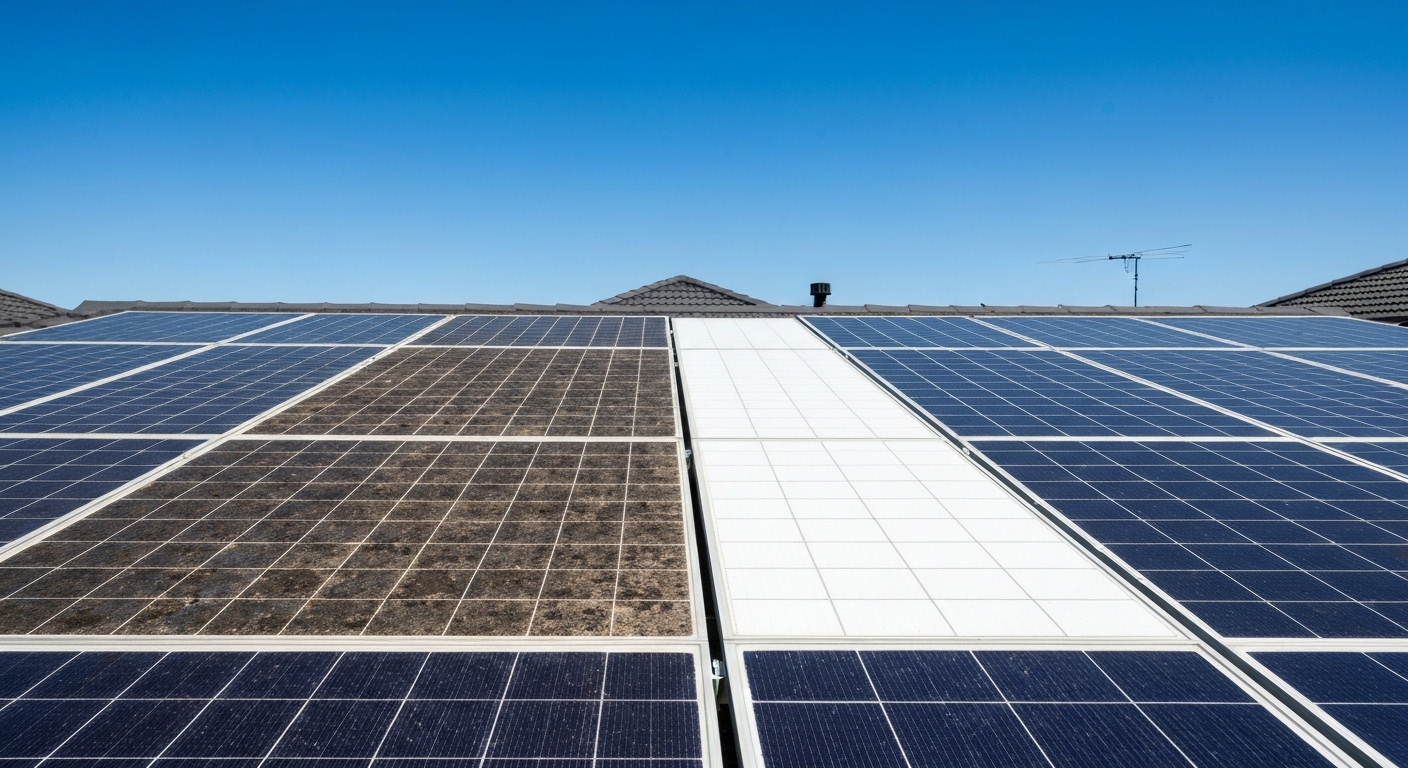
The Question Every Solar Owner Eventually Faces
Your solar system has been on the roof for 10, 12, maybe 15 years. Output is down. A neighbour suggests a clean. But before you book a cleaner, there is a more important question: should you clean or replace solar panels when performance drops?
Getting this decision right matters financially. A professional clean on a 6.6 kW system costs $180–$300. Replacing that same system costs $5,000–$9,000. If you spend $250 on a clean when your panels have structural damage, you have wasted the money and still face the replacement decision.
This guide walks through every major failure mode for Australian solar panels. You’ll learn what each looks like, whether it’s recoverable, and how to calculate whether continued maintenance or replacement gives you better financial returns.
How to Tell if Solar Panels Need Cleaning or Replacement
Before diagnosing specific faults, understand this framework: output loss in a solar system has two causes.
Recoverable (surface-level):
- Dust, dirt, bird droppings, pollen, lichen, mould
- Cleaning eliminates these entirely
Non-recoverable (structural):
- Cell degradation from UV exposure and thermal cycling
- Physical damage (cracks, delamination)
- Electrical faults (PID, bypass diode failure, junction box corrosion)
If your system has lost 8% of its output and a professional clean restores 7% of it, that is an excellent result. The residual 1% is normal long-term degradation. If your system has lost 25% and a professional clean restores only 3%, you have a structural problem that cleaning cannot address.
The diagnostic starting point is always: get a professional clean first, then measure output before and after. Measure over identical weather conditions. If output does not recover meaningfully after a clean, you have structural damage.
Snail Trails: The Visible Warning Sign
Snail trails are among the most common signs of structural panel damage in Australian systems aged 8+ years. They appear as brown, black, or silver-grey lines that meander across the face of the panel. The patterns resemble snail tracks, hence the name.
What Causes Snail Trails?
Snail trails are caused by micro-cracks in the panel’s encapsulant. This is the EVA layer that bonds the cells to the glass. These micro-cracks allow moisture to penetrate. The moisture oxidises the silver paste in the cell’s contact fingers. The oxidised silver migrates along the crack pattern, creating the visible discolouration.
Can You Clean Snail Trails Off?
No. The discolouration is internal — below the glass surface. Cleaning the panel face has no effect on snail trails. This is a key difference when you’re deciding whether to clean or replace solar panels.
Do Snail Trails Kill Output?
Not always immediately. Light snail trailing with intact bypass diodes may cause only 1–3% output loss. Severe snail trailing that has followed micro-crack paths across multiple cells can cause 10–20% loss in affected strings.
What to Do
- Photograph and document the affected panels
- Request an electroluminescence (EL) test. This maps cell damage in detail. It’s available from specialist solar inspection services in most Australian capital cities for $200–$400 per system
- Assess the coverage: if fewer than 20% of panels have snail trails with minimal output impact, monitor rather than replace. If more than 40% of panels are affected with confirmed output loss, model replacement ROI
Micro-Cracks and Cell Damage in Solar Panels
Micro-cracks are fractures in the silicon cells inside the panel. They are invisible to the naked eye. They are caused by:
- Hailstorm impact (Australia’s east coast is particularly exposed)
- Installer foot traffic during and after installation
- Thermal cycling — daily expansion and contraction stress over years
- Transport damage that was not caught at installation
Micro-cracks do not affect output if the cracked cell fragment is still electrically connected. They become a problem when cracks propagate enough to isolate a cell fragment. That fragment becomes an inactive “dead zone” — or worse, a hot spot.
Hot Spots and Micro-Cracks
When a cracked cell becomes isolated, current from surrounding cells is forced through it instead of around it. This creates a localised heat build-up called a hot spot. Hot spots can reach 80–150°C. They can melt the EVA encapsulant, discolour the backsheet, and in severe cases create a fire risk.
Thermal imaging (infrared inspection) reliably identifies hot spots. This is another reason why professional inspections — not just cleans — are valuable for systems over 8 years old.
If hot spots are identified, the affected panels should be replaced, not cleaned. See What Voids Your Solar Panel Warranty for how hot spot damage is typically handled under warranty claims.
Delamination: When Panels Start Separating
Delamination is the physical separation of the panel’s layers. Most commonly, the glass separates from the EVA encapsulant. Or the backsheet bubbles away from the cells. It is visible as milky-white patches, bubbles, or browning on the panel face or rear.
Delamination exposes the internal components to moisture ingress. This dramatically accelerates corrosion of the silver contacts and aluminium busbars. Once delamination is visible, the panel’s remaining service life is measured in months to years, not decades.
Common Causes of Delamination in Australia
- Poor-quality EVA or adhesive used in budget panels manufactured 2008–2013
- Prolonged UV exposure (particularly relevant for Queensland, NT, and WA installations)
- Chemical cleaning agents that degrade the anti-reflective coating and underlying sealant (another reason to never use harsh chemicals on panels)
Delamination cannot be cleaned or repaired. Affected panels require replacement. This is one of the clearest cases where you should replace rather than clean solar panels. Delamination affects individual panels rather than entire arrays. Partial replacements are common — but verify that the new panels are electrically compatible with your existing string configuration.
PID: Potential Induced Degradation
PID is an electrical phenomenon that can cause dramatic output loss. Sometimes 30–50% or more in severely affected systems. It is caused by high voltage differentials between the panel cells and the aluminium frame. This drives leakage current through the panel’s encapsulant.
Why Australia Is at Risk
PID is worsened by:
- High system voltages (common in larger Australian systems designed for efficiency)
- High humidity (relevant to coastal and tropical Queensland, NT, and coastal NSW/WA)
- High ambient temperatures (relevant nationwide in summer)
Can PID Be Reversed?
Early-stage PID can sometimes be partially reversed using a PID recovery device. This applies a reverse voltage to the affected strings overnight. Some hybrid inverters have built-in PID recovery functions.
Advanced PID is permanent. The leakage current has physically damaged the cell surface through sodium ion migration. These panels should be replaced. The replacement system should use PID-resistant panel designs. Most reputable manufacturers now offer PID-free certification.
Normal vs Abnormal Solar Panel Degradation
All solar panels degrade over time. This is normal, expected, and accounted for in every quality panel’s warranty. The standard degradation rate for tier-one panels is:
- Year 1: Up to 2% (initial degradation)
- Years 2–25: 0.5–0.7% per year (linear degradation)
- Expected output at year 25: 82–87% of original rated capacity
Australian context: Most panels installed during the solar boom of 2010–2012 are now 14–16 years old. They’re producing approximately 85–90% of their original rated output, assuming they are tier-one panels and have been reasonably maintained.
Budget-tier panels from the same era may be degrading at 1.0–1.5% per year. Often without meaningful warranty backing. This places them at 75–80% output by now.
How to Calculate Your Actual Degradation
- Find your original installation certificate. It lists the panels’ rated output in watts (Wp)
- Check your inverter’s lifetime yield in kWh
- Compare your current average daily output against what a system of that Wp rating should produce in your location. Use the PVWatts Calculator for Australian irradiance data
- A gap of more than 20% beyond expected degradation (with clean panels) indicates a problem worth investigating
When to Clean vs Replace Solar Panels: The Financial Model
Here is how to make the replacement decision with numbers, not guesses.
Step 1: Establish True Current Output
Get a professional clean. Then measure output over 5 clear-sky days using your inverter monitoring app. Calculate average kWh per day.
Step 2: Calculate Expected Output
Use PVWatts or your installer’s original production estimate. Adjust for panel age:
- 10-year-old tier-one panels: expect ~93% of original rated output
- 15-year-old tier-one panels: expect ~88% of original rated output
- 15-year-old budget-tier panels: potentially as low as 78%
Step 3: Calculate the Deficit
If your post-clean measured output is 10–12% below expected for panel age, this is within normal variation. Cleaning is your best maintenance tool.
If your post-clean output is 20%+ below expected for panel age, you are losing real generation capacity to structural damage.
Step 4: Model the Replacement Return
| Metric | Example |
|---|---|
| Current system output | 18 kWh/day (was 25 kWh/day when new) |
| Deficit from structural damage | 4 kWh/day beyond normal degradation |
| Annual value of lost generation | 4 × 365 × $0.30 = $438/year |
| New 6.6 kW system installed cost | $6,500 |
| Simple payback on replacement | ~14.8 years |
| Expected additional life of old system | 5–8 years |
In this example, replacement barely makes sense on raw output grounds. But when factoring in newer panel warranties, improved efficiency, potential battery retrofit compatibility, and the risk of old-system failure, replacement becomes more attractive.
Australian Warranty Periods and What They Cover
Most panels sold in Australia carry two warranties:
- Product warranty: 10–15 years against manufacturing defects
- Performance warranty: 25 years guaranteeing a minimum output (typically 80–87% at year 25)
For panels installed during 2008–2015 by Chinese manufacturers who no longer operate in Australia, these warranties may be unenforceable in practice. This is a significant consideration when deciding whether to invest in repair vs replacement.
For currently active warranties, see Solar Panel Warranty Cleaning Requirements for how to maintain your warranty’s validity while keeping panels clean.
Clear Signs It’s Time to Replace, Not Clean Solar Panels
Replace — don’t clean — when you observe:
| Sign | Action |
|---|---|
| Snail trails covering >30% of panel surface | EL test, then likely replace |
| Visible delamination or bubbling | Replace affected panels |
| Hot spots confirmed by thermal imaging | Replace affected panels |
| Output loss >20% post-clean | Full system inspection; model replacement |
| PID confirmed, panels >10 years old | Replace with PID-resistant panels |
| Backsheet cracks or yellowing throughout | Replace — fire risk |
| System is pre-2010, consistently under-performing | Replacement ROI likely positive within 8–10 years |
Getting a Professional Diagnosis
Before spending $5,000–$9,000 on replacement, invest $300–$500 in a professional inspection. A quality solar inspection in Australia should include:
- Thermal infrared imaging — identifies hot spots, failed bypass diodes, moisture ingress
- Electroluminescence (EL) testing — maps cell-level damage, including micro-cracks invisible to the naked eye
- Shade analysis — rules out nearby obstructions causing apparent output loss
- DC/AC wiring check — identifies inverter and connection issues separate from panel health
- Written report with specific panel-by-panel findings
Accredited inspectors can be found through the Clean Energy Council’s installer register. Ensure the inspector holds a Grade A or B electrical licence and CEC accreditation.
For guidance on what to look for before hiring any contractor, see the Solar Panel Cleaning Checklist Before Hiring.
Summary: Clean or Replace Solar Panels?
The clean-or-replace decision comes down to one question: is the output loss surface-level or structural?
- Surface-level loss (dirt, dust, biological growth): cleaning restores output fully
- Structural loss (degradation, cracks, PID, delamination): cleaning cannot help
The diagnostic path is simple. Clean first, measure output, compare to expected. If the gap closes after cleaning, maintain and clean. If the gap persists, get a thermal inspection and model the replacement ROI.
Most Australian systems installed since 2012 with tier-one panels still have viable economic life remaining. Clean them, monitor them, and replace only when the numbers genuinely support it.
When deciding whether to clean or replace solar panels, remember: a $250 clean might restore thousands of dollars in annual generation. But if cleaning doesn’t fix the problem, replacement might be the only path to recovering your solar investment.
Sources
-
International Energy Agency (IEA). Photovoltaic Power Systems Programme. Review of Failures of Photovoltaic Modules. Report IEA-PVPS T13-01:2014. Available at: https://iea-pvps.org/
-
Clean Energy Council. Australian Guide to Solar Panel Performance. 2023. Available at: https://www.cleanenergycouncil.org.au/
-
National Renewable Energy Laboratory (NREL). Degradation Rates of Photovoltaic Systems in Different Australian Climates. Technical Report NREL/TP-5J00-78186. Available at: https://www.nrel.gov/pv/
-
Jordan, D. C., & Kurtz, S. R. (2013). Photovoltaic Degradation Rates — An Analytical Review. Progress in Photovoltaics: Research and Applications, 21(1), 12-29.
Frequently Asked Questions
How do I know if my solar panels need replacing rather than cleaning?
Key signs include snail trail discolouration, visible micro-cracks or delamination, persistent output loss after a professional clean, PID (potential induced degradation) patterns, and panels aged over 20–25 years. A professional inspection with a thermal camera or electroluminescence test will confirm whether damage is structural or surface-level.
What are snail trails on solar panels?
Snail trails are brown or silver-grey discolouration lines that snake across the face of a panel. They are caused by silver paste in the panel’s internal contacts oxidising through micro-cracks in the panel’s anti-reflective coating. Once present, they cannot be cleaned away — the damage is internal.
At what age should I consider replacing my solar panels in Australia?
Most Australian solar panels installed 2010–2015 are now in the 12–16 year range and producing 80–85% of their original rated output — still viable. Panels from 2008–2010 that were budget-tier Chinese modules may be degrading faster and warrant an output audit. Replacement becomes financially compelling when output has dropped more than 20–25% from original rated capacity.
What is PID and can it be reversed?
PID (Potential Induced Degradation) is a type of electrical leakage that causes panels to lose output — sometimes dramatically. It is caused by voltage differentials between the panel and its frame, exacerbated by high humidity and high system voltages. Early-stage PID can sometimes be partially reversed with a PID recovery device overnight; advanced PID is permanent.
Is it worth cleaning solar panels if they are old?
Yes — up to a point. If panels are producing 80%+ of rated output, cleaning continues to protect that remaining capacity. If output has dropped below 70% of rated and no surface contamination explains the gap, the lost capacity is likely structural (degradation, PID, or physical damage) and cleaning will not recover it.
Should I clean or replace solar panels with low output?
A professional clean costs $180–$300 for most residential systems and can restore 5–10% output if dirt is the problem. Panel replacement costs $5,000–$9,000 for a 6.6 kW system. If cleaning restores most of your lost output, it’s worth it. If output stays low after cleaning, the damage is structural and replacement may be needed.
Frequently Asked Questions
Key signs include snail trail discolouration, visible micro-cracks or delamination, persistent output loss after a professional clean, PID (potential induced degradation) patterns, and panels aged over 20–25 years. A professional inspection with a thermal camera or electroluminescence test will confirm whether damage is structural or surface-level.
Snail trails are brown or silver-grey discolouration lines that snake across the face of a panel. They are caused by silver paste in the panel's internal contacts oxidising through micro-cracks in the panel's anti-reflective coating. Once present, they cannot be cleaned away — the damage is internal.
Most Australian solar panels installed 2010–2015 are now in the 12–16 year range and producing 80–85% of their original rated output — still viable. Panels from 2008–2010 that were budget-tier Chinese modules may be degrading faster and warrant an output audit. Replacement becomes financially compelling when output has dropped more than 20–25% from original rated capacity.
PID (Potential Induced Degradation) is a type of electrical leakage that causes panels to lose output — sometimes dramatically. It is caused by voltage differentials between the panel and its frame, exacerbated by high humidity and high system voltages. Early-stage PID can sometimes be partially reversed with a PID recovery device overnight; advanced PID is permanent.
Yes — up to a point. If panels are producing 80%+ of rated output, cleaning continues to protect that remaining capacity. If output has dropped below 70% of rated and no surface contamination explains the gap, the lost capacity is likely structural (degradation, PID, or physical damage) and cleaning will not recover it.
A professional clean costs $180–$300 for most residential systems and can restore 5–10% output if dirt is the problem. Panel replacement costs $5,000–$9,000 for a 6.6 kW system. If cleaning restores most of your lost output, it's worth it. If output stays low after cleaning, the damage is structural and replacement may be needed.